


Introducing Major Edward Borrow
February 12 2012
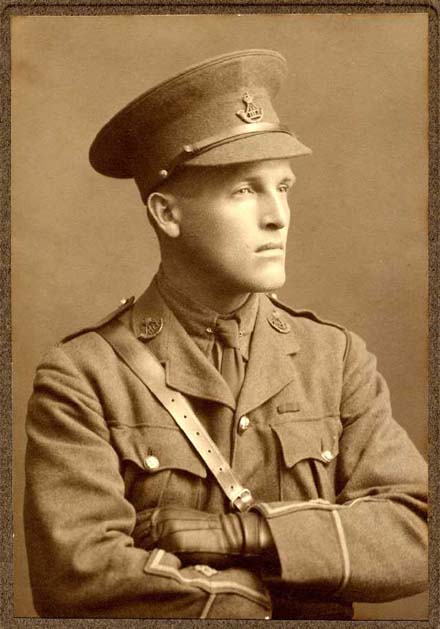
Picture: Durham.gov.uk
[Warning: this is a nothing-to-do-with-art-history post] Some years ago I bought two tin trunks full of letters written during the First World War. They are between Edward Borrow, an officer in the Durham Light Infantry, and his wife, Alys. The letters are rare in that they reveal two sides of the war; a soldier from the front to his wife at home, and vice-versa.
I can't think why I bought them - I was a student at the time and could hardly spare the cash. The correspondence is often moving, and at times intimate, but could not be called great literature. In a sense, that is why the letters are so interesting; their very ordinariness, even cheerfulness, shows a side of the war often forgotten amidst the War Horse-style emotive gloom of retrospective histories (or worse, historical fiction). And, after I came across the letters by chance at a country auction, unloved and randomly wedged into old cigar boxes, I thought that if nobody else was going to look after them, then I must. So I bid over six months rent, and began to organise and transcribe them.
Anyway, the point of this post is to say that today, in a moment of idle Google-ing, I found out for the first time what Edward Borrow looked like. Above is his photo from the museum of the Durham Light Infantry. Seeing it is oddly moving; here is a soldier to whom I have no connection whatsoever, and yet of whom, for at least a part of his life, I know the most private and banal details. Anyone who has written a biography or a thesis on a single subject will know the peculiar feeling of disjointed affection one can feel towards your subject. (I knew I'd spent too long researching for my PhD when I started dreaming about Disraeli.) So here, with a curious feeling of pride, I publish for the first time a few extract's from Major Borrow's letters to his wife, together with his portrait: [click Read on for more]
30th December 1915
You want to hear something of my life in the trenches:- at about 7 a.m. I begin to think about getting up, pull on my other pair of socks (I sleep in my fist pair because it dries them you know) pull on my “rubber boots thigh” look in the glass to see if it will do till its warmer, say “dammit” and wander forth. Then I strafe the night orderlies if they haven’t baled out the mess-dugout properly during the night and send off three reports and one indent. At 8 I go to breakfast, which used to be a lonely meal, only now the Colonel has taken to coming along about then. Then I ask Blatchford if he’s caught any rats during the night (the trenches are full of rats and mice and if we catch any we always have a soup) then to work. I usually start several parties on to pumping, baling, ditching and building dugouts; then to the office dugout and search through orders, General Routine orders, Corps Orders, Division Orders, Brigade Orders, Special War Office Letters and all the suggestions that every Staff Officer thinks he must make or bust each one of which is absolutely necessary to the proper conduct of the War!
23rd May 1916
My own little wife,
The guns have been roaring and crashing and thundering for two days and nights now. I wish I could tell you what it means, but I mustn’t : though perhaps you can guess if I say that one entire battalion was blotted out and, report has it, the best part of another; blotted out just as effectively as if you had kicked a stone out of your way and in almost the same time, comparatively. From where we are in trenches, darling we saw it in the distance about two miles away without knowing what was happening actually and ever since the guns have roared and attacks made to try and recover what we had lost; I don’t suppose you’ll read more than just a paragraph about it in the papers but those roarings and thunderings and anxious wonderings as to whether it will be your turn next will be going on round here for weeks I expect until one side or the other gives up and turns its attention elsewhere. I’m again absolutely safe dear and can walk out of my 30 foot deep dugout and watch a finer pyrotechnic display than ever you saw at the Crystal Palace. For as soon as the artillery fire becomes intensive on either side the other fellow puts up rockets and magnesium lights by the dozen; and the guns flash for miles round you; and in daylight you actually see them plastering the skyline with terrific bursts of earth and rock; black smoke, green smoke, pure white smoke, grey smoke and when an aeroplane hovers over the line tiny puff balls of white burst round it like cotton wool blown about by the wind. Then if the wind is right, as it was the day before yesterday, down comes a cloud of gas – thick greyish, tear producing smoke when every man has to watch as he never watched before, ready to mow down anybody coming up behind that cloud and fight as this war has taught us how to fight. And then perhaps at 3 or 4 in the morning you hear the larks begin their twittering and Teddibee goes off to blessed sleep such as I’m afraid Honeybee doesn’t often get; forgetting everything darling, even the nerve racking anxiety which takes a lot of forgetting!
11th July 1916, during the Battle of the Somme:
When the push began to happen of course – casualties to infantry almost entirely; every day the line tried to push ahead somewhere on the 20 mile front on which we are attacking and every thousands yards was won at a cost of a thousand casualties perhaps 2000, I don’t know, and infantry casualties too. You should get the Cherub to tell you about it; he is now with a field ambulance and not with us any more. I happened to walk into his Ambulance Station the other morning at about 4 a.m. and found him and four worried blear-eyed dog tired looking men they were too – and the Cherub told me that for 3 days and nights they had been doing nothing but bandage and cut and bind up wounds, and the pity of it all is that in spite of all the care and thought behind this push wounded men do not always get taken back to the dressing stations: casualties sometimes come so thick and fast to infantry that wounded have to wait until the battle has been over some time. And a battle ground a week old is not a nice place.
We’ve just come out of the front line and are in reserve now: I suppose we shall go in again shortly, the push isn’t over yet; and when we left, although we didn’t have much to do with it being in German territory than it ever has been; for four days or was it five, Teddibee had had just about 10 hours sleep, and could appreciate how you feel when you write that you haven’t slept for three nights; and he could appreciate too dear the truth of what you write in your letter…
