


Mona Lisa theories new & old
May 5 2014
The Mona Lisa's in the news again. First up comes the unsurprising story that they have not, after three years of extensive digging (above), found Lisa Gheradini's body in the Sant 'Orsola convent in Florence. I say unsurprising, because the man leading the dig, Silvano Vinceti (who is apparently President of Italy's Committee for National Heritage) has form when it comes to crazy Mona Lisa theories: he's the fellow who claimed to find 'letters' hidden in her eyeballs a few years ago. Quite why this fellow was allowed to spend public money digging up an ancient church is beyond me. Still, at least they found a nice poster.
Another Mona Lisa theory reported this weekend, and similarly far out, is the news that scientists have deduced it may even have been intended to be a 3D stereoscopic image. Live Science reports new proof that the Mona Lisa in Paris and the recently 'discovered' copy in the Prado (which is now being heavily marketed as 'The Prado Mona Lisa') were painted at exactly the time in Leonardo's studio:
When I first perceived the two paintings side by side, it was very obvious for me that there is a very small but evident difference in perspectives," study researcher Claus-Christian Carbon of the University of Bamberg in Germany wrote in an email to Live Science. "Maybe the view of a perceptual psychologist is highly sensitive for such tiny differences, but it is very clear that also persons who are not so strongly involved in perceptual sciences can see it easily after having received information on the change in perspective." [See Images of "Mona Lisa" Paintings in 3D]
Turns out, the real "Mona Lisa," or "La Gioconda," and the Prado cousin were painted from slightly different perspectives. Carbon and Vera Hesslinger of Germany's University of Mainz figured out this perspective shift by looking at so-called trajectories, or the paths from a distinctive point on the source, such as the tip of Mona Lisa's nose, to a target, or the observer's (or painter's) eyes. The scientists also asked people to estimate the perspective of the "Mona Lisa" sitter, something Carbon called a psychological assessment of the perspective.
"This is particularly clear if you observe the chair on which La Gioconda sits: In the Prado version, you can still see the end of the end corner of the chair at the background of the painting, which you cannot see in the Louvre version, because the painter of the Prado version looked at the' Mona Lisa' more from the left than the painter of the Louvre version," Carbon said.
The researchers then could recalculate the position the painters took relative to each other and to the "Mona Lisa" sitter in Da Vinci's studio. They found that the horizontal difference between the two paintings was about 2.7 inches (69 millimeters), which is close to the average distance between a person's two eyes. (When a person observes an object, each eye sees a slightly different perspective of the object, both of which are sent to the brain and transformed into the three-dimensional representation of the object that we "see.")
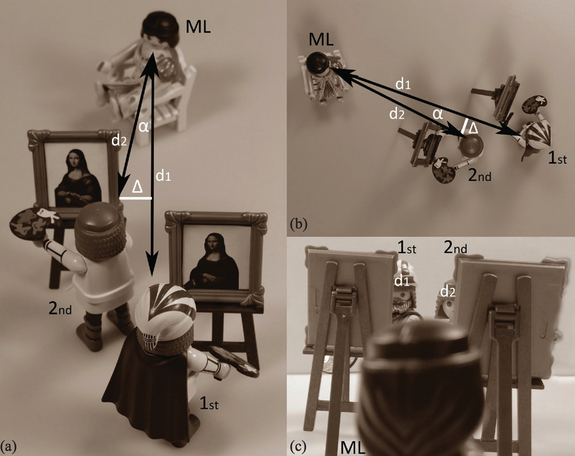
The scientist's report is helpfully illustrated, above, with lego figures! And immediately you can see the problem with the theory that the two artists, Leonardo and A N Other, were observing the sitter from just 2 inches apart. They'd have to have painted so closely together as to make mutual observation of the subject almost impossible, with one artist looking to the right of the easel, immediately in the way of the other looking left. The report doesn't explain why, in the above Lego-illustrated scenario, one Mona Lisa isn't bigger than the other, since one canvas had to be behind the other.
But as regular readers will know, the theory that the 'Prado Mona Lisa' is an exact studio contemporary of the Mona Lisa is already deeply suspect. And sadly this latest theory is what happens when we let scientists loose on art history. Their limited understanding of visual culture means they come up with whacky theories like this. But the press tends to believe them, because scientists must be right, right?
