


A lost Eworth at Burghley?
May 17 2022

Picture: Burghley House
For my latest Diary of an Art Historian column in The Art Newspaper, I wrote about a full-length portrait I saw recently at Burghley House in Lincolnshire. The picture has previously been thought to be a posthumous portrait of Magdalen, Viscountess Montagu (1538-1608), but I think it's period, and probably by Hans Eworth. After Holbein, Eworth was the next start artist working for the Tudor court, and is probably best known for his portraits of Mary Tudor (like this example at the Society of Antiquaries).
The Burghley portrait would most likely have been painted around the time of Magdalen's marriage in 1558, and as such would be one of the last great Marian full-lengths. By the way, the billowing pink drape, which doesn't look 16th Century at all, is largely overpaint, from when the panel was long ago transferred onto canvas.
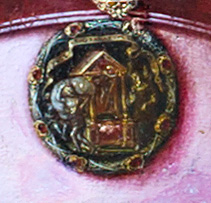
There is one fascinating detail about the Burghley portrait, in the jewel Magdalen wears round her neck (above). As I wrote in TAN:
Eworth worked mainly for Catholics. And fittingly, another mystery in the Burghley portrait—the nature of the scene depicted in the medal around Magdalen’s neck—was solved by a Twitter friend of mine, Fr Robin Gibbons, the first Catholic Priest in Christ Church Cathedral, Oxford, since the Reformation. Robin, without knowing the name of the sitter, identified the scene—of a white robed figure emerging from a tomb, followed by a female figure—as the story of Christ saying “noli me tangere”. It was an eponymous jewel, a Magdalene for a Magdalen.
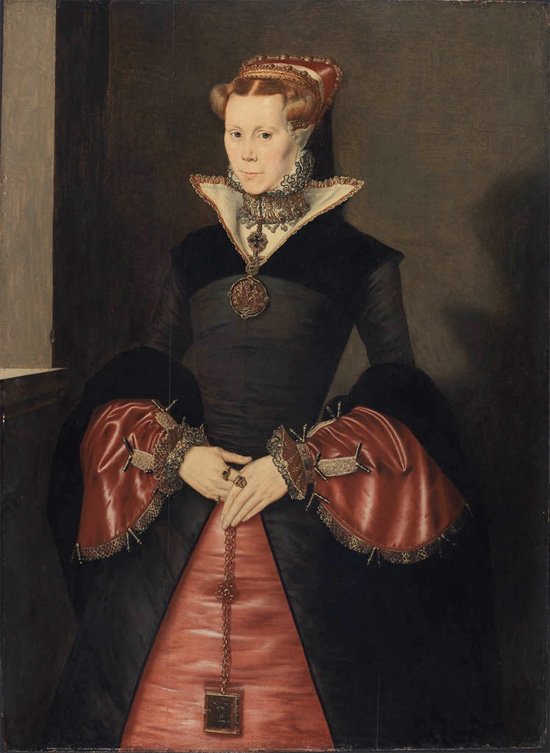
This got me thinking about another Eworth portrait, in the Fitzwilliam Museum, a portrait once thought to show Mary Tudor (above), but currently regarded as an unknown sitter. If the Burghley portrait's jewel showed a Magdalene to identify a Magdalen, did the Fitzwilliam jewel give us any clues as to its identity? The scene in this jewel shows Queen Esther, from the Old Testament story of Esther revealing herself to King Ahasuerus. The only thing is, Esther (or its anglicised version of Hester) was a relatively rare name in the mid-Sixteenth century in England. But there is one Esther/Hester who might fit the bill. From my TAN column again:
among Esthers of the 1550s of an age to be the Fitzwilliam sitter is one Esther or Ethelreda Malte, an illegitimate daughter of Henry VIII. She died in 1559. Her daughter was also called Hester (the anglicised Esther). Her mother, Joan Dyngley, was said to have been a royal laundress, and intriguingly the only other clue to the sitter’s identity in the Fitzwilliam portrait is a prayer book embossed with the letter ‘D’. In the Bible, Esther hides her identity before being recognised by the king, and this is the scene shown on the medallion. Perhaps whoever once looked at the Fitzwilliam portrait and decided it looked like Mary Tudor was half right—is it in fact her half sister?
More here.
