


Previous Posts: October 2011
Two stolen Picasso's recovered
October 11 2011

Picture: Das Bild
After the sad news of yesterday, some better news now from Germany: two Picassos stolen in February 2008 have been recovered.
Tete de Cheval, 1962 (above), and Verre et Pichet, 1944, belong to the Sprengel Museum in Hanover, but were stolen while on loan in Switzerland. The pictures were found in Serbia, which now seems to be the art theft capital of Europe. Das Bild believes that Dick Ellis, formerly of Scotland Yard, was involved in tracking the pictures down.
As ever, it is thought that the pictures were stolen in the hope that a ransom would be paid. The director of the Sprengel Museum, Ulrich Krempel, said:
Often, criminals try to extort a ransom to the insurance or use images as collateral in drug deals.
The sad truth is that as long as museums carry on paying ransoms (or 'fees for information' as the Tate calls them), these thefts will continue.
A tale of two galleries...
October 10 2011

Picture: BG
Rant Alert...
This weekend I went to both the Ahsmolean and the National Gallery. At the former, you can take pictures (e.g., above - I love their low, busy hangs), and the room attendants are cheery.
At the latter, I saw a hapless elderly tourist get bellowed at by a room attendant for seeming to lift his camera. It was such a loud and rude shout that everyone in the room was visibly startled. More and more galleries are allowing photos for personal use - the National should too. And it should stop shouting at its visitors. (I don't like to criticise the National - but as I have my name on their wall, I hope they'll forgive me...)
For your shelves - my publishing picks
October 10 2011
Some art history books just out:
- Human Connections in the Age of Vermeer, by Arthur K. Wheelock, Danielle Lokin
- Lost and Found: Wright of Derby's View of Gibraltar, by John Bonehill
- Pamphilj and the Arts: Patronage and Consumption in Baroque Rome, by Stephanie C. Leone
- Rubens and Britain, by Karen Hearn [pedantic point, Rubens would have come to England. Britain didn't exist.]
- Velazquez, by Norbert Wolf
- Gainsborough Landscapes: Themes and Variations, by Susan Sloman
Restitution - a case study
October 10 2011

Picture: Philip Mould Ltd
This is worth going to: Dr Clarence Epstein of the Max Stern Art Restitution Project will be in London on 20th October to give a talk on tracking down Nazi-looted art. Max Stern was a Jewish art dealer forced to dissolve his business, with his pictures sold at knock-down prices. The lecture is at 8pm at Goodenough College, Mecklenburgh Square London (near Russell Sq.). Call 020 7520 1535 for seats.
We recently gave the above Flemish picture back to the Stern collection. It had originally been sold from Stern's collection at Lempertz auction house in Germany. And guess where we bought it, unknowingly, some 70 years later? Lempertz. And would they give us a refund? Nein...
Money for old rope (with a dead child on it)
October 10 2011

Picture: BG
Viewing the London contemporary art auctions is one of the highlights of my art market year, as the auction houses transform their sale rooms with dramatic lighting and enormous estimates. Where an old master sale is crammed with pictures, people and conversation, contemporary sales are hushed, reverential affairs where no expense is spared. Every piece of art is treated as if it were a priceless masterpiece, its virtues extolled to gullible collectors by trendy specialists in look-at-me glasses. Even the labels are larger than usual, to cope with all those extra zeros. It's worth going just to marvel at the sheer decadence of it all.
The above caught my eye at Christie's. Maurizio Cattelan's Untitled consists of three flagpoles. At the top of one hangs a life-like dummy of a child on a rope. It is the centrepiece of this week's Contemporary Art evening auction on 14th October. At the entrance to the room in which Untitled is displayed is a sign saying:
Please note an artwork in this room is of a challenging nature. Please ask a member of staff if you require any further guidance.
Powerful, or revolting? You decide. But at £900,000-£1,200,000 it provides a telling narrative of the time we live in.
Crushed - $134m's worth of Picasso, Matisse, Braque etc.
October 10 2011

Picture: Paris Museum of Modern Art, Matisse's 'Pastoral'.
Bad news - the criminals behind the daring theft of five pictures from the Paris Museum of Modern Art last year have claimed the works are now destoyed. From the LA Times:
Picasso, Braque, Modigliani, Matisse and Leger paintings stolen in May 2010, and worth about $134 million, may have been dumped in a garbage bin on a Paris street and destroyed with the rest of that day's trash, according to testimony by one of three suspects connected to the theft. The suspect, a 34-year-old watch repairman, was identified only as Jonathan B. by the French weekly Le Journal du Dimanche.
Of course, if I was one of the small time crooks who stole the pictures on the orders of a Mr Big, then I too would say the pictures were destroyed, to make the trail go cold. I suspect Mr Big (or Mr Bigovich, as these characters usually are) is looking at the pictures now, and dreaming of the day in a few years time when he can extract a ransom for the pictures' safe return.
It also turns out that the thief who got into the museum, a Serb known as 'Spiderman', only intended to take one painting, Fernand Leger's Still Life with Candlestick. But security at the museum was so hopeless he helped himself to four more:
...the museum's alarm didn't sound when the art was removed from the wall, so he wandered around the national museum for more than an hour, helping himself to four more masterpieces, before driving away in a car parked nearby. Despite several security cameras, three night watchmen didn't notice the masked intruder.
I find it hard to believe this wasn't an inside job...
The story behind the discovery of Leonardo's 'Salvator Mundi'
October 9 2011

Picture: BG/Sunday Times
Dash out and get a copy of the Sunday Times if you haven't already got one. The magazine has the story behind the discovery and attribution of Leonardo's Salvator Mundi. There's even a quote from moi. (I would link to it, but Murdoch's paywall is in the way.)
The most convincing evidence, for me, is the photo of the exquisite pentimento on Christ's thumb (above). See my earlier pentimenti story for why these little changes can be such useful evidence.
Friday Amusement
October 7 2011

Picture: Cartoonstock
Arthistorynews 2.0 begins...
October 7 2011

Just to say that I'll be joining Twitter as of Monday. You can follow the latest from AHN @arthistorynews.
Brian Sewell on Grayson Perry
October 7 2011
Would you be surprised if I told you Brian Sewell does not like Grayson Perry's new show at the British Museum? Not only does he dislike Perry's pots, but he also wonders why the BM invited him to exhibit in the first place:
I quite see why the director of the BM accepted Perry's proposal for this wretched little show.
Boyishly provocative, aesthetically levelling, too clever by half and ultimately shallow, the reasoning was that with Perry's name, face and persona attached to it, thousands of loyal Perry fans will become fans too of the British Museum.
How naive - exhibitions of Hirst and Freud made no new friends for the Wallace Collection, and they were not held in such derision. Perry is not a man of scholarship, nor of credibility, and neither informs this puerile, silly and self-aggrandising show. Everything is subordinate to Perry's work; the largest exhibit is his, the exhibition's feeble climax is his, and his pots will rise substantially in price now that they have been exhibited in the British Museum. If the director was too unworldly, the trustees should have recognised the commercial implications of Perry's impertinent proposal - dealers in his pots are certainly rubbing their hands with glee, while the rest of us must pay £10 to see these pointless juxtapositions of Perry's current stock in trade with BM property. Was he paid a fee for his curatorial services and for writing the embarrassing nonsense of the catalogue?
"Do not," he writes in it, "look too hard for meaning here." Do not look at all.
The exhibition, The Tomb of the Unknown Craftsman, runs until 19th February.
Look at this painting - did you notice the missing piece?
October 6 2011

Picture: Tate
As I mentioned earlier, the Tate has restored the missing section of John Martin's Destruction of Pompeii and Herculaneum. The decision to restore it was undertaken with the help of a vision scientist, Tim Smith, who tracked the eye movements of 20 people to see how they reacted to the damage in the painting. Not surprisingly, they noticed the missing section. He has written an article about the process:
The decisions made by conservators when restoring important works of art have a direct influence on how the final painting will be perceived and there is a lot of psychological insight that can inform this process. For example, computational models of visual attention can tell a conservator whether a crack or the loss of a segment is likely to capture the viewer's attention and how this will change depending on the context in which the painting is viewed.
For the damaged John Martin we decided to compare how viewers attended to and made sense of different digital reconstructions of the painting by recording viewer eye movements. An eyetracker uses high-speed infrared cameras to record where a person looks on a screen. This allowed the TATE to foresee how viewers might attend to the final product before embarking on costly and time-consuming work on the painting itself.
[...]
In the neutral version of the painting the mouth of the volcano and part of the city is lost and instead the viewer dwells on the edges of the loss, spending significantly less time on the foreground figures. The consequence of the different gaze pattern is that when asked to describe the content of the painting, viewers of the unreconstructed version did not realise it was a painting of an erupting volcano. The painting had lost its meaning and viewers could not view it as originally intended by Martin.
The difference in gaze behaviour between the completely restored and unrestored (neutrally filled) versions confirmed our intuitions about how destructive the loss was. [...]
Isn't this an explanation of the bleedin' obvious? I'd love to know if this exercise cost the Tate anything.
New Burlington Magazine out
October 6 2011
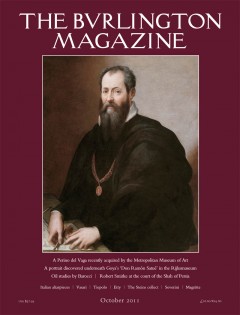
Picture: Burlington Magazine
The October issue is now out, and includes some good new discoveries:
- A new painting by Perino del Vaga for the Metropolitan Museum of Art, New York. (By Linda Wolk-Simon)
- A new painting by Perino del Vaga: recent cleaning and technical observations. (By Michael Gallagher)
- Two unpublished oil studies by Federico Barocci in the Nationalmuseum, Stockholm. (By Daniel Prytz)
- Pietro Testa and the ‘Museo cartaceo’. (By Ingo Herklotz)
- New portraits of Thomas Jenkins, James Byres and Gavin Hamilton. (By Antonello Cesareo)
- Robert Smirke and the court of the Shah of Persia. (By Christopher Baker)
- An intrusive portrait by Goya. (By Duncan Bull, Anna Krekeler, Matthias Alfeld, Joris Dik and Koen Janssens)
Claude at the Ashmolean
October 6 2011

Picture: Ashmolean
A major new exhibition of Claude Lorrain's landscapes opens today at the Ashmolean (until 8th January). Is this ambitious show - of no less than 140 works - further proof that the Ashmolean is now the pre-eminent art gallery in England outside London?
Steve Bell channels Ford Madox Brown
October 5 2011
This is worth a click, a film following the genius cartoonist Steve Bell of The Guardian as he covers the Tory conference in Manchester. Bell takes inspiration from the Ford Madox Brown exhibition now on in the same city, and cruelly mocks top Tories with a modern take on Brown's masterpiece, Work.
Where AHN leads, The Sunday Times follows...
October 5 2011
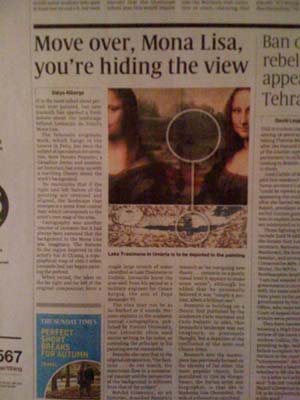
I forgot to brag about the Mona Lisa background story making it into the Sunday Times this weekend (even with a little quote from moi). Here was the original post.
Elizabeth Taylor - up a Hals, down a Modigliani?
October 5 2011

Picture: Architectural Digest
Yesterday saw the news that Elizabeth Taylor had a previously unknown Hals portrait in her collection. But today we find that her Modigliani (lower right, above) is in doubt. Is part of the problem the seemingly vice-like grip over Modigliani 'expertise' by our old friends the Wildensteins? From the LA Times:
When asked about the painting... Christie's Americas head Marc Porter said it was not appearing in a Christie's sale.
"There is a great controversy in the Modigliani authentication world because Restellini and Wildenstein are supposed to be producing new catalogue raisonné."
"So many collectors of her generation have bought Modiglianis that in this time period can't be authenticated," he added. "There are dozens of Modiglianis waiting to be established."
Toledo Museum of Art acquires mega Hals
October 5 2011
The Toledo Museum of Art has acquired a large group portrait by Frans Hals. Painted in the early 1620s, Family Portrait in a Landscape is the earliest of only four known family portraits by Hals to have survived, and until now was the only example to have remained in private hands. The youngest child (botton left) was painted later by Saloman de Bray in 1628 (he signed it in the left shoe). The picture was once larger, but was at some point cut down. The smaller portion, now called Three Children and a Goat Cart, is in the Royal Museum of Fine Art in Brussels. Toledo hope to re-unite the two pictures at some point.
Toledo's gain is the UK's loss. The picture was bought from a private collection here, via a London dealer. An export licence was granted in July this year at a price of £7.75m. It had previously been on loan to the National Museum in Cardiff, but they did not try and raise a matching offer.
It's worth a look at Toledo's website to see how museums should advertise their acquisitions. The Hals is on the front page, under the heading 'Good News!', and there's a video, and further comprehensive notes. By way of a contrast, there is still nothing on the Fitzwilliam's website about their latest acqusition...
Step back in time to Tudor London
October 5 2011

Picture: TriStar
If, like me, you love old views of Tudor London, such as those by Wenceslaus Hollar, then a new Hollywood film has some zippy digital recreations of the old City. Anonymous explores the theory that Shakespeare's work was written by Edward de Vere, Earl of Oxford (which is a load of old phooey), and is set in Tudor London. You can watch the trailer here for views of London Bridge, The Globe, old St Paul's Cathedral etc.
Elizabeth Taylor: Actress, Star, Connoisseur?
October 4 2011

Picture: LA Times
A portrait from Elizabeth Taylor's collection has been identified as a Frans Hals by Christie's. Previously, the picture was considered to be an imitation of Hals' work. From the LA Times:
The painting, "Portrait of a Man, Half-Length," was for decades thought to be by an imitator or student of Frans Hals, the great Dutch painter often compared to Rembrandt for his vigorous, sometimes humorous depictions of the growing merchant class. Now Ben Hall, the head of Christie's Old Masters department in New York, is making the case that Taylor's painting was the handiwork of Hals himself. An expert in Hals' work agrees.
With the change in attribution comes a change in projected value: a canvas that would have likely brought less than $100,000 could now bring $1 million in an Old Masters auction in January.
The re-attribution is an example of the importance of seeing a painting, long known through reproduction, in the flesh. In the 1970s, the painting appeared in scholar Seymour Slive's catalogue raisonné on Hals — the industry standard for what is and is not authentic — as "doubtful and wrongly attributed." But Slive only saw the work in a black-and-white reproduction.
Hall, on the other hand, saw the painting in person in July, when it arrived at Christie's Rockefeller Center warehouse with other material from Taylor's estate. He said it "packed a real punch — making a tremendous impact from even 20 feet away."
