


Previous Posts: articles 2018
Drilling for Leonardo
March 12 2012
'Lost', 'hidden', 'Leonardo'; three words guaranteed to deliver a cascade of press interest. The quest to find Leonardo's lost painting The Battle of Anghiari in Florence's Palazzo Vecchio, which some say was covered up by Vasari's later murals, has uncovered... some old flakes of paint. From The Guardian:
Researchers in Florence say they are one step closer to proving a lost masterpiece by Leonardo da Vinci, The Battle of Anghiari, is painted on a hidden wall in a cavity in Florence's town hall, where it has remained unseen for five centuries.
After drilling tiny holes in a fresco painted on a wall which hides the cavity, the researchers inserted a 4mm wide probe and took samples of paint, which they say is similar to that used by Leonardo when he painted the Mona Lisa. [...]
The research team's probe confirmed the existence of an air gap, originally identified through radar scans conducted of the hall, between the brick wall on which Vasari painted his mural and the wall located behind it. "No other gaps exist behind the other five massive Vasari frescoes in the high-ceilinged hall," the team said.
A sample of black material removed from the back wall was analysed with a scanning electron microscope using energy dispersive X-ray spectroscopy to identify its chemical makeup.
The chemical composition "was similar to black pigment found in brown glazes on Leonardo's Mona Lisa and St John the Baptist, identified in a recently published scientific paper by the Louvre, which analysed all the Da Vinci paintings in its collection", the team said.
"Note that Leonardo painted the Mona Lisa in Florence at the same time," said Seracini, who was featured in Dan Brown's Da Vinci Code.
Flakes of red material were also found. "Analysis of these samples seems to identify them as organic material, which could be associated with red lacquer. This type of material is unlikely to be present in an ordinary plastered wall," the team said.
And on the BBC, a note of dissent:
Tomaso Montanari, an art historian who has led the opposition to the research said that he did not "consider the source of these findings credible."
He added: "What do they mean by saying the findings are compatible with Leonardo? Any painting from the Renaissance would be. Anything from that era could be painted on that wall."
Whether this was worth all the effort remains to be seen. If the Battle of Anghiari has miraculously survived, and if it is anything like Leonardo's other famousy fragile frescoe, The Last Supper, there won't be much left to see. One could reasonably believe that if it was covered up by Vasari, it must have been done so for a good reason - that is, it had perished beyond use. We know Leonardo took great risks with his murals, and was constantly experimenting. After all, what are the chances that Vasari, the first great art historian and Leonardo's biographer, deliberately covered up a viewable Leonardo?
Caveat Emptor
March 12 2012
Picture: BG
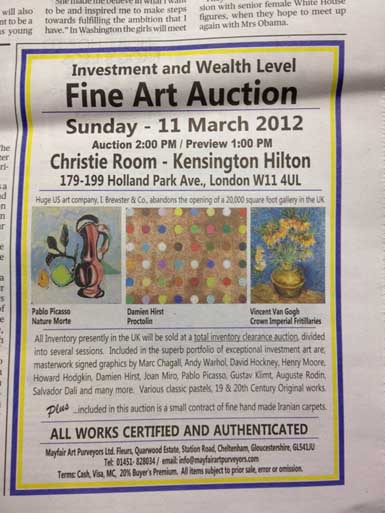
Intrigued by the above advert in the London Evening Standard, I went along to what seemed like the auction of a lifetime in London yesterday. A Van Gogh for sale at 'total inventory clearance' prices? Too good to miss, I hear you say.
Too good to be true, of course. It was a motley selection of prints, some 'signed', and sold in the strangest 'auction' I think I've ever seen. The lots were put up randomly, with each one preceded by a little speech on how valuable it was. Sometimes (with a Dali for example) the auctioneer made reference to a 'price guide' he had, saying the print was worth £4500, but then starting the 'bidding' at a bargain £1500. And still nobody bought it.
Anyone attending the one hour viewing (that tells you something), was first given a lengthy and seemingly inane document detailing the history of printing, which, at the very end, set out the difference between a 'Fine Art Print' and 'a poster' (answer, not very much). I guess this was to avoid any difficulties on the legal front. The auction itself started with a tale of how all this fine art was being sold so cheaply: because a US art gallery had hoped to establish a large gallery in London, and had shipped all this investment quality art to the UK - but, at the last minute, 'the real estate deal fell through', and so the stock had to be sold off. What a curious way of doing business! (I presume the same tale was given at the previous weekend's auction in Birmingham.) As they used to say in the News of the World, 'I made my excuses and left'.
Zoffany's condoms
March 12 2012

Picture: Times
In the TLS, Professor Mary Beard talks about her visit to the new Zoffany exhibition at the RA, and Zoffany's most risque self-portrait, above:
...we then explored some of the paintings we didn't know. One (from the Gallery at Parma) was a curious self-portrait of Zoffany apparently putting on a friar's outfit, actually getting ready to go out to party in fancy dress. And he's looking forward to a good time, for on the wall were hanging up, the label said, two condoms.
"But" asked the husband, "why do they say "two"? There's three of them hanging up -- a pair, and one a bit further to the right."
And that's certainly what it looked like. In fact it looked as if the condom on the right was neatly hanging over yet another version of the Venus of Urbino...just to rub in what the painting was all about. We didn't linger long, but decided to check it out when we got home.
That's where the story took a curious turn. Every single image I could get of this painting, including the one in the catalogue (above), crops off a good few centimetres on the right hand side, so you can't actually see what's going on there, and whether there's a third condom or not. In fact, in a major article on Zoffany self portraits (in the Art Bulletin 1987), William Pressly explains that even he hasn't seen the original painting and has only had access to a photo slightly cropped on the right. On the basis of that, he concludes that Zoffany had painted a strange tear in his image of the Venus of Urbino -- a significantly condom-shape tear (and that's the line repeated in the new catalogue).
Should museums pursue trust status?
March 12 2012
There is much debate in the UK at the moment whether local authority museums, and to a lesser extent archives and libraries, should break free from control by local councillors and enter into what is called Trust Status, which affords much greater independence. In this month's Museums Journal there is an amusing letter* from Laura Wigg-Bailey extolling the benefits:
Being part of a trust is like going off to work or university for the first time – terrifying but totally worth it. You may make mistakes, you may blow the budget on getting Sky Plus or food from Waitrose instead of Lidl but you soon learn that your mistakes affect no one but yourself and you pretty soon put them right.
In my experience, being part of a local authority museum service means bland corporate marketing, no freedom to respond to new media, and a procurement system that has a minor meltdown when you try to order a replica Viking helmet.
It means councillors who know practically nothing about what their museums and galleries are really for and whose social skills mean any opportunities for advocacy are cancelled out as they make a beeline for the free buffet.
As for favourable employment conditions – after recent ructions over local authority pensions who can say how long these benefits will continue to outshine those in the private or third sectors?
No, give me trust status any day and I’ll follow the advice of Adrian Babbidge (as I did when taking over the management of the Uttoxeter Heritage Centre from the local town council) and ensure a water-tight agreement between the local authority and the trust so that museums don’t close or run into the ground from lack of investment.
* to which I was alerted by Peter Davies
More data online at York
March 12 2012
Picture: University of York
I've mentioned before the excellent project run by York University's art history department, which puts primary material online relating to the late 17th and early 18th Centuries. Well, now it has got even better, with a cache of new sales and inventories uploaded. Click here for full details.
Friday Amusement
March 9 2012
Picture: Cartoonstock
Sewell on Zoffany
March 8 2012
Picture: BG
A dazzling piece of writing from the master reviewer in the Evening Standard. You must read it. However, his gripe is that the show is too small:
Alas, it is too small and, crowded and cramped, will be uncomfortable for visitors. With Hockney hogging the main floor of the Academy, poor Zoffany is hidden away in an attic that is as gloomy as a cellar, the number of paintings exhibited far fewer than the number in the catalogue, their impact weakened by a plethora of negligible prints, drawings and even knick-knacks. Nevertheless, even if only an hors d’oeuvres riches rather than a banquet, it is a sound introduction to a painter with a very wide range of experience and patronage.
[...]
Zoffany deserves a longer review to match a more comprehensive exhibition; from the Academy’s there are absentees beyond understanding — those from the National Gallery, the Tate and Greenwich peculiarly irritating; there are more examples in the Royal Collection, and I would like to have seen again the small full-length portraits of Mrs Salusbury in widow’s weeds (black is such a test of a painter’s ability) and Sir Elijah Impey, Chief Justice of Bengal, indulging in dramatic oratory. And we should have been able to see Zoffany’s paintings in the daylight that floods the great rooms below, currently occupied by Hockney.
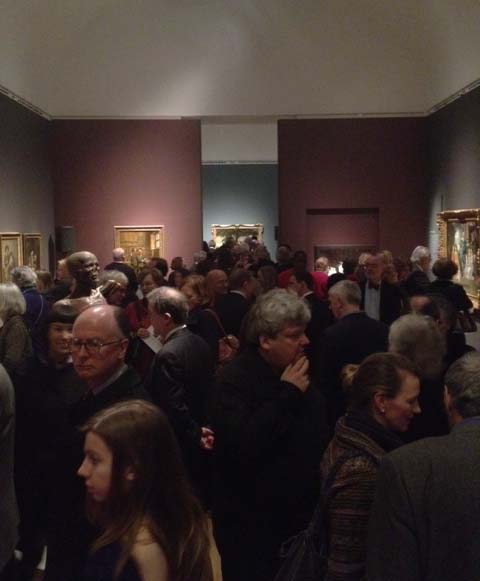
Sewell may be right that the exhibition is a little too cramped - as my photo from the crowded private view shows above. But he omits to mention the mitigating circumstances. The exhibition was due to be held at Tate, but they (daftly) pulled the plug. So the only available central London space, the upstairs rooms at the RA, was the next best alternative. Surely it is better to have a cramped exhibition, than none at all...
Freud mania
March 8 2012

Picture: NPG/Freud estate
The NPG have release 7,000 extra tickets for the Freud Portraits exhibition. The show will now be open till 9pm on Saturdays.
Let's hope the opening on Saturday evenings is so succesful it becomes permanent. I've never quite understood why visual art is seen as a daytime activity, and performance art an evening one. I like going to galleries in the evening - it's usually the only time I can go.
Renaissance portrait symposium in London
March 8 2012

Picture: Courtauld
This looks interesting, a symposium at the Courtauld on Saturday 28th April 'Beyond the Frame: Portraits and Personal Experience in Renaissance Europe'. There's an illustrious selection of speakers, admission is free, and you don't need to book.
As is increasingly the case these days, the art historical blurb needs reading twice if you're not fluent in the lingo:
In Renaissance art historical scholarship, the category of the portrait has provided a key framework for thinking about and discussing representations of the individual, an emphasis that has been echoed in a range of recent exhibitions celebrating Renaissance ‘faces’.
The inaugural Renaissance postgraduate symposium invites new scholars to explore the limits of this framework. It aims to encourage students of the Renaissance, in its broadest definition, to consider the domestic, devotional and urban environments of portraits. Contributors are invited to consider how the experience of viewing, commissioning and living with portraits affects our understanding of their meaning and function, situating the images within their historical contexts rather than within the museum’s exhibition space. Likewise, we invite participants to challenge the terminology of portraiture and to consider objects and images which do not fit into the conventional category of the ‘portrait’ but which nevertheless ‘portray’ individuals.
Stuart beauties at Hampton Court
March 8 2012

Picture: Guardian/Royal Collection/National Portrait Gallery
Exciting news in The Guardian today about a forthcoming exhibition at Hampton Court, and not just because I live round the corner. The Wild, the Beautiful, and the Damned, which opens on 5th April, will look at the women of Charles II's famously salacious court. And happily, this means many fine portraits by Sir Peter Lely will be included, such as Frances Stuart (above left, Royal Collection) and Barbara Villiers (right, NPG). The latter's portrayal as the Virgin Mary holding one of the King's illegitimate children is still quite shocking, if you think about it.
From The Guardian:
The exhibition, the first at Hampton Court on the Stuart period after a decade spent on the Tudors and Henry VIII, is in the Queen's state apartments, which were created in the late 17th century by Sir Christopher Wren for Mary II.
"Beauty was a very thin line," the show's curator, Brett Dolman, said. "On one side, beauty is taken as a symbol of virtue and perfection, beauty could allow you to rise far beyond your original station in life. On the other, beauty is viewed with suspicion as a snare and one wrong step and your reputation is destroyed forever."
Also in the show will be Lely's full-length portrait of a naked Nell Gwyn, whose recent somewhat tragic auction history I have covered here before. From the Guardian article it sounds as if the picture will be exhibited unequivocally as Nell Gwyn - and this is further good news, for the sitter is undoubtedly Charles' most famous mistress. It was only the late Sir Oliver Millar's rather curious suggestion that the sitter might be Barbara Villiers that introduced any doubt on the identification.
'Zoffany' - press reaction
March 7 2012

Picture: Royal Collection
So far, the critics seem to like the Zoffany show at the RA. Here's Alastair Sooke in The Telegraph giving it 4/5, and here is Amanda Vickery in The Guardian. However, Philip Hensher has an engaging piece on the artist in The Telegraph, and makes this bold claim:
He must be the greatest painter of English royalty between Van Dyck and Winterhalter. In his royal paintings, such as the wonderful Queen Charlotte With Her Two Eldest Sons, royalty appears with the necessary spectacle, and even with a whimsical appearance, but also off-duty, relaxed. Other painters of the period, like Gainsborough, rendered royalty as private individuals; Zoffany’s royals have a curious quality, suggesting that they have wandered off from stiffer, stately duties and have flung themselves down without changing their clothes to be alone with each other and the painter. They have, unexpectedly, a connection with Zoffany’s large and innovative series of portraits of actors in their best and most memorable roles.
Meanwhile, over at The Guardian, Jonathan Jones gets into a terrible muddle sneering at Zoffany's Tribuna:
Zoffany's eye for the manners of the English was ironic and true. His strange and wonderful Tribuna portrays the reality of the Grand Tour – a social, not a cultural pilgrimage. It also reveals a trait in British society that remains constant to this day: the studied shallowness of the elite. In Zoffany's grand anthropology of the English ruling class, great art is just a prop for fashion and the rituals of the privileged.
A few quick points (someone has to defend the English elites):
- First, despite those prostitute-frequenting posh Grand Tourists that historians like to highlight, it is undeniably the case that the lure of Italy was primarily cultural. If it wasn't, most Tourists would have stopped in Paris, and England's country houses wouldn't be full of antiquities, and so heavily inspired by classicism.
- Second, our best source of information about the painting comes from the correspondence of two high members of the elite whom Jones derides as 'shallow'; they are Sir Horace Mann (who is in the painting, and was an art dealer on the side), and Horace Walpole, 4th Earl of Orford, and one of England's greatest art historians.
- Third, if the art in the Tribuna was just a prop for the privileged, why did Zoffany take such care to portray the figures as admirers of art, rather than each other? All the conversations in the picture are clearly being held around the objects themselves. Indeed the groupings are really no different to Teniers' depictions of the Habsburg elites admiring Archduke Leopold's art collection.
- Finally, the Tribuna was commissioned by the elite of all English elites, King George III and Queen Charlotte. And they were browned off that Zoffany had put any people in it. In other words, all they wanted to do was look at the art. They couldn't give two hoots about the social rituals or the fashion.
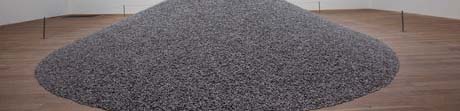
More on Weiwei's seeds
March 7 2012
Picture: Guardian
The Art Fund have been in touch, to say:
In terms of disclosure of the details of the acquisition, we are always completely open, as our members would expect us to be, about any grants we have offered to a museum – in this case £100,000.
Regarding the total cost of the acquisition, we generally also announce the cost at the time of announcement unless the acquiring museum wishes to publish this information separately (which in this case, Tate will do in their annual review, which I believe is published in September).
Curiouser and curiouser. I wonder why Tate wanted to announce the price seperately from the acquisition. Did they fear it becoming a distraction? The Art Fund is usually a generous funder, so in this case one would expect the £100,000 to be a fairly large proportion of the final cost. In which case the 8 million seeds are beginning to look relatively cheap.
Guercino acquired by the Nation
March 7 2012

Picture: BBC
Guercino's Samian Sybil has been accepted by the UK government in lieu of inheritance tax. The picture was first commissioned by Giuseppe Locatelli, and has been in the Spencer Collection at Althorp. The picture's original pendant, the Cumaean Sibyl, is at the National Gallery. Presumably, the Samian Sibyl will now be allocated to the National permanently.
No value has been released for the Guercino, but it must have been many millions. So thanks HMG for foregoing a whole heap of tax, and thanks also to David Lloyd George for coming up with the acceptance-in-lieu scheme in 1910 (even if inheritance tax itself is horrid).
Update: a reader has sent me this link to the recent sale at Christie's of Guercino's King David, also formerly of the Spencer Collection, which sets out the history of the set.
Another reader adds:
The amount of tax settled by the Guercino is 3.2 million pounds. As I imagine the work would have been subject to the same 40% tax hit as all the other Spencer items sold in 2010, (including the King David and the Rubens), the value of the Samian Sybil has been determined to be the same as the King David, (which sold for at auction for 5.2 million pounds).
Martin Postle on Zoffany's 'Tribuna'
March 7 2012
Video: Royal Academy
A lovely tour round Zoffany's masterpiece by Martin Postle.
New discovery heralds 'Zoffany' at the RA
March 7 2012

Picture: BG
Well, where to begin? The classy layout? The excellent catalogue? The varied and invigorating selection of works? The virtuoso display of the dying art of curation? For me, there aren't superlatives enough to describe the new Zoffany exhibition at the RA. Yes, Zoffany may never be in the top rank of artists from his ultra-talented generation. But there are few artists who tell us more about painting and painters in the 18th Century.
Born in Germany, studied in Italy, celebrated in England, and, at the end, almost abandoned in India, this perpetually peripatetic artist and his unprecedentedly varied network of patrons from German kings to Indian maharajahs gives us an unparalleled view into how art was valued and commissioned in the 18th Century. We can see in Zoffany the desire for large formal portraits, for conversation pieces, for subject pictures, for landscapes, for still lifes, for historical pictures, and even religious ones. He could paint the lot. True, the studied control of his paintings may bely a lack of fluency, and even genius in handling oil paint. But he was still capable of producing great paintings, such as the Tribuna [Royal Collection]. What he may have lacked in talent, he made up for in labour.
And in this exhibition, excellently curated by Martin Postle, we can see the whole range of Zoffany's work. Proof of how varied he could be in his approach comes in an exciting new discovery of the above landscape The South Gate of Lal Bagh, Dhaka, dated 1787. This picture was at auction in Sotheby's only last December, where it was catalogued as by Robert Home. I remember standing in front of it and being sure it wasn't by Home (on whom I'm something of an anorak), but I never made the connection to Zoffany. The figures are so unlike his usual figures, more sketch-like and elegant. But there, hanging next this landscape at the RA is another very similar scene by Zoffany which confirms the attribution beyond doubt. The picture was estimated at £60-80,000 at Sotheby's, and seemingly didn't sell (I'd value it at about £250,000 now). It's a great coup for the exhibition, and an important discovery, being one of only three surviving landscapes from Zoffany's time in India.
But perhaps the most pleasing thing about the show is that it is happening at all. This kind of single artist, scholarly exhibition is seen, at least amongst those who now control many of our exhibition spaces in the UK, as unfashionable. Now, funders and marketing people want 'thematic displays', onto which you can tag on topics of (dread phrase) 'contemporary resonance'. It should forever be to Tate's shame that they cancelled this exhibition ('too idiosyncratic' apparently), not least when we see the piss-poor effort - 'Migrations' - they have put on in its place. And it should be to the Royal Academy's perpetual credit that they have stepped in and rescued it. I suspect that most of all, however, we have to thank the Yale Center for British Art, who first sponsored the exhibition. Ultimately, of course, we must be grateful to the late Paul Mellon, whose largesse is now almost single-handedly keeping good old-fashioned art historical research in the UK going, not least through the Paul Mellon Centre in London. If it wasn't for his money, these kind of exhibitions, with their spin-offs of new research and discoveries, would most likely not take place any more. So please support the exhibition by going to see it. I promise you won't be disappointed.
Beltracchi - 'I made thousands of fakes'
March 6 2012
When the German master forger Wolfgang Beltracchi was convicted and sentenced to six years in prison, German police revealed a list of over 50 paintings they believed were fakes. But now Beltracchi has said he painted many, many more. From Der Spiegel:
Speaking to the media for the first time since he was sentenced, Beltracchi refused to name the exact number of paintings he forged throughout his career, which he began in the 1970s by creating "unpainted works by old masters, and later Jugendstil and Expressionists" and selling them at flea markets. But during the interview with SPIEGEL, Beltracchi said that due to high demand, he could have easily put "1,000 or 2,000" forgeries on the art market.
That's a lot of dodgy pictures. Where were they all sold? If I was a modern art auctioneer, I'd be feeling rather anxious. To see how easily the likes of Christie's and Sotheby's were fooled by Beltracchi, see my earlier post here.
Update: A reader comments:
Truth or puckish shit-stirring?
Prado copy hits the news again
March 6 2012
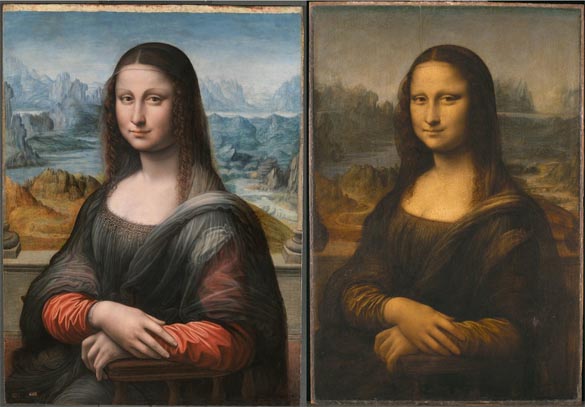
Picture: Prado/Louvre
A classic example of how speculation can become fact. From the Daily Telegraph:
'Mona Lisa copy may have been painted by Leonardo's lover'
Last month, a copy of Leonardo's most famous painting rocked the art world with revelations about its provenance.
Two weeks after it went on show to the public at the Prado, the museum's conservation team believe they are closing in on a conclusion about the painting's authorship.
The most likely candidate is Gian Giacomo Caprotti, the apprentice known as "Salaì" - which translates as "Little Devil" - who went to work in Leonardo's workshop when he was ten years old.
Many historians believe, though it is not proven, that Salaì was Leonardo's lover. He is presumed to be the youthful model for Leonardo's paintings 'St. John the Baptist' and 'Bacchus', as well as numerous drawings.
Things we can't know for sure in relation to this story:
- Nobody knows if Salai was Leonardo's lover, or even if Leonardo was gay.
- We can't really be certain that the Prado copy was painted simultaneously alongside the original.
- We don't know much at all about Salai's style or oeuvre, and certainly not enough to make a stylistic attribution.
On Tate's new seeds
March 5 2012

Picture: Graham Turner/Guardian
A reader writes:
To answer your question, yes!
Perhaps the reason behind the Tate/ArtFund decision not to disclose the price is that they are embarrassed. However, as you rightly say, that is not a valid reason. If they believe in the 'work' they must be able to defend the expenditure.
For the ArtFund to collude in this, when they are always begging for funds from their members, is a disgrace.
Strong stuff. I've asked the Art Fund if there was any reason behind not releasing the extent of their contribution. But answer comes there none.
Of course, it is possible that the secrecy is to protect a super low price paid to Mr Weiwei, which would be seen as lowering the market rate for his seeds. But why would the artist want his benevolence to be secret?
It would be interesting to know what the going rate for Weiwei's seeds was before the recent Tate installation, to compare with what they fetched after it. I suspect, in other words, that in return for all that publicity and establishment endorsement, Mr Weiwei owes the Tate a big favour...
Update: it has been hinted to me that the lack of disclosure has something to do with the artist's recent run-in with the Chinese authorities. Presumably, if that is the case, Weiwei won't be selling anything publicly at auction for a while either.
A Lely in Louisiana?
March 5 2012

This came up for sale over the weekend in the US, and made a strong price. Catalogued as 'Follower of Van Dyck', the picture looked to us like a portrait by Sir Peter Lely, from early in his career. The sitter was identified as Lady Newburgh.
New Tate website
March 5 2012

Picture: Tate
Still in beta form, and not officially launched, but you can have a play around here. Looks very good. And nice size reproductions too, which is a great improvement on the old site.
