


Christie's NY Old Master drawings
January 31 2018

Picture: Christie's
The top lot in Christie's New York Old Master drawings sale was a watercolour by Turner, Lake Lucerne from Brennan, which made $.109m (inc premium). A lot which exceeded its estimate dramatically was Jupiter handing a newborn boy to Diana by Perino del Vaga, a pupil of Raphael; this made $708,000 against an estimate of $150k-$200k. The sale totaled $3.9m.
'Charles I - King and Collector' (ctd.)
January 26 2018
Audio: TAN
Here's my podcast with The Art Newspaper, discussing the new exhibition at the Royal Academy.
'Charles I - King and Collector'
January 26 2018

Pictures: BG
I enjoyed the new Royal Academy exhibition, 'Charles I - King and Collector', so much that I had to blag a press pass and go again the next day. As the private view ended, the security staff had to almost physically push me out. I would have been the last to leave, but Anne Webber, of the Commission for Looted Art in Europe, bagged that honour.
As I said below, I was ambushed by a BBC film crew in the last room of the exhibition, and asked for my reaction to the show; 'one of the greatest feats of curation of modern times; it'll be a blockbuster', I said. And it's true. You can read glowing reviews almost everywhere.
This isn't a review, more a series of thoughts. I'll be writing in more detail about the exhibition in The Art Newspaper next month, and I've also recorded a podcast for them on the exhibition. That'll be out soon.
First off, the exhibition is magnificently paced and presented. Each room is filled with just enough masterpieces; it's not too busy, and even with the usual crowds, it shouldn't feel too difficult to get a good look at everything. The curators have gone for a less is more approach. I'm probably not making much sense in saying that, given the sheer number of wonders on display. But remember that what we see at the RA is only a fraction of what Charles I amassed.
Anyone who knows the extent of the bartering that goes on between museums these days will know how difficult it is to pull off important loans. 'You can borrow my Titian, if I can borrow your Rubens', is how it usually goes. The RA, having only a limited collection of its own, is not in a strong position to do this. So in bringing together the works they have, the RA's Per Rumberg and the Royal Collection's Desmond Shawe-Taylor and have achieved something extraordinary.
Then of course there are the works themselves. There are four Titians - including the Supper at Emmaus from the Louvre, and four giant Mortlake Tapestries based on designs by Raphael. The series of Mantegna paintings, the Triumph of Caesar look as good here as they ever have done. There are too many wonders to list here. Not one is a disappointment. (Well, perhaps the newly cleaned Guido Reni & Studio Toilet of Venus from the National Gallery, but only because it is hung beside so many great Gentileschis).

But as a Van Dyck obsessive, I'm pleased to report that he steals the show. In the first room, we are faced immediately by his Triple Portrait of Charles I. And there he is also represented by the well known but little seen Self-Portrait with a Sunflower, which hangs beside self-portraits by Rubens and Daniel Mytens. The latter two self-portraits were owned by Charles I (who also owned a self-portrait by Van Dyck) but the Sunflower self-portrait overshadows them both with its... well, its sheer pizazz.

There were instructions not to photograph the Sunflower self-portrait, but since it was once owned by my 5 times great grandfather, I gave myself a special exemption. I'll write more about this picture, and the self-portrait which Charles I owned, sometime soon.

The Van Dyck quota gets even better in the following rooms. We not only see his full length portraits of Charles I and Henrietta Maria, and those of his children, as well as other members of the court. But here amassed for the first time are all four of Van Dyck's large-scale portraits of Charles; theRoyal Collection's Great Piece, the Equestrian Portrait from the National Gallery, the Equestrian Portrait with Monsieur de St Antoine from teh Royal Collection, and the Portrait of Charles Hunting from the Louvre. Hanging discretely in the corner is Van Dyck's portrait drawing of Charles. To stand in one place and be able to see all of these is about as good as being an art lover gets. At least for this one.

And then in the final room we see one of my favourite Van Dycks, his Cupid and Pysche, as well as the NPG self-portrait and his portrait of his mistress, Margaret Lemon. Also here is his Itlian Sketchbook, on loan from the British Museum. Which is a slight bore for me, as I was wanting to film it soon. But that's enough about Van Dyck.
Jonathan Jones in The Guardian has drawn some ire by suggesting that the exhibition should make us take a more revolutionary view of the Royal Collection itself, arguing that we should:
Nationalise the egregious monarchist folly that is the Royal Collection. Put these wonderful paintings and sculptures in our public galleries where anyone can see them for free, any time we like.
Now, ardent monarchist as I am, I have to say that I can see why Jones left the RA show thinking this. The 80 works from the Royal Collection look so good in the RA's almost unrivalled exhibition galleries, that it's hard to think of them going back to their less vaulted and less visited homes, in various royal palaces across the South East. Hopefully, a more balanced approach between the Royal Collection being a working collection in busy palaces, and something that can be more generously spread across the UK, can soon be struck.
So there's no doubt, then, that the RA show is a visual feast, of a kind rarely seen. I would have liked to have seen a little nod towards 'context'. Not necessarily of the wider historical scene in England in the 17th Century - there wouldn't be space to do that, in a way that might fully explain, say, whether Charles' devotion to art contributed to oubtreak of the Civil War. But in an exhibition so devoted to the personal taste and decisions of one man, I'd like to have seen an attempt to understand more about that man's motives. We see here what Charles collected, and how he collected it - but not why he collected it. (Personally, I think Charles was more driven by a rivalry with his late, older brother, Henry Prince of Wales, than many suspect. Henry showed every sign of being as astute a collector as Charles, but was physically stronger and cleverer than Charles too, and would doubtless have been a better ruler. Certainly, comparing Van Dyck's larger portraits of Charles with Robert Peake's portraits of Henry is revealing.)
It might have been enough to explore all these questions in the catalogue, but that alas is the only slightly weak part of the equation. Perhaps it's unfair (because the RA doesn't have depth of curatorial presence you get in most other big institutions) but a comparison can be made with the current Royal Collection exhibition on Charles II at the Queen's Gallery. For that show, a typically thorough catalogue uses the moment of assembling the exhibits to re-evaluate and re-assess them and their context. We don't get this in the RA catalogue, and instead have only a series of quite brief essays, some of which seem merely to be going through the motions. Still, a less than satisfying catalogue should only persuade us to spend more time in the actual exhibition itself. That's what the RA does best - it puts on great exhibitions. I can't wait to go again.
Bill Jordan
January 25 2018

Picture: Dallas News
I was very sad to hear of the death of Bill Jordan, the renowned scholar of Spanish 17th Century art. He was most recently an independent scholar, but his last post was as Deputy Director of the Kimbell Art Museum in Texas. I only met him once, but we communicated by email quite a bit - he was one of the most generous art historians I've encountered. And an astonishingly good connoisseur. One of his most important discoveries, a Velazquez of Philip III, he gave to the Prado Museum. There's an article on his life here, in The Dallas Morning News.
Non Merci, Jeff
January 25 2018
In the aftermath of the 2015 terrorist attacks, Jeff Koons donated a work, 'Bouquet of Tulips' to the city of Paris. But now a number of leading French cultural and political figures have said; 'non merci'. The signatories to an open letter in Liberation point out that generous Jeff only donated 'the idea' of the piece, and that the French state and donors will have to pay €3.5m to actually make and install the thing. More here from Naomi Rea on Artnet.
Job Opportunity!
January 25 2018

Picture: Huw David Jones
The National Museum of Wales is looking for a new Director of Collections. Salary is unspecified, but:
The ability to speak Welsh is desirable.
More here. Closing date is 12th Feburary.
'Great Art' on ITV
January 25 2018
Video: ITV
For a while now, a company called 'Exhibition on Screen' has been making feature length documentaries based on exhibitions such as the one on Canaletto at the Queen's Gallery in London. Now, these films have been edited down to a more manageable 45 minutes or so for ITV. Above is the one on Canaletto, and you can see others (on the Impressionists, and Michelangelo) here.
Sotheby's moves into AI
January 25 2018
Video: Thread Genius
Sotheby's has bought an image recognition software company, called Thread Genius. The video above shows that the software allows you to search by images and parts of images. The press coverage about the acquisition focuses on how this will help clients, but I suspect at least as useful will be its connoisseurial abilities. Even a reverse Google Image search these days can be scarily effective. The days of Christie's and Sotheby's sending a junior specialist to delve through the Witt Library or the Frick archive, will soon be over.
'Rubens: Power of Transformation' at the Staedel
January 25 2018

Picture: Staedel Museum
This'll be a good show: 'Rubens - The Power of Transformation' at the Staedel Museum in Frankfurt (8th February - 21st May) will comprise:
[...] about one hundred items—including thirty-one paintings and twenty-three drawings by the master—and explores a hitherto little-regarded aspect in his creative process. The presentation reveals how profound the dialogue was into which Rubens entered with his predecessors’ and contemporaries’ achievements and fathoms the scope of their impact on the five decades of his production.
More here.
Michelangelo at the Met
January 25 2018
Video: Met Museum
The Met's exhibition of Michelangelo drawings has been getting rave reviews. But today the turtle himself showed up. More here.
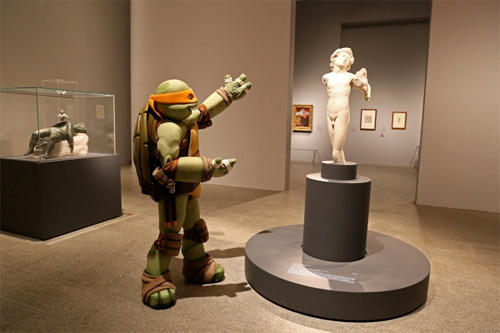
Art history toilets (ctd.)
January 25 2018
Video: Golden Throne
Remember the gold toilet artwork at the Guggenheim, which visitors could actually use? Now the museum has offered it on loan to the Trump White House. More here.
Graham-Dixon on the contemporary art market
January 25 2018

Picture: Royal Collection
There was an excellent edition of the BBC radio show Start the Week with Andrew Graham-Dixon, in which he said many wise things about the more absurd end of the contemporary art market. He was also joined by Don Thompson, an economist who has researched about the financial aspect of the contemporary market. Well worth listening to.
Art history trousers
January 25 2018

Picture: Yizzam
If you'd like some tight trousers printed with works by Henri de Toulouse Lautrec, then step this way.
'Moving Pictures' (ctd.)
January 25 2018
Audio: BBC
Cathy Fitzgerald's excellent BBC Radio series 'Moving Pictures' is back, and well worth listening too. Each programme looks in detail at a single picture. More here.
Italian Museums (ctd.)
January 25 2018
Every time I read something from James Bradburne, the director of the Pinacoteca di Brera in Milan, I am more in awe. Bradburne is essentially leading the charge to save Italian museums from themselves, and has just given a refreshingly candid interview to Richard Holledge in the FT. He says of his challenge at the Brera:
I am taking on the beast, a museum run as a department of a department of a Soviet-style state bureaucracy. [...]
In Italy people confuse an excellent collection with an excellent museum. Italy has superlative collections but very bad museums, while Cincinnati, Cleveland and Denver in the USA, for example, have far better museums than any in Italy but they don’t have such good collections. The Getty collection is second-rate — sorry if I offend my friends — but it’s a great museum. They do things with the collection that we are barely imagining.
And his new plan to get people to look at art for longer? Simple, a chair:
“If you want people to look longer and see more, you give them something to sit on because nobody learns standing up,” says Bradburne. “I have just ordered 150 portable stools for the Brera.”
The Leonardo magic show
January 25 2018
Video: BBC
Andrew Graham-Dixon's new Royal Collection programmes on BBC4 have been excellent. Here's a fantastic moment when UV light reveals some faded copperpoint drawings by Leonardo. More on the programmes here.
The Otto Naumann sale
January 25 2018
Video: Sotheby's
Here's a Sotheby's film ahead of the sale of the Old Master dealer, Otto Naumann. As I've said before, Otto is the Obe-Wan of the Old Master trade, and it'll be strange not seeing him at fairs like Maastricht. I only met him a couple of times in my London trade days, but he was always generous to younger dealers. I hope his sale does well.
Old Masters in new spaces
January 25 2018
Video: Sotheby's
I noticed in the front of Sotheby's latest Old Master sale catalogue a series of photos showing pictures in New York-style apartments. They looked good, and are evidently part of an attempt to persuade people that old art can look good in a modern setting. Of course, AHN agrees entirely. Above is a video Sotheby's have released showing how the designer Victoria Hagan put the interior scenes together.
Happy Burns Night
January 25 2018
Video: Liverpool John Moores University
It's Burns Night, and here in Edinburgh we've done the full haggis supper. Newly released today is a new facial reconstruction of Robert Burns, based on his portrait by Alexander Nasmyth. Not entirely successful, I'd say. More here on the techniques behind the reconstruction.
Apologies...
January 23 2018
No news today; on my way to London to see the Charles I exhibition at the Royal Academy. Excited!
Update - a BBC film crew ambushed me for my take on the exhibition, during the private view. My immediate reaction? 'This is one of the greatest feats of curation of modern times'.
