


How to get ahead in French museums
August 24 2015

Picture: youropi.com
According to Vincent Noce in The Art Newspaper, the system by which French museum heads are appointed is scandalous - and it helps if you're a buddy of the Prime Minister:
Prime Minister Manuel Valls wanted the directorship of the Villa [Medici, the French Academy in Rome, above] for the wife of Gerard Holtz, a sports journalist who is a close personal friend. The woman in question, Muriel Mayette, was forced to quit her job as the head of the Comédie-Française last year in the face of a widespread revolt from the company that was founded by Molière.
Holtz denies having asked any favours of the prime minister—but the prime minister did intervene in a move that has been widely denounced. “Muriel Mayette has no competence at all for the post,” wrote the conservative newspaper Le Figaro, while Le Monde said that “everyone” finds such a nomination “despicable”. Mayette declined to comment.
Beware fake Van Goghs
August 24 2015
Some fellow has been arrested for trying to sell a fake Van Gogh self-portrait, for £11m. No photos of the fake have been released alas. But apparently the man had forged documents certifying its authenticity from the Van Gogh museum. More here.
'Soundscapes' vs 'Sensorium'
August 24 2015
Picture: Guardian
When the National Gallery recently put on an exhibition called 'Soundscapes', where paintings were paired with newly commissioned music, the critics went bleeugh, and said it was unspeakably awful. But now Tate Britain have done pretty much the same - only with smells too - and called it 'Tate Sensorium'. Will the critics respond differently? I suspect they might.
Mona Lisa theory no.724
August 24 2015

Picture: Louvre
It's August, news is slow (stock market crashes notwithstanding), and news outlets are forced to gorge themselves on Mona Lisa stories.
Ping into my inbox comes this press release:
The Mona Lisa Knot
My Journey Finding Leonardo da Vinci’s Mona Lisa
Caroline Cocciardi has found a message of love authored and painted by Renaissance artist Leonardo da Vinci on his most prized possession, “Mona Lisa”.
For the last 500 years this anomaly visible to the naked eye has gone unremarked-upon the Mona Lisa painting. The models only embellishment, a one inch by four inch interlocking embroidered knot pattern in the form of a series of geometric designs that do not belong on Mona Lisa's frumpy house dress!
Writer, filmmaker, and interior designer Caroline Cocciardi spent a decade in search of an unknown Leonardo da Vinci. “Not the masterful artist, engineer, or draftsman I was looking for Leonardo, the man who grabbed my soul with his mural, The Last Supper, in Milan in 1999. The experience lead me to discover Leonardo: The Lover.”
Cocciardi’s discovery of The Mona Lisa Knot holds a profound and surprising message from Leonardo in the only language he trusted to express his highest sentiments: mathematics. Leonardo’s The Mona Lisa Knot message is about to be revealed.
Mona Lisa theory no. 723
August 24 2015

Picture: Via Mail
Scientists at Sheffield Hallam University say Leonardo developed something called the 'uncatchable smile' with the Mona Lisa:
Researchers found that by expertly blending colours to exploit our peripheral vision, the shape of the subject's mouth appears to change according to the angle it is viewed from.
When viewed directly, the slant of the mouth is distinctly downwards, according to the research by scientists at Sheffield Hallam University and Sunderland University.
As the viewer's eye wanders elsewhere to examine other features, however, the mouth appears to take an upward turn, creating a smile that can only be seen indirectly, much like the Mona Lisa's.
The technique is called sfumato, and can be seen in both the Mona Lisa and La Bella Principessa.*
And while other artist's have attempted to use the same technique, none have done so as expertly as da Vinci, the researchers claim.
'As the smile disappears as soon as the viewer tries to 'catch it', we have named this visual illusion the 'uncatchable smile,' researchers Alessandro Soranzo and Michelle Newberry of Sheffield Hallam University wrote in a paper published in the journal Vision Research.
Yet another 'paper' on art history written by scientists who don't know enough about art history. More here.
*which is not certainly by Leonardo
Artists in Britain 1500-1640
August 19 2015

Picture: NPG, 1554 Self-Portrait by Gerlach Flicke, a German artist at work in England in the 16th Century.
The American art historian Prof. Robert Tittler has published online an extroardinary database of artists working in Britain in the 16th and early 17th Centuries. There are some 2,578 names.
Here's the abstract of the paper:
This resource identifies all those men and women who have been identified as painters of any sort working in England, Wales, Scotland or Ireland between the years 1500 and 1640. At this posting, it includes 2,578 such entries. It includes those who were native to the British Isles and also those aliens who came and worked there at any time during this era. It also includes those whom contemporary occupational descriptions refer to as pursuing any specialty within the general category of 'painter' including, e.g., 'limner', 'picture-painter', 'glass-painter', 'herald painter', 'manuscript illuminator', etc. Each entry indicates, wherever possible, the places of origin and of residence, contemporary occupational description, dates of life and of activity, details of training, known works, and general biographical information. Each name is also accompanied by a list of sources, and by the identity of those who researched that name.
I think this great effort, which reflects years of dedicated research, qualifies Prof. Tittler for my new award: 'Hero of Art History'. Future nominations are most welcome. To qualify, I think art historians must have done something to which we're all indebted, but which nobody else has ever done. A founder recipient - I was thinking today as I thumbed through one of his many tomes - must be Algernon Graves, whose indexing of things like loan exhibitions in the 18th and 19th Centuries is invaluable.
Update: a reader writes to nominate Frits Lugt - agreed!
'5,000 Years of Faith'
August 19 2015

Picture: Apollo
I'm full of admiration for the philanthropist Jonathan Ruffer's (above) plans to create a centre for religious art in the north of England. Centred on Auckland Castle, which Ruffer bought from the Church of England (along with that series of Zurburans) and gave to a charitable trust, the new exhibition spaces will be in the Castle itself, a new gallery in Bishop Auckland, and the Bowes Museum in nearby Castle Barnard. Ruffer revels in the fact that such art is 'deeply unfashionable', and will plunder the storage rooms of museums across the country, where many great pictures are banished. You can read more about Ruffer's plans in Apollo, here.
And next time you hear anyone complaining about the impossibility of raising money for the visual arts from philanthropists outside London, remember Ruffer.
Perronneau mystery solved
August 19 2015

Picture: Neil Jeffares
Neil Jeffares has solved an intriguing mystery in the life of the gifted french pastellist, Jean Baptiste Perronneau. There has always been a gap in Perronneau's biography, when, between 1773 and 1777, nobody knew where he was. But now Neil has established that he was in Madrid, thanks to finding the above pastel in Lisbon in the Museu Nacional de Arte Antiga, which has a dated inscription on the reverse placing Perronneau in Madrid in 1776.
A full, if characteristically modest description, is on Neil's blog here.
Update - of course Neil should be duly appointed a Hero of Art History for his online Dictionary of Pastellists. Though I have already appointed him 'King of all Things Pastel', so I'm not sure which honour is better.
New Tate Britain director announced (ctd)
August 19 2015
Video: Nottingham Contemporary
A reader has alerted me to this video of the new Tate Britain director Alex Farquharson interviewing Sir Nick Serota back in 2013. I think we can see then, in Sir Nick's approving noises about Farquharson's success in mixing old and new art in exhibitions, just one reason Farquharson might have been high on Sir Nick's list to take over at Tate Britain.
Italian Museums (ctd.)
August 18 2015
I mentioned the other day that the Italian government is taking steps to shake things up (at last) in the Italian museum sector. Today they announced some new appointments as directors of Italy's most important museums. And for the first time there's a slew of foreign appointments.
Ermanno Rivetti in The Art Newspaper reports:
Out of the 20 posts—evenly split between men and women—seven have gone to non-Italian EU nationals (three Germans, two Austrians, one British and one French). The ministry made the selection from 1,200 Italian and 80 foreign applications with the help of a committee that included Paolo Baratta, the president of La Biennale di Venezia, and Nicholas Penny, the former director of London’s National Gallery. [...]
Italy's seven new foreign directors:
Eike Schmidt Uffizi Galleries (Florence)
Sylvain Bellenger Museo di Capodimonte (Naples)
James Bradburne Pinacoteca di Brera (Milan)
Cecilie Hollberg Galleria dell’Accademia (Florence)
Peter Aufreiter Galleria Nazionale delle Marche (Urbino)
Gabriel Zuchtriegel Paestum Archeological Park
Peter Assmann Palazzo Ducale (Mantova)
Other appointments include:
Paola Marini Gallerie dell’Accademia (Venice)
Anna Coliva Galleria Borghese (Rome)
Cristiana Collu Galleria Nazionale di Arte Moderna e Contemporanea (Rome)
Good news there's to be new leadership at the Uffizi. Step one, a decent website...
Many AHN congratulations to all those appointed.
Update - there's been a predictable backlash in Italy against some of the new, foreign appointments. Here's a choice line in The Independent:
Angelo Tartuferi, the head of the Gallery of the Florence Academy who was also replaced by a German – 48-year-old Cecilie Hollberg – hit out at [a] suggestion that the new managers had been hired “to make up for lost decades”. He said Italy had invented museum curation methods that German experts felt obliged to study.
Do the 'Italian curation methods' copied in Germany include useless websites, arbitrary gallery closures, lax security, and overly optimistic attributions? I doubt it.
Everybody Out! (ctd.)
August 18 2015

Picture: Via Twitter
It was a nice touch to see the new National Gallery director Dr Gabriele Finaldi talking to suspended and dismissed NG employee Candy Udwin today. Let's hope some meaningful dialogue can help end this strike. This week also sees a new chair of trustees take over, Hannah Rothschild. Today is the 64th day of strike action at the Gallery this year.
Udwin, who was suspended and later dismissed for allegedly passing on commercially sensitive documents to the PCS Union (though she has appealed against her dismissal), has become a cause celebre of this strike, with the Union claiming she has been 'victimised' by the Gallery.
Anyone interested in a quick Google of 'Comrade Udwin', as the 'Weekly Worker' calls her, will see that she has a long and proud history of being involved in strikes, has stood for election as a member of the London Socialist Alliance, and at one point was even expelled by her former union, Unison, which must take some doing.
My point is not that even the most committed communist shouldn't be entitled to a secure and well paid job at a place like the National Gallery. Instead, it seems clear from reading the comments of people like Udwin that the dispute at the Gallery has all along been about far more than the specific issues of over-time, pay, and conditions. The National Gallery has become a convenient stick with which unions and the hard left can beat the government.
Here, for example, are some remarks from Candy, as reported by the PCS:
Candy said she believed there should be more strikes. “Help us make this a victory, so we can help the movement wipe the smile of David Cameron’s face,” she said.
In other words, if the same policies were being introduced in a less high-profile museum (as happened at the Royal Armouries in Leeds in 2012 for example), we'd not have heard much from the PCS.
Udwin's remarks also show how the PCS Union has needlessly made the strike at the Gallery worse, and in turn strengthened the exasperation of management and trustees. Again, as reported by the PCS:
[Udwin] described how her members [at the NG] originally discussed two-hour strikes about the issue but have felt so supported by PCS that they have carried out many more hours of strike action than they planned.
I should note that at a preliminary hearing appealing against her dismissal, a judge ruled that it was 'likely' Udwin had been unfairly dismissed. A full hearing takes place in October. I do hope somes sort of resolution can be agreed before then.
Update - I hold no candle whatsoever for Securitas, but I thought I'd see how they've got on at other institutions, to see if they really are the private sector demons some would have us believe. I came across a report by the Collections Trust, which is a charity that acts as:
[...] the professional association for collections management. Established in 1977, it is a UK-based charity that works worldwide with museums, libraries, galleries and archives to improve the management and use of their collections. It does this by providing know-how, developing and promoting excellence, challenging existing practices, pioneering new ideas and bringing experts together.
The Trust did a 'case study' on how Securitas were getting on at the Royal Armouries in Leeds. Here are some quotes:
Securitas Officers work seamlessly alongside the museums’ in-house security team [...]
'The relationship works so well with Securitas as they are responsive to our needs, they are flexible, consistent and have a good understanding of the contract’ Adrian Payne (Facilities Officer) [...]
Securitas have recently been awarded an extension on this contract. The Royal Armouries in Leeds have been impressed with the difference the Securitas team have made.
'For us, as a customer facing business, it was important that Securitas provided the same excellent level of service as our in-house team. The Securitas guards have integrated very well and are always polite and approachable. This ensures the Security department continue to provide the standards expected of a National Museum.’ Margaret Eyre, Contracts Manager
Update II - the National Gallery apparently decided today not to reinstate Candy Udwin, as her supporters had hoped. Here is a statement from the 'No Privatisation at the National Gallery' Facebook page:
We heard today the result of Candy Udwin's appeal hearing, and unfortunately the Gallery has decided to uphold its original decision to sack Candy.
This shows a disgraceful disregard for justice, and we are now calling on the new Director Gabriele Finaldi to do the right thing: step in and Reinstate Candy.
Thank you for all the support you continue to show Candy. This makes your support for our strikes even more important so please keep the solidarity coming!
Join us on our Friday night picket 5-6.30pm to send a message to Dr Finaldi to do the right thing!
(followed by solidarity social afterwards in Silver Cross pub Whitehall)
This means that a full employment tribunal hearing will take place in October.
But it does seem from a preliminary hearing that Candy's claim to be reinstated might have some strength. I haven't been able to get a copy of the full report, but here from the PCS Union website is what appears to be a fairly strong initial judgement in her favour:
“it actually says no more than that the claimant did what any employee, but perhaps more particularly one in the trade union looking for relevant material, could have done. That is, she accessed the respondent’s internet legitimately and found a document that was marked private and confidential. Having found the document she used it to do a calculation. That cannot be wrong or improper.
"....the claimant could have shared this with any other employee entirely legitimately. Instead, she told Mr Bemrose, her trade union national negotiator. I consider it highly likely that it will be accepted, as the claimant urges, that an internal trade union representative (here, the claimant) is at liberty to consult a senior national (i.e. external) trade union negotiator freely and openly with relevant concerns......I do not consider it likely that the claimant informing Mr Bemrose will be found to be culpable of blameworthy conduct, let alone gross misconduct........
"I consider it is likely that it will be accepted at the employment tribunal that the claimant was engaged in trade union activities. I further consider it likely that to the extent that Dr Foister did believe that it was gross misconduct, as to which I express no conclusion, the tribunal will find that she was wrong and that she had categorised it manifestly excessively. I consider that the information available to Dr Foister will be thought not to found a reasonable belief that what the claimant actually did was gross misconduct. That is, it is likely to be found that the publication to Mr Bemrose was not misconduct which the claimant was attempting to cloak with trade union activities as a defence. It actually was permissible trade union activities is what I consider an employment tribunal is likely to find.”
Might an eventual, if rather political solution to the present crisis be to reinstate Candy - which seems to now be as much a demand from the strikers as stopping the outsourcing plans, and which would be a straightforward and positive thing for the National to do - but at the same time carry on with the Securitas deal? That way each side would have a victory of sorts.
Incidentally, I don't remember any protests when the National Gallery 'privatised' their cafés and restaurants (now run by Peyton Byrne).
Should museums charge?
August 18 2015

Picture: Standard
Here in the UK, museums funded by central government are obliged to offer free entry. So, for example, the National Gallery in London is free to enter, and you can just walk in without hindrance (if the staff aren't on strike, that is). In Paris, by contrast, you have to pay EUR15 to get into the Louvre, and often wait in line for an age to do so. That said, it's free to get into Notre Dame, but for Westminster Abbey there's a fee. Such are the idiosyncracies of state funding.
Free museum entry has become something of a political football in the UK. The Tories (boo) introduced charges in 1974, then Labour (yay) abolished them a year later. In the eighties, the Tories introduced them again, only for Labout to abolish them once more in 2001. Now, however, the Tories are in again, and the question of re-introducing charges has apparently arisen, not least because government grants are seen as not keeping up with any amount of revenue foregone in ticket sales. Which of course they never do, even under Labour governments.
In the Evening Standard, Simon Jenkins has written a good piece arguing not necessarily for the abolition of free entry wholesale, but for allowing those institutions who want to charge to do so.
I am against the Government itself reintroducing museum charges, which were ended for the big museums in 2001. But I am equally against the Government telling museums not to charge. If they wish to be free and can find someone to cover the cost, good luck to them. But nothing so enervates an institution as having its decisions curbed by politics. Museums should grow up. [...]
The effect of non-charging on London’s museums has been clear. Money talks. The National Gallery’s grant is where it was 10 years ago, and it shows. The major institutions have switched their energies to blockbuster charging exhibitions and money is raised for flashy buildings to accommodate them. Meanwhile, the quality of the permanent displays has atrophied (except at the V&A) and hordes of objects languish unseen in basements. It is hard to avoid the conclusion that what is free has been buried, to make way for what makes money.
Meanwhile, the British Museum and the National Gallery are near intolerable for the daily crush, dominated by parties of schoolchildren dumped by foreign tour operators (and teachers) who cannot believe their luck. The NG can at times be more of a teenage crèche than an art gallery. Free entry is a half-billion pound taxpayer subsidy to the tourist industry
There is something tempting in the idea that free entry should be free for UK residents (ie, taxpayers) but not for overseas visitors. These days, for institutions in London like the British Museum and the National Gallery, a majority of visitors are from outside the UK. By and large, we UK residents pay when we go to museums overseas - should we charge overseas visitors to see our museums?
Maybe. But the trouble is, how to do it? If we had ID cards in Britain, you could allow free entry to UK citizens, but not to anyone else. But we don't and anyway under EU law, it is illegal to charge members of one state for entry, but not another. I suppose we could make non-EU residents pay, but then how do we expect to sort out who comes from where? It wouldn't work. And we - that is, museums and the government - are so hooked on the headline numbers of visitors, that the belief is visitors can ultimately be made to pay their way (ie, in shops and cafés) if only we can get them into the museum in the first place. That's one reason so many museum extensions end up increasing toilet, restaurant and shop space, but not display space.
I doubt very much that the present government, even though it's a Tory one, will allow the re-introduction of entry charges. Free entry has become a political Rubicon which cannot be crossed. When a previous Tory culture Secretary of State, Jeremy Hunt, said that free entry would be maintained 'no ifs or buts', he said it with the support of David Cameron and George Osborne, who are of course still the PM and Chancellor. Indeed, Cameron once sacked a previous Tory culture spokesman after he suggested exactly the policy that Jenkins advocates; allowing museums to charge - if the trustees felt they wanted to.
So, if museum grants are going to go down, but visitors numbers are going to continue to go up, even in such a way as to cost institutions money (visitors must, for example, go to the toilet and put bags somewhere etc), then what to do? It seems to me that free entry is taken too literally by institutions, who allow people to wander in without any reminder at all that each visit must be paid for somehow. The most one sees are small, easily ignored perspex boxes saying meekly 'please donate'. Few people do. We must somehow develop the idea among visitors that our museums must be supported not only through the taxpayer, but additionally through individual support by those who are able to afford to do so (which, let's face it, is most of us).
How? I'd be in favour of something closer to the model they have at the Metropolitan Museum in New York, where you can certainly get in for free if you want to, or really need to, but they give you the full guilt trip if you do so without paying at least something. What do you think? Any ideas?
Incidentally, the National Gallery is one place we can be sure will never introduce entry charges, thanks to the tortuous terms of the Mahon bequest. Under the terms of Sir Denis Mahon's will, the numerous paintings he left to the National Gallery and other institutions such as the Ashmolean, the Fitzwilliam and the National Gallery of Scotland can be withdrawn if those insitutions introduce charging. Personally, I thought that was a rather odd, even selfish thing to do. If you want to give an institution a painting, that's great. But don't turn it into a means to exercise power beyond the grave.
Update - a US reader writes:
I like the Met Museum scheme. Those (the majority) who can should pay the full entry fee to visit and subsidize those who can only pay less. If you got there by bus or cab you can pay something to the museum. That is what private schools and universities do with their high full fees partially funding scholarships
The hotel and tourist industry should also subsidize “attractions” that bring some of their business.
School groups should be free as a matter of public policy and building a future audience.
A UK reader writes:
At the Wallace the plastic boxes made a reasonable contribution....as they are beginning to do at Derby Museums, though of course on a very different scale.
Did you check with any big London Museums what % of their non grant income comes from the boxes?
I did not! But I have sent enquiries today, and will let you know the answers.
Sotheby's profits down - 'rather bumpy'
August 17 2015

Picture: Sotheby's
Sotheby's share price has dropped a little - to $37 - on news that its profits were down by 16% to $125m, on auction sales of $1.86bn. New CEO Tad Smith described the results as 'rather bumpy'. In their defence Sotheby's pointed to a calendar change, and in particular the fact that one or two guaranteed lots in recent contemporary sales didn't quite work out as expected. This maybe so - but it only goes to highlight how risky such high value guarantees are to the auction houses. A wrong punt on a 'record breaking' contemporary work can prove extremely costly to the year's overall figures. It was such speculation that nearly sank the auction houses back in the last crash (when Sotheby's share price was about $6 at one point). And you'd think they might have learnt by now. But if anything, Christie's massive foray into guarantees in a bold bid to seize the initiative in the contemporary market will only increase pressure on Sotheby's to follow suit. 'Rather bumpy' indeed.
Still, it was heartening for all purveyors of things artistic to see that what Sotheby's classed as 'Asian buying' was up 35% overall, with 'greater Asian bidding in more than 20 sales categories including Old Master Paintings, British Pictures and 20th Century design'.
For a full analysis of the figures, see Alex Capon's report in The Antiques Trade Gazette.
Everybody out! (ctd.)
August 17 2015
Today is Dr Gabriele Finaldi's first day as the new National Gallery director. And what a day to start on - according to the NG, hardly any rooms are open, due to the strike action by PCS Union members:
Rooms open: Lower Gallery E, Central Hall, Annenberg Court (Take One Picture), 9–12, 51, 57–65, and 66 (Art in Dialogue: Duccio | Caro). NB: Room 1 (Sansovino Frames) will be open from 1pm.
The strike is 'indefinite', so who knows how long this will last.
For Apollo Magazine, Maurice Davies (formerly of the Museums Association) writes that Finaldi has inherited an organisation 'in crisis', and must urgently restore its political reputation. I'm not sure an institution that is a) better off than it has ever been and b) with more people visiting it than ever before, can be described as 'in crisis'. Maurice also writes that he thinks the PCS Union has:
[...] played the game well, mounting a dignified, sometimes witty campaign. It’s made full use of the gallery’s visibility at the heart of London, on the conveniently pedestrianised Trafalgar Square, an established place of political protest.
Since the recent Securitas deal represents complete defeat for the PCS Union, it seems to me that it has run a terrible campaign, and has let its members at the Gallery down badly. At the start of this dispute, there was very little appetite to go down the full 'privatisation' route among NG trustees and leadership. But the PCS' continuous grandstanding, for its own reasons, has left the Gallery with no option.
New Tate Britain director announced
August 17 2015

Picture: Guardian
Congratulations to Alex Farquharson, who has been appointed Tate Britain's new director. He is the founder of Nottingham Contemporary and before that was, according to the Nottingham Contemporary site:
[...] an independent curator, writer and university lecturer, based in London. Exhibitions he curated in those years include British Art Show 6 (with Andrea Schlieker) and If Everybody Had an Ocean at Tate St Ives and CAPC Bordeaux. He was also a Tutor and Research Fellow on the Curating Contemporary Art MA at Royal College of Art in London, and wrote extensively on art and curating in international art magazines and other publications. He was Curator then Exhibitions Director at Spacex in Exeter, 1994-1999 and Exhibitions Director at the former Centre for Visual Arts in Cardiff, 1999-2000. He currently serves on the Arts Council Collection Acquisitions Committee and is a Trustee of Raven Row, London.
I'd have thought that someone with Alex's background might have been a natural fit at Tate Modern, which is also looking for a new director. But there we are - to Tate Britain he goes, where 500 years of decidedly un-contemporary art awaits someone with vision, passion and energy. Certainly, starting a new museum from scratch, and turning into a success suggests that Alex has what it takes. AHN wishes him the best of luck, in what has become something of a poisoned chalice.
Fakes, fakes everywhere (ctd.)
August 17 2015

Picture: New York Times, a fake Pollock sold by Knoedler
The Knoedler fakes scandal rumbles on - now (reports The Art Newspaper) the defunct gallery has begun to settle some of the cases against it.
The $37 Picasso (ctd.)
August 17 2015

Picture: Newshour.com
Earlier this year, a Picasso stolen over a decade ago from a French museum was intercepted in the mail in the US. The package was described as a piece of 'art craft' worth just $37. Now, the picture has been returned to the French authorities, in a glitzy ceremony, above. Alas, the picture - a cubist work called 'La Coiffeusse' - was displayed upside down on the easel.
And, worse, the picture seems (to judge from a photo taken before it was stolen, below) to have suffered somewhat, and was perhaps rolled or scrunched up during or after the theft. The picture will now return to the Georges Pompidou Centre in Paris. Hopefully they will take better care of it this time - they weren't even sure when the picture had been stolen.
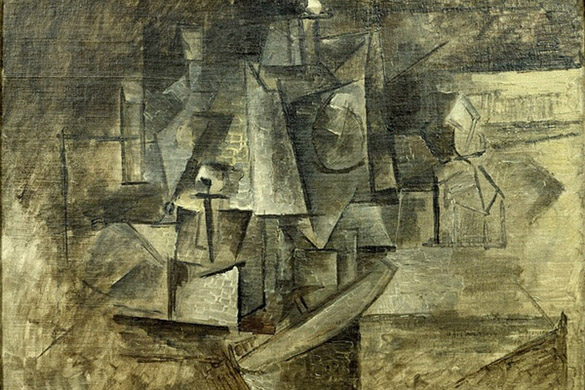
More here.
The Huguenots at 'Britain's Versailles'
August 11 2015

Picture: Buccleuch Estates
Boughton House in Northamptonshire is one of the greatest and most bejewelled stately homes in Britain. It belongs to the Duke of Buccleuch, and has been in his family since it was built by his ancestor Ralph Montagu, 1st Duke of Montagu. Apart from a few days in April, the house is only open in August.
I would strongly encourage you to go if you can. This year, the Duke (with curator Paul Boucher) has put on an exhibition all about the Huguenot origins of the house; it's one of the best stately home shows I've ever seen. The Duke's approach is a world away from the current National Trust fad of 'too much stuff', and shows how a fine house can and should be made accessible to visitors. Happily, you'll find no beanbags at Boughton. The house is a reminder of why these places are best looked after by people who live in them and care about them. And, in my experience, few stately home owners are as enthusiastic about their collections - and how to best share them with the public - than the current Duke of Buccleuch.
The story of the Huguenot influence on British taste is one I hadn't really appreciated before. (Huguenots by the way were a much persecuted group of Protestants in France). After Louis XIV issued the Edict of Fontainebleau in 1685, large numbers of Huguenots escaped persecution by coming to Britain, then a staunchly anti-Catholic country (so much so that soon afterwards, in 1688, we got rid of our Catholic king, James II).
The man who proved most welcoming to these Huguenot exiles in Britain was Ralph, 1st Duke of Montagu, sometime British ambassador to French. An enthusiastic Francophile, he created at Montagu House in London (now the site of the British Museum) and at Boughton in Northamptonshire not only a large houses in the latest French style, but also mini French Huguenot courts, where French was spoken and scores of French craftsmen produced paintings and furniture that still survive to this day. It was largely thanks to Montagu's support that so much French artistic taste began to enter the English aesthetic in the late 17th Century. (It's also thanks to the Huguenots, by the way, that we have oxtail soup in Britain; at the time, Huguenots in London were so poor they could only afford to make soup from butchers' discarded tails. Somehow, the taste caught on).
The extraordinary thing at Boughton is how intact the house and collections have remained. You can walk around more or less as you would have done at the turn of the 18th Century. There are, for example, over 50 flower paintings by the Huguenot painter Jean-Bapstiste Monnoyer, and the complete accounts survive to tell us who made what, and how much they charged. Other treasures on display include the first piece of music printed in Britain, and the first A-Z of London - both printed by Huguenots. The show is also a reminder of how, culturally as well as economically, immigration can be far more beneficial than many think.
So, hurrah for the 1st Duke of Montagu. You can find more info on how to visit Boughton here. And here below is the press release that accompanies the exhibition. If you go, do drop into the church at Warkton nearby, which has a series of exquisite marbles by Roubiliac (who of course was a Huguenot).
A significant collection of Huguenot artwork and craftsmanship will go on display in Northamptonshire on the 300th anniversary of the death of the group’s persecutor, Louis XIV of France.
Boughton House, known as the English Versailles, will host a summer exhibition of works by Huguenot migrants to Britain, three centuries on from the death of the French monarch who denied their religious and political rights by revoking the Edict of Nantes, leading to their exodus from the nation.
Highlights of the exhibition include the first piece of music ever printed in this country (a set of French Chansons by Lassus), a selection of Isaac Oliver’s celebrated jewel-sized portraits and the first A-Z of London, by Jean Rocque.
Paul Boucher, the exhibition’s curator, said: “This significant new exhibition celebrates how the historic influx of skilled Huguenot migrants to Britain transformed the cultural life of our nation. Beginning in the House’s dramatic unfinished wing, the story will then continue through to the exhibition in the Steward’s Hall.”
Boughton, the Northamptonshire home of the Duke of Buccleuch, is also home to a stunning array of Huguenot paintings, furniture, maps, armoury, porcelain, music and silver, which form part of the celebrated Buccleuch Art Collection, and many of which were commissioned by Ralph, the 1st Duke of Montagu in the 17th and 18th centuries.
Tours of the House will run every day during the exhibition and will highlight Boughton’s many examples of Huguenot craftsmanship on permanent display.
Paul added: “Other than its sheer scale and diversity, what’s remarkable about this collection is that many of the items are still housed within the surroundings for which they were purchased, making for a truly immersive experience.”
The Buccleuch Art Collection, much of which resides at Boughton House and within the Duke of Buccleuch’s Scottish residences, Bowhill House and Drumlanrig Castle, encompasses more than 50,000 objects, including a vast library and archive.
The special Huguenot Summer exhibition will run from August 1st - 31st at Boughton House during the Estate’s summer opening season. House and/or gardens ticket holders will gain free entry into the exhibition, which will also be open to arranged group visits throughout July and September, by appointment.
In nearby Warkton, visitors will be able to see the newly restored Montagu monuments at St Edmund's Church. These include the sculptures in Carrara marble by the Huguenot Louis François Roubiliac, one of the greatest sculptors ever to work in England. Among his other notable memorials are those to Shakespeare, Garrick, Isaac Newton and Handel in Westminster Abbey. The church will be open Monday - Saturday from 10am - 2pm throughout August.
Picasso yacht seizure
August 10 2015

Picture: Guardian
Here's a curious story - a picture by Picasso apparently valued at EUR25m has been seized on a yacht in French waters. The picture is subject to a Spanish export ban, on account of its cultural importance in Spain. But it was seized by French customs officers, who found with it a document from the Spanish government refusing its export. Oops.
That said, regular readers will remember that sometimes these 'illegal export' stories aren't always what they seem.
The Picasso in question belongs to Jaime Botin, part of the Santander banking dynasty. He bought the picture in 1977 outside Spain - and says it was never a part of Spain's artistic heritage. All of which is moot, for in Spain any picture that has been there for even a short period, and worth even one Euro, must apply for an export licence - which can be denied on any grounds.
Anyway, the moral of the story surely is - don't keep a Picasso on your yacht.
Update - ABC News reports that:
Mr Botin, 79, had been trying since 2012 to obtain authorisation to export the painting, but the culture ministry refused because there was "no similar work on Spanish territory" from the same period in Picasso's life.
In other words, the Spanish authorities decided to keep the picture in Spain simply because they liked it, and thought that there should be a picture from that period of Picasso's life retained in Spain. It has effectively been nationalised.
Rimini panel acquired by the National Gallery (eventually)
August 10 2015

Picture: National Gallery
The National Gallery in London has announced an innovative way to acquire the above picture by Giovanni da Rimini, which was painted in 1292-1336. Recently sold by the Duke of Northumberland at Sotheby's for £5.7m, the panel had been at risk of being exported from the UK permanently. But the Gallery has struck a deal with the US collector Ronald S. Lauder which goes like this:
American businessman, philanthropist, and art collector, Ronald S Lauder, has now stepped in to provide the funding to enable the painting to be bought by the National Gallery. The 52.5 x 34.3 cm panel will be loaned to him for his lifetime. It has, however, been agreed that 'Scenes from the Lives of the Virgin and other Saints' will return regularly to Trafalgar Square during this period – this will initially be in 2017 – and then up to once every three years after that. At the end of the loan the painting will return to the National Gallery permanently.
While few could doubt the picture's importance or value, it was always likely that a public appeal for the Rimini would have proved a hard task. So it seems to me that this deal is an excellent way of acquiring the picture in a time of limited funds. Well done to all involved.
More here.
