


New Titian discovery
May 8 2015

Picture: Your Paintings
Here's a big one; conservators cleaning the above Portrait of a Lady, previously catalogued as 'Follower of Titian', have not only found a better than expected painting, but also what appears to be Titian's signature (below).
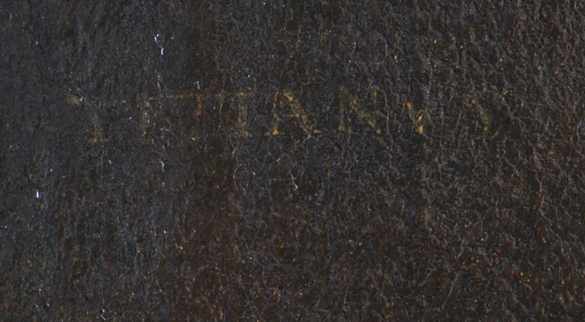
The painting belongs to English Heritage, as part of the Wellington Collection at Apsley House in London. An x-ray of the painting revealed an unfinished Titian composition beneath the portrait.
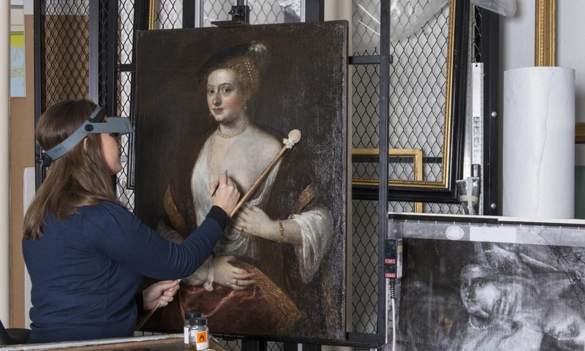
More details here.
I don't think I ever remember seeing it on display at Apsley House.
Leading art investment fund wound up
May 8 2015

Picture: The Fine Art Fund
There's an interesting snippet in the FT from Georgina Adam, reporting that one of the leading art investment funds is to be closed:
The Fine Art Fund is winding down its first fund (started in 2005/06) and, says director Philip Hoffman, “has returned all the initial capital to investors”. Over the next three years, it will sell off the last nine works in that fund. Returns are expected to be between 4 and 7 per cent net, says Hoffman, who explains that the result has been “dragged down by sluggish yields” on Old Master paintings.
This outcome is disappointing, says Michael Plummer, of art investment firm Artvest: “Expectations are according to risk, and art falls between ultra-safe US treasuries with no interest and private equity or venture capital investments at 20 per cent, so investors could have expected a result in the teens. When you consider that the period the fund covered saw the greatest growth in value the art market has ever known, they could have expected better.”
Regular readers will know I often caution about seeing art as an investment in the short term, which is the sort of horizon investment funds like this must work on. The problem is not that paintings, even Old Masters, don't go up in value over even the short term, but that the market is so illiquid. You need to be sure of making in excess of 30% profit on a painting to take care of just the transaction fees. Add in the fees an investment fund charges, and it is very difficult to make short term gains on Old Masters. Unless you're in the sleeper game of course, but that is a whole different ball game, and the risk factor goes through the roof. So remember, even though Old Masters are a useful medium to long term store of value, you should first buy art because you like it.
X-raying Rubens' 'The Fur'
May 8 2015

Picture: Codart
One of the exhibits in the Rubenshuis Museum's excellent new exhibition, Rubens in Private is the portrait of Rubens' second wife known as 'The Fur'. It shows Helena Fourment on a plain background wrapped in a fur coat. But an x-ray of the painting shows that there was originally a fountain in the background. The Codart website gives further details on the fountain:
It was a two-level fountain and reached to Helena’s shoulders, with the base adorned with a lion’s head, water streaming from its mouth. Of particular note is the sculpture on the pedestal of the fountain, which is of a little boy urinating. These hidden elements gave the portrait an explicit erotic connotation and that is most probably the reason why they were overpainted in a later stage.
Danger at the Biennale!
May 8 2015

Picture: Mirror
Guests at the Prada Venice Biennale party got a little wet when the pontoon collapsed into the Grand Canal. Nobody was injured. More here.
Clandon - one room survives
May 8 2015

Picture: National Trust
Well, sort of. The above room, precariously hanging on, is the 'Speaker's Room'. More here.
Politics
May 7 2015

Picture: Twitter
I thought I’d spend a few moments looking at the election here in the UK from the point of view of ‘the arts’. Regular readers may know that I was a Conservative adviser on the arts for some years, during the 2005 election, and the 2010 election. I know the arts minister, Ed Vaizey (above), reasonably well. I may be biased, but I think the Conservatives have been generally good for the arts sector.
First, I think Ed Vaizey has been an excellent arts minister. He has held the job for five years, and that’s provided a useful point of continuity for the sector. Too often, the job of arts minister is seen as a staging post for other jobs, and sometimes ministers don’t even last a year. Ed’s first task in 2010 was to try and persuade the Chancellor, George Osborne, not to savage arts funding in his emergency budget of that year. Although there was a headline cut of 30% for the Arts Council, this was not as bad as many feared, and many other departments fared worse. Major museums were affected similarly, although some ‘only’ had to deal with a 15% cut initially.
Having been involved in trying to ‘sell’ the arts to the Tory leadership in earlier times, I can attest to Ed Vaizey and Jeremy Hunt’s (Hunt was Secretary of State for Culture, before getting the Health job) success, and the difficulty of their challenge. Many Tory politicians, including some of the most senior, think the state should get the hell out of the arts and heritage. Leave it to the market and philanthropists, like they do in the US. That’s misguided, obviously, and it has taken some effort over the last 15 years to get the party to see the benefit of state support for the arts and heritage (and I'm proud to have played a small role in that). Free museum entry, for example, has been steadfastly maintained, when many said the Tories would abolish it. It has also been good for the arts in general that the government has adhered to the ‘arms length principle’, whereby Ministers stump up taxpayer cash, but leave the spending of it to semi-independent arts and heritage professionals. We’ve not seen a return to the ‘instrumentalism’ of New Labour days, when it was thought that the arts could be explicitly used to help health policy, for example.
Then there has been the dramatic benefits brought about by changes to the distribution of National Lottery good cause money. Under Labour, the original formula for distributing this money was altered - reducing it from 20% to 16.6% - and a significant chunk was diverted towards health and education spending. It was Conservative policy from 2005 onwards to reverse this change. Since 2010 this change has brought in over £400m in extra capital funding for the arts and heritage. That’s one of the reasons we’ve seen some excellent museum extensions, and many stellar acquisitions (another change was to allow Lottery funding to be used to acquire objects). Sadly, some museum directors prefer £1m in guaranteed annual funds to the £10m one-off grant they may have to fight for. But there is now unprecedented cash available for museum renovations, acquisitions and extensions.
No other party has said they will retain this increase to arts and heritage capital spending. And we should really commend ministers for seeing through the change. When I first helped draw up this policy in 2005, we commissioned an opinion poll, to see what the public made of the changes. We expected everyone to want to see arts funding rise. But the opposite answer came back; people would rather Lottery money was spent in health and eduction, on cancer machines and the like. We quickly buried the poll. Too often, those lambasting the government for not greatly increasing arts funding forget that there is no widespread popular appetite for such an increase.
So, broadly speaking, it seems to me that the arts have done reasonably well under this government, given the economic backdrop. Those bewailing the cuts must surely understand that it was never going to be the case that the arts would be protected, when, say, the police and health budgets might not. Recently, the director of London’s Wallace Collection, Christoph Vogtherr, launched an extraordinary attack on the government, accusing ministers of “systematically reducing funding and commitments to the arts”. He also convened a debate at the Wallace Collection to discuss “this destructive development”, where he made many gloomy predictions, warning of a wholesale ‘privatisation’ of the arts, the return of admission fees, and even the destruction and sale of paintings.
A nationally funded museum has never been used in such a political way, and I thought it was a muddled intervention. It was noticeable that few other national museum directors came to his support. While it is true that the Wallace’s annual ‘grant-in-aid’ has shrunk by about a third (from £4.2m in 2010/11 to £3m in 2013/14) the scale of the reduction is no worse than that endured by other government bodies. It is simply wrong to suggest that cuts in the UK are due to a ‘systematic’, Tory targeting of the arts. After all, Ed Miliband has explicitly said there is no more money for the arts (though he has said, splendidly, that he wants to get more art out of London museum basements, and lent to regional museums).
Then there is the uncomfortable truth that, despite the Wallace’s reduced grant, the museum actually has more income than ever before. In the first year of this government, the Wallace’s total income was £6.8m; last year it was £8.12m. The same is true for a surprising number of museums; grant-in-aid has declined, but overall income has risen. Even the Guardian, following on from a National Campaign for the Arts survey, had to concede recently: "One of the indicators that has risen most is the earned income of arts organisations."
Why? Because museums and arts organisations have been forced to go out and shake the tin - and have found that it works. In other words, the best response to government cuts is to try something different - not just whinge about it. As the Wallace coyly admits in its accounts, last year it enjoyed ‘a successful year of self-generated income’; restaurant takings, trading income and donations all rose. Visitor numbers are at a record level. The Collection’s major galleries have been refurbished for the first time in 30 years. The place is in better shape than it has ever been. But listening to Vogtherr, you’d think Isis were advancing down Oxford St.
I was surprised to see that Vogtherr’s remarks drew no response from the government. No. 10 (and the Tory campaign chief, Lynton Crosby) long ago decreed that ministers can talk only about the economy; there are no votes in museums. It was “long term economic plan” or nothing. The Conservative’s positive work in the arts (DCMS, by the way, never had any Lib Dem ministers) must thus be sacrificed to the most boring election slogan in history.
Here, then, is the real problem when it comes to arts funding, which I'm afraid is going to be under further pressure in the next parliament. Despite the view of those inside the sector, ‘the arts’ do not rank highly among the public when it comes to allocating government spending. That’s why local government can get away with outrageous cuts to regional museum budgets. Ultimately, I'm afriad this is the fault of those in the arts who have failed to make the wider case for public support. Government can't do everything.
Update - it's a massive Tory victory! I thought it would be much closer, and even suspected we'd get a Labour administration with support from other parties. The pollsters were way out, the poor Lib Dems are toast, and here in Scotland, the prospect of a second referendum has been almost a dead certainty. But the big question of course is; who will be the next Culture Secretary and Arts Minister?
Update II - in fact, the bigger question is; will there continue to be a seperate culture ministry?
New Leighton drawing discovered
May 6 2015
Video: Sotheby's
A newly discovered drawing by Lord Leighton (below), a study for his 'Flaming June', will be sold by Sotheby's as part of their 'Duchess' sale - featuring items from the estate of Mary, Duchess of Roxburgh.
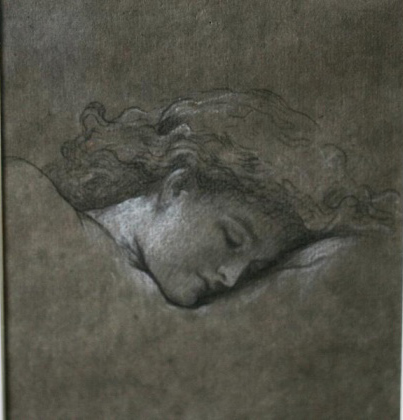
The sale is the subject of the above video, in which Sotheby's goes for the full 'Downton Abbey' effect. It works rather well.
Anyway, more details of the drawing here.
$363m
May 6 2015
Video: Sotheby's
Sotheby's New York Modern & Impressionist sale brought in $363m yesterday. The above featured Van Gogh made $66m, and sold to an Asian collector. More here.
Site-specific installations, Renaissance style
May 5 2015

Picture: TAN
I've written a piece for The Art Newspaper's new magazine supplement for the Venice Biennale. It's a handsome publication, and well worth buying if you're Venice-bound. Many of the articles are also online, including mine on (naturally) some of the more Old Master-y things to see in Venice; I focused on five works that remain in their original locations. More here.
Apologies...
May 5 2015
There have been no posts today - sorry about that. I'm on the way back to Edinburgh from London, where I was showing some pictures to various experts. I can't say what the pictures were here, but happily all went well. Some of them are headed to museums, so I should be able to tell you more soon.
I've been working on some of the pictures for what seems like an age. You can imagine the relief when years of 'is it or isn't it?' anxiousness finally comes to an end. I realise this might sound trite, but the most rewarding aspect is the feeling that you've somehow done justice to the artist concerned. Regular readers may remember Ernst van der Wetering discussing the same reaction, in relation to Rembrandt.
London mid-season OMP sales
May 4 2015

Picture: Sotheby's
The 'mid-season' Old Master sales were held in London last week, and one or two prices caught my eye. The above Virgin and Child was offered at Sotheby's as 'Workshop of Murillo', with only one enticing line of cataloguing; 'This appears to be a unique composition'. The estimate was £15,000-£20,000, and I wasn't surprised to see it make £269,000 (inc. premium).
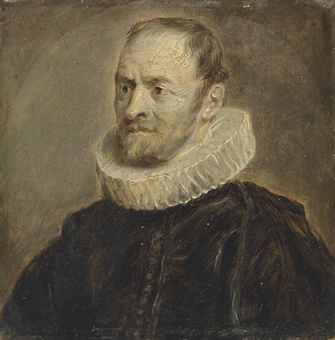
At Christie's South Kensingon, the above 'Follower of Van Dyck' made £104,500 against an estimate of £3,000-£5,000. It was the second time I had seen the picture at auction (it came up about a year ago, in a minor UK sale, if I recall correctly), but the first time I had seen it in the flesh. It is plainly a copy, and the speculative high price is all the more suprising when we consider that the original (below), of which there can be no doubt, sold in 2010 at Sotheby's in New York, for $1.53m.
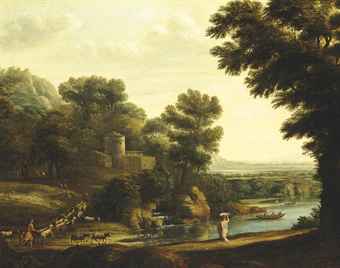
The only picture I bid on last week - but alas unsuccessfully - was the below 'Follower of Claude', which made £206,500 against an estimate of £7,000-£10,000. Neither landscapes nor Claude come within my limited area of expertise, but I thought the picture looked right for early Claude. It had been rejected as the work of an imitator in the 1961 Claude catalogue raisonné. We may yet see it again, as the real thing.
Clandon Park destroyed by fire (ctd.)
April 30 2015

Pictures: NT/BBC
The National Trust have some photos of the devastation inside the house here. And the BBC have some more too, here. The photo above shows the marble hall, and below is how it was before. Let us hope that the Francis Barlow Cassowary picture was in fact saved.

The image below shows a portrait from Clandon which had been cut out of its frame by quick thinking members of the fire brigade. This is very heartening news to hear, and raises hopes that many other pictures might have been saved too. The Hogarth/Thornhill I mentioned below was, however, apparently set into a wall - so we must wait to hear what happened to that.

Update - a reader writes:
I work for the fire service doing fire safety, it never ceases to amaze me how little regard is given to the potential losses should a fire happen in these old properties.
The level of fire resistance and hidden voids that fire exploits to spread means we have practically no chance of saving a building. Consider the fires at Winsor Castle, and more recently the Macintosh.
Fire safety may not be very exciting (far from it!) but a bit of common sense and pre-planning can help to save the mobile treasures such as pictures and tapestries. Investment in fire stopping will help contain a fire in one area (macintosh) and allow the local fire service to save more and tackle the blaze.
Excellent points.
Update II - The National Trust has said that one of the Barlows was saved, and also the Hogarth Thornill House of Commons portrait. Overall, however, it is looking exceptionally bleak.
What happens next is anyone's guess. Will the Trust aim to restore the house? My instinct is that they won't. Much depends of course on things like insurance. But all the noises one hears from the Trust these days, whether it is beanbags at Ickworth, or the new Chairman, Tim Parker, and Dame Helen Ghosh keen to say that the Trust is not in favour of acquiring any more 18th Century mansions, suggests that the leadership's heart won't be in it.
Clandon Park destroyed by fire
April 30 2015
Video: NPAS Redhill
Clandon Park, a National Trust property in Surrey, has been destroyed by fire. The initial reports were that one wing had caught fire, and the BBC is still reporting that 'at least one wing' has been gutted. But as the above aerial footage shows, the entire interior has gone. It seems extraordinary that the fire spread so extensively, and was not able to be controlled, despite the presence of 80 firefighters. Nobody was injured.
It looks, from the image below, that the fire started to the right of the photo. It was reported at about 4pm, and apparently began in the basement.

But soon the whole house was aflame.


The early 18th Centuryhouse was the home of the Earls of Onslow, and was designed by the Venetian architect Giacomo Leoni. Three members of the Onslow family were Speakers of the House of Commons. From the outside, the house was not one of the most spectacular in Britain, but the interiors were as lavish as any you might find, including the marble hall.

The house contained many fine treasures, including a state bed.

News reports described items being removed and being placed on the lawn to be 'wrapped in bubble wrap', so happily some things were salvaged. But given the speed with which things happened, doubtless many important works have been lost. Well done to those who were bravely involved in the rescue operation.


Having a look at the online Your Paintings database, I see the pictures included; a Wright of Derby, a large Zoffany:

And a famous picture by both Hogarth and Thornhill of Speaker Arthur Onslow talking in the Commons to Sir Robert Walpole.

I seem to remember, when I visited a couple of years ago, that there were more pictures than I can see now on the Your Paintings site - perhaps there were further works on loan.
The last serious fire like this at a Trust property was Uppark, back in 1989. Then, the Trust carried out an extraordinary restoration, and the house was re-opened in 1995. Although the first floor and the garret floor (where the fire started) were destroyed, and collapsed into the ground floor, the walls of the ground floor largely escpaed serious damage, allowing the restoration to go ahead. Looking at the latest photos from Clandon - and the fact that the fire started in the basement - I'm not sure we can expect that this time. What should be done?

Update - a reader tells me that six important paintings by Francis Barlow have been lost, as well as the series of Mortlake tapestries.
Update II - it's as bad as I feared. Dame Helen Ghosh has given a statement saying the house is 'essentially a shell'. More here.

Ramsay's portrait of Bonnie Prince Charlie - official!
April 29 2015

Picture: BG/Earl of Wemyss
I'm off to London today to give a lecture on Jacobite portraits. (Greetings from the train, as we pass through York: the Minster is looking very fine today, and in the sidings - treat of treats - is a steam train). I was checking a few dates for my talk last night, and found, wonderfully, that the Oxford Dictionary of National Biography entry for Allan Ramsay has been updated to include his newly discovered portrait of Bonnie Prince Charlie (above, the one I made a TV programme about last year). Here is the new paragraph:
Ramsay never forgot Scotland and three visits he made between 1745 and 1748 may serve to chart his social progress. He was in Edinburgh when the Young Pretender entered on 16 September 1745 and when the Guse-Pye house was briefly threatened as a site of strategic importance; but during this visit of perhaps three months he displayed a practical tolerance towards his sitters, who included the wife of the solicitor-general, Mrs Robert Dundas, and Lord and Lady Ogilvy, the most enthusiastic Jacobites (all in priv. colls.). It was on this visit to Edinburgh that Ramsay also painted Charles Edward, the Young Pretender, most probably in October 1745. The portrait, which is in the collection of the earl of Wemyss, was categorically identified as a likeness of Charles in 2014. The only known likeness of the Young Pretender made while he was in Britain, it was engraved by Robert Strange and became an important image of Jacobite propaganda in 1745–6.
I didn't expect the DNB to move this quickly, so I'm delighted.
Guffwatch - Biennale edition
April 29 2015
Guffwatch - Biennale edition
April 29 2015

Picture: Spectator
In The Spectator, Jonathan Meades takes a sharp aim at the sort of guff we're likely to find at this year's Venice Biennale. He lays the blame on the new breed of 'curators':
Curators were, till a generation or so ago, urbane historians of the renaissance or donnish scholars of the Beaker people. The dusty smell of muniments rooms hung about them. Today they are — well, what are they? Achingly hip neophiliacs who have mastered the peculiar illiteracy that comes from having been the willing victims of critical theory, cultural studies and art history, which, as we all know, begins with Duchamp — and ends with him too. Where once museums and galleries were repositories of what already existed, they have mutated into stores of stuff commissioned by their amply funded curators who impose their pensée unique upon a public too timid to protest that this is a load of balls. That taste is of course avant garde — the thoroughly conventionsalised, institutionalised art of the establishment.
Curators have moved from the passive to the active. From being receptive to what is actually made to being controlling. From accepting random expressions of individual creativity that belong to no ‘school’ to proposing taxonomies and ordering up ‘site-specific’ works: where creation ends and curation begins is moot. The spectre of ‘collaboration’ looms. And so, too, does that of the century-old modernism and the anti-establishment posturing that is de rigueur throughout the establishment. This consensual frivolity is, of course, taken seriously; there can be no more damning proof than the risibly self-important language that the curatocracy employs to explain installations so mute they are meaningless. It is, laughably, called ‘art writing’: ‘…on the one hand cultural productions are symptomatic of these relations, while on the other analytic of them — having the potential of intervention and critique, again with a specific placement and angle, or, if you will, method of intervention and mode of address.’
No. Me neither. Curator shall speak unto curator.
Caravaggio - the comic!
April 28 2015

Picture: Ben Street
Ben Street alerts us, via Twitter, to the above comic book being advertised in France. Below is a page from the inside (link here). Clearly, all art history should be illustrated thus.
Anyone want to draw Van Dyck for me?

Update - Ben points us to a comic biography of Rembrandt.
'Spot the fake' at Dulwich Picture Gallery (ctd.)
April 28 2015

Picture: BBC/Dulwich Art Gallery
In January, Dulwich Picture Gallery hung a fake painting in place of one of their masterpieces, and invited visitors to see if they could identify it. I thought it was a good idea - anything to encourage close-looking. Now they've revealed which picture the fake was; Fragonard's Young Woman. More here.
Tory blow to antiques trade?
April 27 2015

Picture: BG (miniature by John Smart at Cincinnati Art Museum)
Ivan Macquisten in The Antiques Trade Gazette reports that the Conservative party has pledged to ban entirely the trade in antique ivory. This is a reversal of their former position, which was (quite rightly) to ban ivory trading but to make a concession for that ivory which is clearly antique, such as in 18th Century portrait miniatures like the one above, by John Smart.
The ATG reports that the latest announcement was made by Conservative campaign headquarters, and not ministers, who have been supportive of the art market. Since it is a daft position, I'm sure it's a mistake. But it might not be. In which case, either buy all the miniatures you want to now, before the international market ends, or, similarly, sell.
Update - a reader writes:
This is utterly absurd. Obviously antique miniatures came into being long before there was a threat to elephant survival and the continued trade in them would have no bearing on this whatsoever. It is a classic case of using a sledgehammer to crack a nut. Or do the Conservatives think they can grab votes from the Greens with this daft idea?
Update II - another reader writes:
Thank you for that pointer to the article in the ATG about the conservative position on ivory. Let us hope it is a mistake.
I have just been cataloguing a portrait for a forthcoming auction that has an important gilt artist-designed frame dating from 1868-69. One of its most distinctive and attractive features is a row of four ivory paterae inset diagonally across the corner butt joints. The sale room took the decision to remove the ivory and have it replaced with replica material so that the portrait could be sent for viewing in the US. Had they not done so, they tell me that there was a very real possibility that the frame would have been destroyed at immigration.
Surely - considering the contribution that the art trade makes to the UK economy - the Conservatives should be lobbying for our sensible legislation to be adopted worldwide, rather than removing the exemption on ivory in historic works of art. It seems to me philistine, indeed an act of vandalism, to have to remove the ivory keys from a William Morris piano, for example, so that it can be exported from the UK to an overseas buyer. An international convention could be adopted that would make it quite clear that it has no wish to endanger twenty-first century elephants, but cannot see how banning the antique use of ivory would help them.
Bacon self-portraits 're-discovered'
April 27 2015

Picture: BBC
When is a 'discovery' not a discovery? When the pictures have been known about all along.
Still, today's Bacon 're-discovery' story is a good bit of PR-ing from Sotheby's [via the BBC]:
Two self-portraits by Francis Bacon are going on public display for the first time after being rediscovered in a private collection, before being sold.
Although experts knew the works by the late painter existed, they had no idea who had bought them.
Descendants of the original owner have decided to sell the paintings, which are expected to fetch up to £15m each.
The artworks are titled Self-Portrait 1975 and Three Studies for Self-Portrait (1980).
A Bacon painting featuring his friend and fellow artist Lucian Freud, became the most expensive artwork ever sold at auction when it fetched $142m (£89m) in New York in 2013.
Oliver Barker, Sotheby's senior international specialist in contemporary art, described the discovery of the portraits as "a pretty extraordinary collecting moment".
"(Art dealer) Marlborough Fine Art kept a photographic archive and so both of these paintings appeared in a book on Bacon's self-portraits, but apart from being reproduced in books they've not been seen," he said.
"We knew of the existence of the paintings but simply had no idea where they could be. The first time I saw these paintings it was such a wonderful awakening. They're both so luminous."
