


Optimism (ctd.)
April 4 2013

Picture: Sotheby's
The government has placed a temporary export ban on the Raphael drawing Head of an Apostle, sold from Chatsworth last year. It has to be done, I suppose, but if a UK museum manages to come up with the necessary £29.7m, I'll eat my trousers. Under our current export system, the more expensive an item is, the more likely it is to leave the country.
The 15th Century manuscript sold by Chatsworth in the same sale, for £3.8m, has also been temporarily blocked.
New Louvre director
April 3 2013

Picture: Tribune de l'Art
Didier Rykner has the scoop on the Louvre's new director, Jean-Luc Martinez. He is currently head of the museum's Greek and Roman antiquities department.
Is Google bringing us too close to art?
April 3 2013

Picture: Google Art Project/Albertina/detail from Durer's 1503, 'The Lare Piece of Turf'
There's an interesting, if slightly loopy article in The Daily Dot by art historian Professor James Elkins, about the effect of Google on art history:
[...] we are now seeing things more closely than we should, than we were ever meant to. That is particularly true in the case of artworks that are uploaded at very high resolutions—so high that we see them more closely than the artists ever intended.
No evidence is produced to back up the claim that 'artists' never intended us to look at their work close up, or under magnification. And no wonder, because it's mainly nonsense. True, Godfrey Kneller once upbraided someone for looking at his paintings too closely, by saying, 'my pictures are not for smelling of'. But I suspect that the likes of Holbein and Durer, not to mention miniaturists like Nicholas Hilliard, would have delighted in viewers admiring the intricate detail of their work. In any case, as an empiricist I always take as my starting point the artist Jonathan Richardson's maxim, in his treatise on connoisseurship:
In making our Remarks upon a Picture of a Drawing, we are only to consider what we Find, without any Regard to what, perhaps, the Master Intended. 'Tis commonly said of Commentators, that they discover more Beauties than the Author ever thought of.
In other words, beware of anyone who speaks of 'what the artist intended'. Professor Elkins' remarks strike a chord here on AHN, because regular readers will know that I place great emphasis on the art of close-looking. It's an essential part of learning to be a connoisseur, which in turn is an essential skill that all art historians and art lovers should aspire to practice. By only looking at pictures from afar, or as Professor Elkins assumes, 'as the artist intended', not only we can never learn the trademark techniques that make up an artist's technique, but we also lose part of our knowledge of how they worked. Understanding the craft of painting is vital, and enjoyable. Reducing artists to simple conjurors of composition, mere storytellers, is foolish.
Update - a reader writes:
Your comments in AHN on James Elkins' article about the Google Art Project are (as always) full of sense. I have in the past much enjoyed your reports of braving the disfavour of custodians at public galleries by your practice of close-looking, and I don't doubt its value.
It strikes me that Elkins may be making the wrong objection, as it were, and that Google's inadequacy as a tool for the connoisseur is not the short distance, but the lack of depth. One of the (many) reasons why Pointillist works (for example) are so much more striking in reality than in reproduction is that they aren't at all flat, and their colours leap and flash as the viewer moves round them.
However, this would not necessarily rule out the use of reproductions as a scholarly tool, if we could recover a sense of depth using raking light. I'm aware that this is already done by art and archaeology photographers, but it is now possible to take the practice beyond creating a series of photos taken at different times of day.
Perhaps I could direct your readers' attention to this web page, illustrating Hewlett Packard's use of 'reflectance imaging' for the ancient Antikythera mechanism.
If one clicks on these images, and uses the mouse to click-and-drag across the image, one can direct the raking light at will, to bring out particular details. You will see that it's very easy to control, and effective in bringing out detail. The technique has been extensively used by the different Antikythera teams to examine the artefact via the internet.
I would suppose that the same technique could also be used as a scholarly tool for the art historian, and would also enhance the experience of viewing a reproduction for all art-lovers. I'd be very interested in hearing your expert view on this.
There is, inevitably, a technical drawback: the camera-and-lighting rig used for the Antikythera mechanism is large and heavy and expensive, and too unwieldy to be brought into most galleries. Perhaps Google could be persuaded to help develop a smaller version. Or perhaps such a thing is already under way? That would be wonderful, though I'm not of course arguing that a photographic reproduction can be anything like a replacement for the object itself.
Fascinating. Google should clearly invest in one of these machines. And imagine sculpture too...
Adam de Colone and Adam de Colonia (ctd.)
April 2 2013

Picture: Burlington Magazine
Last year I mentioned an article in The Burlington Magazine by Rudi Ekkart, which seemed to show that the Scottish artist Adam de Colone and the Netherlandish painter Adam de Colonia were one and the same person. Well, it turns out that they weren't. In the latest issue of The Burlington (above, which focuses on British Art), former Director of the Scottish National Portrait Gallery, Duncan Thomson has shown that Ekkart missed out, or misunderstood, a crucial piece of evidence in relation to Adam de Colone's upbringing in Scotland, that is, a document that Colone signed for the Privy Council proving that he was born and raised in Scotland. This means that he cannot have been Adam de Colonia, who was brought up in Dordrecht and Rotterdam. I can't link to the letter here, but it's an important one to note for anyone interested in Scottish art history.
Pre-Raphaelites in the US
April 2 2013

Picture: New York Times
The Pre-Raphaelite exhibition at Washington's National Gallery (formerly at Tate Britain) has gone down like a cup of cold sick with Roberta Smith of the New York Times:
If you are genuinely interested in art and emerge from this show thinking that you have seen scores of outstanding paintings, you should spend more time studying other examples. For comparison the galleries adjacent to this exhibition contain two outstanding works by the Pre-Raphaelites’ French contemporaries, Eduard Manet’s “Dead Toreador” (probably 1864) and Paul Cézanne’s portrait of his father reading a newspaper (1866). Consider the simplicity, directness and mysteries of these paintings against the moralizing and endless intricacies of the Pre-Raphaelites. It is a contrast between the complex and the merely complicated.
Pre-Raphaelite art is a volatile, highly complicated mixture of questionable intentions, literary erudition, ironclad nostalgia, meticulous realism, lavish costumes and a prescient technicolor palette. The brotherhood was formed in 1848 by William Holman Hunt, John Everett Millais and Dante Gabriel Rossetti, three disgruntled students at the Royal Academy of Art. Barely 20, they were repelled by the decadence of art and society, much of which they ascribed to the Industrial Revolution.
For pastel fans...
April 2 2013

Picture: Alte Pinakothek, Munich
...allow me to direct you to a fine piece of research by Neil Jeffares, King of all things pastel, on a previously obscure sitter painted by La Tour, Elisabeth Ferrand.
Tate follows Kensington Palace display ethos
April 1 2013

Pictures: Anon.
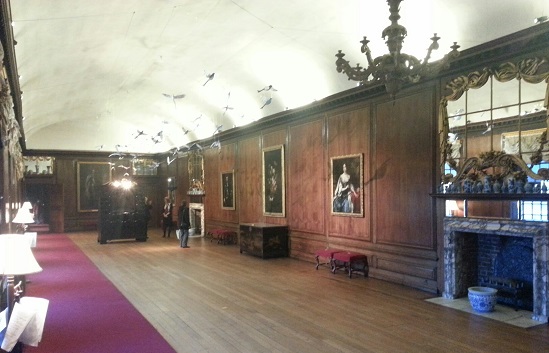
Disturbing news from Tate Britain. Senior managers and marketing staff have been so impressed by the new picture display at Kensington Palace that they're planning to copy it themselves. This means that the new hang of the 'historic collection' in Tate Britain's newly refurbished galleries, due to open this autumn, will use many of the features employed by Historic Royal Palaces in their £12m revamp of Kensington Palace.
For example, a nervous curator tells me that an order has been issued to re-write all picture labels along the lines of those now used at Kensington Palace. My source has sent me a photo from Kensington Palace of the sort of thing that is now in vogue (above), where George II is described as 'a bit boring'. They tell me:
It's been decided that labels like this are the best way of widening access to what is now called our 'old stuff'. The removal of any useful information from the labels for our recent 'Looking at the View' exhibition [as covered earlier on AHN here] was considered a success, so we've been told to use descriptive terms that are 'more relevant to a younger audience'. The new policy is, in portraits, to describe sitters as 'a bit dull', 'quite cool', and 'really fit'. The access team are still working on new terms to describe landscapes, but I've heard that 'totes amazeballs' was only narrowly rejected by the Future Label Forum.
More worrying still, I've been told that Tate managers were so impressed by the flock of flying and squawking paper seagulls in the picture gallery at Kensington Palace (below) that they've commissioned Jeff Koons to come up with a similar design for the Duveen galleries. The funding for the commission will come from savings realised by last year's curatorial redundancies, and by a new organic cafe, to be built in the space formerly occupied by Tate's photographic archive. Alarming...
Update - Check the date! Quite a few readers were fooled by this, but as a former Tate employee says:
Really enjoyed your April Fool - not really all that far from the truth!
Another reader couldn't quite believe that the label I showed from Kensington Palace was actually real:
It is very unkind of you to pretend that the Tate is following the Historic Royal Palaces in its moronic labelling, and that the example from Kensington Palace is real! Some of the more cynical among us might easily have believed you - so thank goodness it is 1 April!
One reader points out some of the information that should have been on the Kensington Palace label, but wasn't:
Your photo of the caption just shows how un-informative these are: visitors may wonder how Copley came to paint someone who died before he was born. As you probably are aware, unlike anyone less informed looking at the work in this context, the painting a copy by Copley of a work by an earlier artist, Morier.
Indeed. Or at least that is how the picture is catalogued on Your Paintings. I can't see any mention of the picture in Jules David Prown's catalogue raisonne of Copley's paintings.
One reader has volunteered to help Kensington Palace with their future label writing efforts:
"George II was punctual...." Perhaps that explains why they called him 'King George the second'.
The Grumpy Art Historian refers me to an alleged label writing exercise in advance of the Ashmolean Museum's re-opening. Says his source:
The labels that ended up in the final display had apparently been written, revised and dumbed down innumerable times thanks in large part to the efforts of the outside experts who even forbade the use of the word ‘century’; ‘too confusing for the general public’ was the message (there was, I gather, a rich moment when a curator asked at one of their regular public meetings ‘How then do I describe the 17th century?’; ‘the seventeen hundreds’ came the reply’).
A reader shares their view of the new Kensington Palace display:
I visited England last September and spent more than a week in London - had a ball, however the one disappointment was Kensington Palace. We visited after hearing that the whole place had been done up. We didn't enjoy the display theme - it was vaguely ridiculous and very distracting from the actual paintings and other pieces. As a comparison, Apsley House was fabulous.
Finally, another does so in a stronger vein:
My wife and I visited the palace last month, together with some of her German relatives, I couldn't believe the inept displays, and the even more inept descriptions & potted histories that accompanied them. It left our visitors much bemused, who couldn't understand why, with all our history, and the objects to accompany the story of it, we would choose to dress it in a manner more in keeping with the windows of a department store.
I agree with both the above comments. The new interior display at Kensington Palace is nothing short of disastrous, and, worse, a monumental waste of money. With its daft labels such as that shown above, swirly carpets, constant drive-you-mad sound recordings, and an overly liberal use of bargain basement bunting, it seems deliberately aimed at four year olds. And like nanny it insists that everyone must be spoon fed. There is no concession to anyone with an intellectual age greater than about ten. It isn't possible to enjoy the paintings on display without being distracted by hidden speakers blaring woefully scripted 'whispers', as imagined 18th Century courtiers whitter on about their corsets, or something similarly tedious. Every other wall is graffiti-d with vapid text. There is a constant belittling of the palace and its history, to the extent that a building built for majesty is now utterly devoid of it. As I overheard one visitor saying, it's like being in a bad dream.
Historic Royal Palaces [HRP] so often gets things right, and has in the past been excellent at combining accessibility with serious historical presentation, and preservation. The new 'Secrets of the Bedchamber' exhibition at Hampton Court Palace is great fun, but also conveys some serious historical messages. But at Kensington Palace HRP have gone completely mad. Bringing history to life for children is commendable, but not to the extent that it takes second or even third place in a nauseating theme park. I chose to ridicule the label of George II because it tells us all we need to know about the failure of the Kensington Palace approach. You might have thought that a child's interest would be piqued by George's most memorable achievement; that he was the last English King to lead his troops into battle. Indeed, the painting on display shows him doing this, at Dettingen. But there is no mention of this on the label, where instead we are told that he was merely 'a bit boring'. This dumb approach to history isn't just daft, it's treason.
OPEN opens
April 1 2013

Picture: PCF
More good news from the Public Catalogue Foundation - they have secured the initial funding (of £125,000 from the Arts Council - well done them) needed to establish OPEN, the Oil Painting Expert Network. OPEN is intended to provide specialist art historical advice to collections which don't have such expertise in house.
The opportunities provided by OPEN are significant - of the 210,000 paintings (80% of which are in storage) photographed and published online by the Public Catalogue Foundation, 30,000 have no artistic attribution at all. That's one in seven. The combination of expertise and new high-quality digital images (many of paintings which have never been photographed before) should mean that we are able to make many more discoveries like the Van Dyck recently found at the Bowes Museum. I hope that OPEN will also be able to provide advice on other aspects of collections, such as conservation.
Regular readers will remember me lobbying for the creation of such a scheme for some time, first at a conference at the National Gallery in 2011, and also in a book published by Museums etc., Museums and the Disposal Debate. The PCF have kindly asked me to be on the steering group to help set up the network. You can read more about the OPEN announcement in my newsletter for the PCF here.
Can you paint better than this?
April 1 2013

Picture: Mail
A new TV series is to find Britain's best amateur portraitist. The series, on Sky Arts, will have a prize of £10,000 and a commission to paint the novelist Hilary Mantel. One of the judges will be Sandy Nairne, director of the National Portrait Gallery, who recently chose Paul Emsley to paint the Duchess of Cambridge. Don't hold your breath.
Death of the galleries
March 30 2013

Picture: Faygate, via Flickr
Interesting take on the decline of contemporary art galleries from Jerry Saltz in The New York Times. He says the ramifications aren't just economic, but artistic:
Christie’s, in partnership with a company called Y&S, now provides “a venue for emerging artists not yet represented by galleries” and “creates a bridge between young artists and a young audience.” Translation: “We’re cutting out dealers. Come on down. Make a killing.” Thus, unrepresented artists go straight to auction. Work that is sold this way exists only in collector circles. No other artist gets to see it, engage with it, think about it. The public functions of the gallery space and its proprietors—curation, juxtaposition, development—are bypassed and eliminated. All these people supposedly want to help artists, and they probably think they are doing so. But they’re engaged in something else, and it makes being around art less special. Too many of the buyers keep their purchases in storage, in crates, awaiting resale. Mediocre Chinese photorealism has become a tradeable packaged good.
Simon Schama at the new Rijksmuseum
March 30 2013

Picture: Wikipedia
Simon Schama has an interesting essay in the FT on the soon to open Rijksmuseum (shut for ten years!), which henceforth is to be known as 'The Museum of the Netherlands'. He tells us that the museum is to have a new display ethos, with galleries including numerous objects from a related period, from paintings to cutlery, rather like the V&A:
What has been done with the museum is less a restoration with some fancy contemporary design than the inauguration of a curatorial revolution. When you see those early Rembrandts or the great mannerist “Massacre of the Innocents” of Cornelis van Haarlem with its ballet of twisting rumps, you will also encounter, as would those who would first have seen them, the silver, weapons and cabinets that were the furniture of the culture that made those pictures possible. You will enter the historical world of the Netherlands at a particular moment. And, because the objects are housed in frameless, edgeless displays in which the glass is of a stunning invisibility, nothing in one’s field of vision separates images from artefacts.
The new displays mean that:
History and art have their natural companionship restored, for – although historians condescendingly suppose images to be “soft” evidence of the past, and art historians suspect historians of obtuse philistinism – the truth is, as Huizinga knew, they need each other to reconstruct the reality of lost worlds. History without the eloquence of images is blind; art without the testimony of texts is deaf.
Too true.
This Easter, I am wearing...
March 30 2013

Picture: BG
Happy Easter everyone!
Update - a reader writes:
hahahahah omg that shirt is great!!
More on Mahon's £10m 'Caravaggio'
March 29 2013

Picture: TAN
The Art Newspaper has an interesting update on Sir Denis Mahon's 2006 'Caravaggio' discovery. Regular readers will remember that Sir Denis bought it at Sotheby's, where it was called 'after Caravaggio', and Sotheby's are now being sued by the then vendor. I'm reliably informed that the picture isn't in fact by Caravaggio, but a competent copy.
However, TAN reports that the picture was jointly owned by Sir Denis and Orietta Adam, his close friend, and valued for insurance and export licence purposes at £10m. Which makes one wonder what sort of inheritance tax liability was levied on Sir Denis' half-share, whoever he left it to. 40% of £5m is quite a hit, especially if the picture is indeed a copy worth not much more than the £50,000 he paid for it.
In the Prado gift shop...
March 29 2013

Picture: BG
...a possible clue as to why the museum was so keen to over-hype their curious copy of the Mona Lisa.
Yesterday...
March 29 2013

Picture: BG
Apologies for the lack of service yesterday, I went to the Prado for a final visit to the excellent exhibition, 'The Young Van Dyck', along with Philip Mould. Above is a photo of Philip beside a fine study [Private Collection] for 'Suffer Little Children Come unto Me' [National Gallery of Canada], which he discovered in 1993 in a minor auction in London. The study's inclusion in the exhibition was a nice endorsement of how the trade can advance art history.
I'm hoping to have a fuller review of the exhibition here soon. If you haven't yet been, you have two days to go!
TEFAF joins Sotheby's in China
March 27 2013

Picture: The Economist/AFP
Like most art dealers and auction houses, TEFAF [The European Fine Art Fair, at Maastricht] has for some time been trying to 'get more Chinese' to come and sample its wares. Now, however, they've decided to have a TEFAF fair in China itself, and in collaboration with Sotheby's. Not so long ago, TEFAF members used to resist vigorously any involvement with the main auction houses. But the new partnership is a sign of how things have changed, and the increasing dominance of auctioneers. More details on TEFAF Beijing in the Antiques Trade Gazette here.
Meanwhile, China Daily has an interesting take on a recent selling exhibition at Sotheby's New York of Chinese art, seeing it as a move by the auction house into dealer territory:
The art work with fixed prices rather than being offered in the traditional auction is an attempt by Sotheby's to gain new business at time its auction revenue has declined. It's also a move into an area traditionally run by private art galleries: sales exhibitions. And it's drawing criticism from some gallery owners who deal primarily in Asian art.
"This will be an uphill battle," said Martha Sutherland, principal of M. Sutherland Fine Arts gallery. "We are in the bespoke business and we offer the personal touch." [...]
In 2012, Sotheby's reported total revenue of $768.5 million, which included auction and private sales. That was a decline of $63.3 million, or 8 percent, from 2011. The decrease was mainly caused by a $79.4 million, or 11 percent, drop in auction-commission revenue. Private sales were a record $906.5 million, an 11 percent increase from $814.6 million in 2011.
Henry Howard-Sneyd, Sotheby's vice-chairman of, Asian art, said the auction house doesn't see its move into sales exhibitions as a threat to galleries.
"There are new galleries being formed and galleries closing down all the time," he said. "It's a constant cycle. I think Sotheby's is being one of those new faces in that market place. It's just part of the ongoing innovation and creativity of the contemporary art market. "
Finally, in the Old Master world, dealer Johnny Van Haeften (in an interview with Art History Abroad) also sees increasing auction house dominance, and says the future is bleak for Old Master dealers:
Auction houses are doing so many private treaty sales now; what sort of impact do you think that has on dealers?
I think it’s one of the greatest threats to the dealing world. Christie’s and Sotheby’s have both announced that 20% of their turnover comes from private sales, which is quite scary.
Do you think it’s affected the quality of their auctions?
Certainly the quality of the sales has reduced considerably, as has the quantity. The availability of pictures is diminishing, and it’s difficult for us to compete with them. There is an attraction that Christie’s and Sotheby’s offer – they say, ‘if you sell with us, it will be totally discreet and private and it won’t go to auction’, but if you go through a gallery, that would happen anyway. I suppose their main argument is that they have access to more clients.
What about the future of Old Master dealers?
I think it’s fairly bleak. As the availability declines, the cost price gets higher. But I think there will always be Old Master dealers and there will always be people who prefer to buy from dealers – as soon as they realise that at auction the price can only go up and at galleries it can only go down. We’ve noticed already this year, that buyers are starting to come back to galleries, because the intensity of the pressure to make up your mind by a certain time is not present in a gallery – you have a little bit longer, you can try it out in your home and you don’t have to take a risk, like a dealer buying a very dirty picture that doesn’t clean well and then being stuck with it. There always has been huge competition between the dealers and the auction houses, and there always will be.
As I've said before, there is only one way dealers can continue to compete with auction houses, given that we cannot out spend them or out market them, and that is to out think them. That's what makes it such fun.
A woman? Mon Dieu!
March 27 2013

Picture: Telegraph
They're having a row in France over the Louvre's new director.
Newly found Reni makes CHF 1.2m
March 27 2013

Picture: Gallerie Koller
A re-discovered Assumption by Guido Reni has been sold in Switzerland for CHF1.22m, against a CHF 120,000 reserve. More details here.
Really?
March 27 2013

Picture: CNN
CNN reports that the Gagosian Gallery is to have an exhibition of George W. Bush's paintings. Hard to believe. Still, Gagosian had to make up for the loss of Hirst and Koons somehow.
