


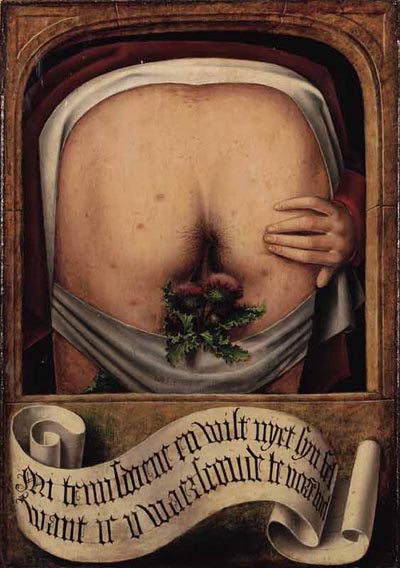
A naughty diptych
August 7 2012

Picture: Liege University
The clever folk over at WTFArtHistory have dug out this Flemish diptych, which warns people not to open it. To see why, click 'Read On'.
Robert Hughes
August 7 2012
Sad to read that Robert Hughes, the great art critic and art historian, has died. They always say that nobody ever builds a statue to a critic - but Hughes deserves one, if only for being one of the few influential people in the art world to dare say, 'this Emperor has no clothes'. Here he is with Jeff Koons.
What does an international culture summit do?
August 7 2012
Why do we value the arts? Why, in Britain and many other countries, does the state support them? Between 2004-6, I used to work in politics advising the Conservative party on arts and heritage policy. Even though being in opposition is obviously frustrating, we in the shadow DCMS [Department of Culture, Media and Sport] team set out some important policies which have since been implemented by the coalition government, such as increasing Lottery funding to the arts, heritage and sports. Perhaps most importantly, we managed to persuade the Conservative party (which in its history has displayed worrying signs of Philistinism) that the arts are worth supporting, period. (We also, I'm proud to say, managed to stop those planned 'Super Casinos').
A perennial discussion at the time was over how government should 'value' culture and the arts. Labour Culture ministers had figured out that the best way to squeeze money out of Gordon Brown was to present culture as a social tool, the so-called 'instrumental argument' by which you say that the arts can help cut crime and hospital waiting lists. We, on the other hand, argued that this was all fine but funding museums to tackle social problems diverted them from their core purpose, and that you should support the arts on their own merits (the so-called 'intrinsic argument'). There were endless seminars and thinktank pamphlets on the matter, in which people spoke in jargon-laden platitudes, the sort that make your brain hurt. Thankfully, this rather tedious debate has moved on, and most people in government these day are happy to fund culture simply because it's good, and people like it. As the Arts Council used to say in the old days, when the great Kenneth Clark was there; 'the best for the most'.
But it sounds as if the whole question is about to be re-opened, for in Edinburgh later this month there will be an 'International Culture Summit'. Say the organisers:
Culture ministers and leading commentators from around 40 countries around the world are set to gather next week for the Edinburgh International Culture Summit – the first-ever event of its kind.
Amid a global economic crisis, wars and revolutions, the Culture Summit will ask why culture remains important, explore its contribution to social and economic development and compare international approaches to promoting and supporting culture.
Though I wait with interest to see what answers the summit comes up with, I dread having to go through the whole 'why should the state support culture' argument all over again. You can get a glimpse of the quality of the discussions to be had in this 'think piece' by one of the organisers, Edinburgh Festival director Jonathan Mills, a man who clearly needs to study more history:
We have already begun to enter a period in history where no specific culture, ideology, theocracy or politics will be all pervasive or dominant. We are now living in world in which knowledge comes simultaneously from various, divergent technological, ethical, philosophical, and above all, cultural sources and locations.
In a world which is facing monumental challenges, especially in light of a series of recent, acute and on-going economic crises, a summit focussing on mutual cultural interests and shared human values is both timely and appropriate.
When judges decide attributions
August 6 2012

Picture: New York Times
Those allegedly fake Jackson Pollocks sold by Knoedler will soon be debated in a New York courtroom. In The New York Times, Patricia Cohen looks at what happens when judges have to decide on authenticity:
Of course judges and juries routinely decide between competing experts. As Ronald D. Spencer, an art law specialist, put it, “A judge will rule on medical malpractice even if he doesn’t know how to take out a gallstone.” When it comes to questions of authenticity, however, lawyers note that the courts and the art world weigh evidence differently.
Judges and juries have been thrust into the role of courtroom connoisseur. Legal experts say that, in general, litigants seek a ruling from the bench when the arguments primarily concern matters of law; juries are more apt to be requested when facts are in dispute.
In a seminal 1929 case involving the authenticity of a painting purportedly by Leonardo da Vinci [above], both a judge and jury got the chance to weigh in. The art dealer Joseph Duveen was sued by the owners of the painting, “La Belle Ferronnière,” for publicly calling it a copy. The jury included a real estate agent, a shirt manufacturer and a furniture upholsterer. Two artists were also on the panel and ended up on opposite sides of a hung jury.
With a deadlock on his hands, the New York State Supreme Court judge took the case back. He rejected Duveen’s argument that artistic attribution was not a question of fact that could be decided in a court of law but purely a matter of opinion, and ordered a second trial. Duveen ultimately settled with the owner. [...]
What previous rulings show, however, is that while judges and experts consider the same evidence — provenance, connoisseurship and forensic analyses — they tend to value it differently. For example judges tend to give added weight to the signature of an artist on the work, Mr. Spencer said, whereas experts rely more heavily on the connoisseur’s eye.
Juries have also gone their own way. In deciding the Duveen case in 1929, The New York Times reported, jurors reacted to the expert testimony by concluding that “the connoisseurs had given them little but an exotic vocabulary and a distrust for connoisseurs.”
The Duveen case picture was recently sold at auction as 'Follower of Leonardo'.
Update - a reader writes:
I was intrigued by the juxtaposition of your pieces on Lord Duveen's 1929 litigation and on the recently discovered painting of a female person, two infants and a lamb; I (seriously) hope the two are not related.
Me too!
'for a licle picture of 12 artichoks.... £00-02-00'
August 6 2012

Many fascinating new documents have gone online at 'The Art World in Britain 1660-1735', including a list of picture payments from the 3rd Earl of Leicester (who bought a still-life of artichokes for 2 shillings), and a spirited letter from Godfrey Kneller to a client who seems not to have liked one of his paintings.
More optimism. Bordering on Loonery.
August 6 2012

Picture: Daily Mail
I know it's August and, Olympics aside, there's not much news about - but this latest art 'discovery' really pushes the limits of credulity. How did it ever get taken seriously? Why are the media so easy to fool on art 'discoveries'? Above is a work claimed by its owner, Fiona McLaren, as a Leonardo - and not just any Leonardo. It is supposed to be Francis I's last commission from the artist, and shows not the Virgin and Child with St John the Baptist, as you and I might think, but Mary Magdalene with Jesus' son. The Daily Mail has the story:
The striking portrait, which shows woman embracing a young child, was nearly assigned to the rubbish tip on several occasions, but facing financial difficulties Ms McLaren, 59, from Scotland decided to take the painting to an expert for a valuation.
Auctioneer Harry Robertson, the director of Sotheby's in Scotland, gasped when he saw the art 23ins by 28ins work which had hung on a landing and in a bedroom in London for decades, before being transferred to Scotland when Ms McLaren and her mother moved into a farmhouse. 'I showed it to him [Mr Robertson] and he was staggered, speechless save for a sigh of exclamation,' said Ms McLaren, according to The People.
Mr Robertson took the work to London for further testing by specialists on old masters and next year the painting will be closely inspected by experts at the Hamilton Kerr Institute at the University of Cambridge, where it should be dated conclusively. [...]
Other experts have stated that the painting is at the very least from the da Vinci school. Professor Carlo Pedretti from the University of California said he thought it was by a Leonardo da Vinci pupil of a later generation, possibly the 16th century.
Ms McLaren said her father used to call the painting 'Madonna and Child with John the Baptist, but having spent a decade researching the history of the work, the nurse believes the painting is actually not the Virgin Mary with baby Jesus, but Mary Magdalene and her son. She thinks the true meaning of the artwork may have been disguised for centuries because such a work would have been considered heretic by the Roman Catholic Church. The Pope decreed the Virgin Mary should be illustrated in blue whereas Mary Magdalene had to be shown in red attire, as depicted in this painting.
Regular readers will know we've seen quite a few art history fantasies over the last few months. This, though, is the most fantastical of them all. The 'evidence' that this is by Leonardo goes as follows:
Indications of a da Vinci: 1. A similarity between the boy and child in his famous piece Madonna of the Rocks, 2. A distinctive 'v' shape in the middle of the woman's hairline reminiscent of that shown in the last supper, 3. The fleur-de-lys is often said to be a hidden emblem of the secretive Priory of Sion, 4. The area by the woman's shoulder is unfinished, common in da Vinci works, 5. A tracing of the figure in the Last Supper matches exactly the outline of the woman in this painting, 6. The baby's second toe is longer than the big toe - another classic da Vinci feature.
Yes, that classic Leonardo technique, the one we all looked out for in the recent National Gallery exhibition: the crap drawing of the toes. This mad story has made The Scotsman and The People, as well as The Daily Mail. A book will also be published, by a reputable publisher, Mainstream, which is part of the Random House group. The book will be available in hardback, paperback and e-book, suggesting the publisher thinks big things of their potential blockbuster. On their website, they describe the book thus:
Da Vinci’s Last Commission by Fiona McLaren is one of the most astonishing detective stories in the history of art. It is also a tale of the courage and tenacity of a woman who challenged the international art establishment, orthodox history and the Church in her quest for the truth.
There's even talk of a newspaper serialisation. How the hell did a respectable publisher fall for this barrel of palpable nonsense? And why are they publishing the book before the Hamilton Kerr have even begun their tests?
Now you might say, 'calm down Bendor - isn't this all harmless fun?' But actually, it isn't. The occassional fantasies are I suppose inevitable. But as readers, you and I deserve better of our newspapers and publishing houses than to read utter nonsense presented as 'news' or 'the most astonishing art detective story in the history of art', by clueless journalists and publishers who can't be bothered to pick up the phone and ask a real expert about the painting in question. (And even when they do ask an expert, then not understand what the expert is saying, as in this case with Carlo Pedretti, who said 'it's by a 16th C follower' - which means it isn't by Leonardo.)
We're now getting to the point where anyone can cobble together a few nutty facts, leap to conclusions, and make an outlandish claim that garners the world's media attention. Last month we had the Caravaggio hoo-ha. Before that we had the 'Bronte Sisters' portrait 'discovery', in which an auctioneer's error-strewn press release made it into The Daily Telegraph verbatim. Soon, newspaper readers and book buyers will see another 'art discovery', and think, 'oh another fantasy'. Genuine art historical discoveries will be like the boy who cried wolf; nobody will believe them anymore.
Titian and the restorer from hell
August 2 2012

Picture: National Gallery
Last week we had an interesting story about a Titian in Canada being re-attributed to the great master, following conservation and the removal of later over-paint. I discussed how important it is to fully understand condition before attributing pictures, and how a good picture in bad condition can often be judged merely as a bad picture by scholars.
I've always felt that a similar case to the Canada example might be Titian's Portrait of Vendramin Family, now at the National Gallery. Forever called 'Titian' (even by Charles I's top Titian connoisseur, Van Dyck, who once owned it), it is now labelled as 'Titian and Workshop' by the Gallery. You can zoom in on the painting here. The group of three awkward looking boys on the left are considered to be too weak to be by Titian himself, as are the two furthest on the right. The Gallery says they 'must be by the artist's workshop'.
It's just a hunch, but I'm not so sure. We know Titian employed studio assistants quite widely, but personally I find it hard to believe that he would have allowed five portraits to be painted so badly by his workshop, for what was obviously an important commission. If we are to find workshop assistance in such a picture, it is perhaps more likely to be in the drapery or background. In their present condition, the portraits in question (especailly the three on the left) are so awkward as to make one wonder why Titian would allow the picture to leave the studio looking like that, when the rest of it is so good by comparison.
It seems more likely to me that we are dealing here with a question of condition. The five children seem to have suffered so much damage over time that they now look clumsy, and it is thus impossible to make a firm attribution as they presently appear. Furthermore, I've just come across this interesting reference to the picture in the diary of Joseph Farington from 1818, when it belonged to the Duke of Northumberland. Farington records looking at the picture with the artist Benjamin West:
He sd. that picture was totally ruined by a Frenchman who was employed to clean it. He painted over it & substituted His heavy colours for the charming tints of Titian. Nothing remains of the original but a Candle stick & part of the upper corner of the right hand of the picture as seen when looking at it.
The picture was cleaned in the '70s, and much over-paint removed. But I'd love to know more about the condition of the three heads on the left, and the two on the right. One of National Gallery's excellent Technical Bulletins on the picture would be fascinating, with full paint analysis to determine what is and isn't original paint. I haven't looked at the picture with magnifiers and torches, but I'd be willing to place a bet that, at the very least, the three heads on the left are to a substantial degree damaged and re-painted by a later hand.
Restitution - Simpsons style
August 2 2012

Picture: The Simpsons
Three Pipe Problem alerts me to the last known appearance of the Czartoryski Raphael, on The Simpsons.
So much for that then
August 2 2012

Picture: Art Newspaper
There was great excitement last night when The Art Newspaper reported that the Polish Foreign Ministry had announced the re-discovery of Raphael's Portrait of a Young Man. The picture is perhaps the most famous 'lost' painting in the world since its disappearance after the war, when it had been looted from the Czartoryski family by the Germans. Viewers of the first series of 'Fake or Fortune?' may remember Fiona Bruce interviewing Prince Czartoryski about his frustrating hunt for the painting. The Art Newspaper said:
A spokesman for Poland's Ministry of Foreign Affairs' Office for the Restitution of Cultural Goods told the Polish media today (1 August) that he is confident the painting will be returned to Poland. “Most importantly, the work was not lost in the turmoil of the war. It has not been burnt or destroyed. It exists. It is safely waiting in a region of the world where the law favours us,” he said, declining to disclose in which country.
The same story was also reported in the Polish media. But alas, this morning The Art Newspaper carries an update, stating:
In a subsequent statement on its website the Ministry of Foreign Affairs has tried to calm expectations, saying: "We have no information as to where exactly the image is... however, we can confirm that [the ministry] continues to monitor all signals reaching us about the image's location."
So what's going on? It's unlike The Art Newspaper to break such a big story without getting everything thoroughly checked out. Rummaging around the Polish news sites, the story today is that some remarks by Professor Wojciech Kowalski, who is the Polish foreign ministry's adviser on the restitution of cultural objects, were 'misinterpreted'. Instead, he seems to have said that although he does not know where the painting is, he knows it hasn't been destroyed. Which of course sounds even more curious. And curiouser still, the Dziennik Polski reports that the picture has apparently been seen by a number of Italian art historians since the war. But nobody is prepared to say where it is. Huh.
Update - a reader writes:
Even the painting looks embarrassed.
'We came to London'
August 1 2012

Picture: National Gallery
A reader writes:
I took your advice and went to the National Gallery with my two girls this morning.
Not (much) wishing to reignite the old controversy about Tate Britain's woeful hang of historic British art, but I couldn't help thinking as I wandered through room 35 and the Sackler Room what a great job the NG has done in its display of the British 'greats' - Turner, Constable, Wilson, Gainsborough, Hogarth etc. And effortlessly contextualised within the European old master tradition, too (something, through no fault of its own, Tate can never do). For the time being, at any rate, the National Gallery is the place to go to see great British painting.
However, at £3.70 per bun, I wasn't surprised that the cafe was totally empty.
Bit of a random point this, but I've never entirely understood the rationale for taking the best British art away from the national collection. You wouldn't go around the Louvre, and expect to have to go somewhere else to see the Poussins. Yet that is what we do in London, with Turner. I have this vain hope that one day we'll leave Tate Britain to focus on what it wants to focus on - art from c.1900 onwards - and re-integrate the best of British art with the National Gallery. The National will eventually want to turn the large building it owns behind the gallery, the Trafalgar Hotel in Orange Street, into a new gallery - and there'll be plenty of room for the best of British art.
Burlington Magazine also says, 'come to London'
August 1 2012
Interesting to see that London's emptiness is making wider news. For another reason to come to London, see this month's editorial in The Burlington Magazine, which highlights the range of exhibitions on at the moment. The magazine also makes the art historical case for why London is a top banana city:
London is one of the most frequently depicted cities in the world, attracting foreign and native painters for over three centuries, from the jobbing view-taker to some of the great European masters. Its extremes of urban topography and variety of street life, experienced under swiftly changing light and weather, account for much of this detailed pictorial biography. Perhaps only Paris can compare with it in this respect, although Venice runs it close, albeit with a narrower focus. Of course, the appeal of London has not been purely visual; it has been the subject of extensive social comment from Hogarth onwards. For the most part this has entailed scenes of poverty and deprivation or ones of finger-wagging contrast, particularly by artists and photographers in the nineteenth century. At the other extreme is London as a scene of pageantry and processions, of coronations and state funerals.
Found - a Lichtenstein 'lost' for 42 years
August 1 2012
Video: New York Post
Interesting how the art historical time-scales shrink for modern and contemporary art: these days, a painting unseen for just a generation can be hailed as a 'lost' work - with all the attendant publicity. In this case (a Roy Lichtenstein painting that's been found in storage in New York), it seems 'mislaid' is a more appropriate word. And (am I being too sceptical?) standby for the picture to appear at auction soon, heralded as a major 'discovery'.
Using history in government
August 1 2012

Picture: Telegraph
As a historian of foreign policy by training, forgive me for highlighting some excellent news in today's Telegraph:
The Foreign Secretary [William Hague] believes history has diminished as a factor in the formulation of British foreign policy in recent years and needs to be re‑emphasised. With this in mind, he has liberated the FCO’s small corps of in‑house historians from a basement in a satellite building and installed them in a newly refurbished library in the department’s imposing main premises in King Charles Street, off Whitehall.
“Just as one draws on economists and people with specialist knowledge of a particular country, so we should be drawing on the insights provided by our historians,” he says, taking a break from overseeing the British response to the crisis in Syria. “The historians are an obvious resource and they were not appreciated by the last administration. They were languishing in a basement and now the light is shining on their books. It is intended to be a signal to the whole Foreign Office to use them, and to remember the importance of understanding history.”
Splendid. Can we have some historians in the Treasury too please. And while we're at it, an art historian might not go amiss in the Department of Culture.
Come to London!
July 31 2012

Picture: BG
Something strange is happening. London is empty. It's the quietest I've ever known it (and I've been lucky enough to live here all my life). On my commute this morning the roads were so empty it felt like a scene from 28 Days Later. Normally, the Cromwell Road and Knightsbridge are filled with rush-hour traffic. But today, not a sausage. Christmas Day is busier.
I guess everyone has decided to stay away for the duration of the Games. So if you want to see some of the finest museums and galleries in the world without the crowds, then now is the time to come to London. There's a new secutiry system at some museums during the Olympics (like the National Gallery above) but it generally takes no time to get through.
Crypt paintings discovered in Prague
July 31 2012

Picture: Codart
Fascinating story over at Tribune de l'Art about the discovery of a crypt with 17th Century frescoes in Prague. One of them is a copy of a Rembrandt engraving, The Raising of Lazarus. Further details here on the CODART site.
How did they do that?
July 31 2012
Video: ITN
At last, a bit of art history gets in on the Olympic act. On Nelson's Column, Edward Hodges Baily's statue of Nelson has been given a makeover, and an Olympic torch.
Nobody does it better, part 2
July 31 2012
Video: BBC
In terms of originality, the funniest thing ever?
Salvator Dallas?
July 30 2012

Picture: Robert Simon/Tim Nighswander
Big news, potentially - Brian Boucher in Art in America has the scoop that the newly discovered Leonardo, Salvator Mundi, is being considered by the Dallas Museum of Art. The picture, with a rumoured price of $200m, is reported to be at Dallas now. The museum says 'We are actively exploring the possibility of acquiring it.'
And so they should, for in doing so they would double the number of Leonardos on public display in America. Being an American discovery, it seems to me right that the picture stays in America. The other US Leonardo is Ginevra de Benci in the National Gallery of Art, in Washington. Boucher notes that the Salvator Mundi would, if Dallas did buy it, become their 'destination picture'. But he also records some of the (sadly inevitable) doubts associated with buying a 'discovery' painting, which come from the New York-based dealer Richard Feigen:
For his part, Feigen, who saw Leonardo's Salvator Mundi in London, does not find it to be as commanding a work, and observes that it would be a lonely old master in a European paintings department in Dallas with strengths in the 18th through the 20th centuries.
"To me it is not a gripping masterpiece," he says. "For me Dallas would make a more serious splash by going after several lesser priced paintings in very fine condition. It would be cause for chatter in the museum world if Dallas bought eight or 10 really serious old master paintings, a field where they had not previously ventured."
Salvator Mundi has been "very considerably overpainted," according to the catalogue from the National Gallery's exhibition, and subsequently "aggressively over-cleaned," in addition to, at some point, suffering a split in the wood panel, resulting in some paint losses.
These condition issues, along with the high price, may be the reason the sellers have found no takers after offering the painting to other museums, which three sources who spoke to A.i.A. said it had been. The price and condition are also said to have led to considerable debate among those connected to the Dallas Museum.
"With an acquisition of that magnitude there's always some divided opinion," said a Dallas-based source with knowledge of the situation who spoke on condition of anonymity. "Its price and condition have led to some doubts."
I'm slightly surprised to see a dealer as emminent as Feigen commenting on the suitability of a potential sale by a fellow dealer. 'Not done', as my grandmother used to say. And as I said when I first saw the picture, the condition really isn't that bad.
New Soutine acquisition for London
July 30 2012

Picture: Ben Uri Museum
A 1933 work by Chaim Soutine, La Soubrette, has been acquired by the London Jewish Museum of Art, Ben Uri. The HLF gave £193,000 towards the picture, and its website says:
La Soubrette (Waiting Maid), c. 1933, is of international importance and has been acquired by private treaty through Sotheby’s, thanks to a £193,000 Heritage Lottery Fund (HLF) grant and almost equal support from the Art Fund and the V&A Purchase Grant Fund. In addition, many philanthropists from the UK, Europe and the USA have also contributed and share Ben Uri’s vision of ever strengthening its internationally renowned museum collection, and ensuring the painting is saved for London and the nation. The important acquisition – which has taken over 15 months to complete – follows on from Ben Uri’s discovery and acquisition in 2010 of the lost but now celebrated Jewish Crucifixion ‘Apocalypse en Lilas, Capriccio’, painted in response to the Holocaust by Marc Chagall in 1945.
