


Leonardo as comedian
January 17 2012

Picture: Royal Collection
Following on from the rather lame jokes in the East Anglian Times' review of 'Leonardo' (see below), here's a genuine Leonardo joke from one of his notebooks:
It was asked of a painter why, since he made such beautiful figures, which were but dead things, his children were so ugly; to which the painter replied that he made his pictures by day, and his children by night.
Isn't that pretty funny? I bet it was during the Renaissance. In fact, you only have to look at Leonardo's drawings to see that he had a good sense of humour. One of my favourites is the above finely executed head of a man in profile [Royal Collection]. I like to think that Leonardo thought his subject needed livening up, and so hurriedly added the impish face to the left. Another favourite is the drawing of a Rocky Cavern, complete with cheery-looking duck [also Royal Collection].
The worst 'Leonardo' review you'll read
January 17 2012

Picture: EADT
From the East Anglian Daily Times' columnist Lynne Mortimer (above, amusingly portrayed in the paper as The Mona Lisa):
The Leonardo exhibition was extraordinary. You could get close enough to his sketches to see his left-handed pen strokes and backwards writing.
He had a bit of the same trouble doing hands as Walt Disney, it seems. Fortunately Leonardo did not resolve this by giving his figures three fingers on each hand and white gloves. It would have spoiled the look of Woman with Ermine (stoat in its winter coat).
The cartoon was there... and, to trot out the old joke, it still didn’t make me laugh.
The two versions of The Virgin of the Rocks, one from the National Galley the other from the Louvre, in Paris, were brought together in one room. Leonardo’s Last Supper wasn’t there. It was painted on to a wall in a convent in Milan and has badly deteriorated over the centuries. But a painting of the original is on show and you can see the very long toes of the apostles.
As we left the exhibition my husband turned to me and shook his head. “It was very good... but...”
“But what?”
“There was nothing about Titanic, was there? And we didn’t see that painting he did of Kate Winslet in the cabin.”
Boom. Boom.
Art History students just love the net
January 17 2012
Students at Yale are being turned away from an art history course because too many of them surf the web during class.* Professor Alexander Nemerov is limiting this year's intake to fit a smaller room on the campus - one where there is no Wifi. He told Yale Daily News:
In the past many students in the lecture were doing Facebook or email or all kinds of things on their computers. So for me it’s better if there’s a room where that is not possible, and one of the unfortunate effects of that is that I have to limit the enrollment of the class to the capacity of the auditorium.
Clearly, they were all reading Art History News.
Hitting 'le jackpot' - eventuellement...
January 17 2012
Video: Francetvinfo
The town of Vic-le-Comte in France is celebrating a EUR2.3m windfall, after the Louvre bought the above Pieta by Jean Malouel (d.1415). The Louvre paid EUR7.8m for the picture - but part of the price went back to Vic-le-Comte in order to resolve a potential legal dispute over its ownership.
The work had first been sold by a parish priest in the town for just a hundred francs in 1985. The priest thought it was an 18th or 19th Century work, and needed to raise funds to pay for the heating. But - heureusement - in France all works of art in churches have belonged to the state since 1905, so it was never the priest's to sell. And happily, as it says in the film above, the town has now been able to reclaim at least a part of 'le jackpot' it missed out on in 1985.
In Le Figaro, the chief curator of paintings at the Louvre, Vincent Pomarede, called the acquisition 'the most important in the last fifty years'. For more details in English head over to Le Tribune de l'Art here.
Elizabeth Taylor's Van Gogh...
January 17 2012

Picture: Christie's
...will be sold at Christie's in London next month, with an estimate of $7.5-$11m.
Hockney at the RA: 'what happened?'
January 17 2012

Picture: Royal Academy/David Hockney, 'Woldgate Woods, 21, 23 & 29 November 2006', oil on 6 canvases.
Alastair Sooke in the The Telegraph is not convinced by the new blockbuster, and gives the show three stars out of five:
Whether or not we accept this argument, the simple truth is that the show is far too big. Like a sprawling oak in need of a tree surgeon, it required a stronger curator prepared to lop off the deadwood. I could happily have done without the watercolours recording midsummer in east Yorkshire in 2004, or the suite of smallish oil paintings from the following year.
Perhaps it’s a generational thing, but I don’t understand paintings like these. Fresh, bright and perfectly delightful, they are much too polite and unthinkingly happy for my taste: if they offer a vision of arcadia, it is a mindless one. Moreover, they resemble the sorts of landscapes that we expect from amateur Sunday painters. Hockney is anything but that – yet whatever game he is playing here eludes me.
The iPad drawings from 2011 are similarly irksome. Some people get excited because they were made using a piece of fashionable technology (a tablet computer with a touch screen). Yet the technique is surely immaterial – as Hockney says, an iPad is just another tool for an artist, like a brush.
I love the bracketed explanation of what an iPad is, presumably for the Telegraph's more disconnected readers. Over at The Guardian Adrian Searle is similarly unimpressed. It all seems a little unkind to me. Here, at last, is a great British painter painting Britain. Isn't that, on rarity value alone, worth praise?
Painting underwater. Really?
January 17 2012
Video: ITN
A Russian 'underwater artist' has been making the news lately: Denis Lotarev and 'The School of Underwater Painters' say they paint in the depths, on waterproof canvases. There's something about this that I find hard to believe.
Hockney at the RA
January 17 2012
Video: Royal Academy
Here's a nice interview with the great man on his new show at the Royal Academy.
A new Rubens discovery in Oslo
January 16 2012

Picture: National Gallery, Oslo
Rubens scholar Dr Nico Van Hout has published a newly discovered early sketch by Rubens in an excellent article in the Rubensbulletin (the image in the bulletin can be magnified in great detail in pdf). The sketch, which belongs to the National Gallery in Oslo, has for many years been catalogued simply as 'Flemish School'. Van Hout, however, is convinced that it is by Rubens, and dates it to 1610-11. He believes it may relate to Rubens later painting of 1618, the Rape of the Daughters of Leucippus in the Alte Pinakothek, Munich (below), as a ‘first draft’.
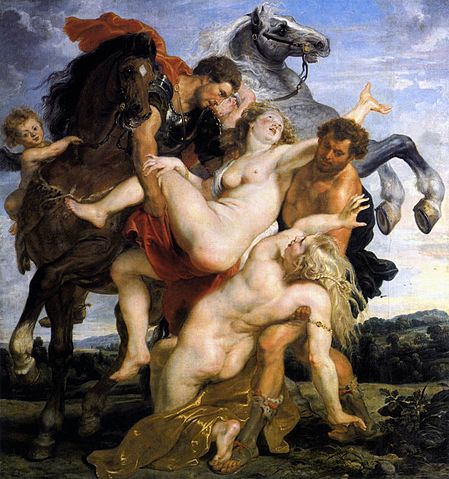
The picture has had a chequered attributional history. Julius Held, the late guru of all Rubens sketches, believed it was ‘not autograph’. He noted that ‘the gamut of colours is darker than is normal with Rubens, and the paint film lacks the characteristic use of delicate glazes’. Van Hout argues that some of the ‘darkness’, such as in areas of the background, is due to later over-paint and the fact that the sketch appears to be painted over another composition. He also suggests that the original study has been worked up into a finished picture, and this may be why it has lost some of the fluidity of a normal Rubens oil sketch.
I can see elements of both arguments here. The brushwork is first class, and the expressions of the male figures are very Rubensian, as is the drawing of the horse. On the other hand (and obviously I am far from being an expert on Rubens and his studies), the handling of areas such as the flesh tones in the daughters does seem to me to be a little unusual. A layer of darker than usual ground (Rubens studies are usually on a pale imprimatur) gives the flesh tones a grey and slightly heavier quality than the deft and rapid application one might expect, and the face of the central daughter might almost be described as laboured. And perhaps the overall composition is overly lyrical at the expense of the subject’s narrative power, something Rubens so often focuses on, as seen in the 1618 Rape. For example, in the Oslo study the figures are finely arranged in a harmonious, rising cascade from left to right, which gives rise to a very pleasing composition – but it gives no obvious explanation as to how the figures got there. They seem to be floating, which is something noted by Elizabeth McGrath in her volume of the Rubens Corpus Subjects from History, where she did not identify the sketch as being by Rubens. In the 1618 picture there is no such ambiguity - the daughters are clearly being hoisted up by the twin brothers Castor and Pollux, called the Dioscuri. Perhaps this is why Rubens abandoned the earlier composition. Hopefully more technical evidence will be available; it would be good to see an x-ray of the panel to see what lies beneath.
The composition is known in five other works, including this drawing in the Musee Conde ascribed to Rubens but not by him, and intriguingly a panel previously called ‘Van Dyck’ in the Roselius Collection in Bremen. I'll see if I can find an illustration of this.
An art historical cornucopia
January 16 2012

Picture: University of York
Richard Stephens of The University of York has been in touch about the website of The Art World in Britain 1660-1735. The project aims to put as many primary materials on the web as possible from the period in question, and has begun already with invaluable sales catalogues, newspaper adverts, and a checklist of some 8000 paintings in Irish and UK collections. It is a fantastic resource - and another demonstration of why the future of art history is online.
Richard also asks me to mention that if anybody out there has any additional sources the project might find useful (like, say, Sir Peter Lely's 'List of Paintings made by my Studio Assistants but Which I Signed as my Own'),* then he would be grateful if they could please let him know.
*I made this up. Tho' there should be such a list; Lely was rather naughty late in life, and quite a few later signed works are largely studio productions.
Axes fall at Tate Britain
January 16 2012
In The Sunday Times yesterday, Dalya Alberge had details of some impending redundancies at Tate Britain. I won't name any names here before the news is confirmed (find them behind the paywall if you must), but it seems that the gallery is about to discard some serious scholars, including world-renowned experts on Constable and Turner. This seems a shame to me, for Tate is essentially junking their investment in building up a generation of expertise on two of Britain's most celebrated artists. Some have said for a while now that Tate no longer seems interested in being a centre of expertise; these redundancies might appear to confirm that.
Everybody out!
January 16 2012
Strikes are planned by room warders at the National Gallery on 19, 28 January and 2, 4 February. The stoppages may mean the Leonardo exhibition has to close. The warders, who are frequently on strike, want the Gallery to always have one warder per room, rather than one for every two rooms as the Gallery would occasionally prefer. The warders may be right that one per room would be safer. But it would be safer still if they didn't spend much of the time standing next to each other, having a good old chinwag.
Works by this artist made $506m at auction last year. Who is he?
January 13 2012

Picture: Wikipedia
This is Zhang Daqian (1899-1983), or if you prefer, 张大åÂÆ’. Last year his paintings sold for more by value than any other artist in the world. Qi Bashi, whose works totaled $445.1m, finishes the year as runner up. Picasso, who has been no.1 for years, only made it to fourth place, behind Warhol. Full details at Reuters here.
Friday amusement - adult edition
January 13 2012
Video: Etam
Art History doesn't get much racier than this: a French lingerie firm has filmed an undercover advert in the Musee D'Orsay. The museum is upset at this breach of their strict no photography rule, a reaction which seems a little... de trop. I wonder if the National Gallery in London would be upset too - anyone care to find out?
ps - when you play it again (which I know you will) see if you can spot the peeping pierre whipping his phone out for a cheeky snap. Must have made his jour.
Van Gogh's house to be saved
January 13 2012

Picture: TAN
The Art Newspaper reports that a house in Belgium where Van Gogh lived (and which, by the look of it, he also painted) is to be saved from dereliction by the local council. More details here.
Spotmania - there's no end to it
January 13 2012
The Spots are producing some great candidates for guffwatch. Or perhaps we should have a new competition, Spotballs. Please send me good examples if you see them. If nothing else the exhibition is useful for flushing out the true believers, those Hirst disciples who, at this defining moment of revelation, still cannot see that it is all just meaningless.
Here's the normally sound Adrian Searle squeezing out 900 Spot words for The Guardian, largely by explaining the bleeding obvious:
So here come the spots: a quarter century of two, three, four and five-inch circles, with some as big as 40in across, and others just a couple of millimetres. Never mind the shifts from imperial measurements to metric: they're all just spots. Clean and flatly painted circles of household gloss on white or off-white backgrounds, they cover canvases large and small in unremitting grids. No two spots touch, and no colour is repeated on the same canvas, although some are close as dammit to being the same hue.
And so it goes on.
More worryingly, here's the Director of Tate Modern, Chris Dercon, whom Christina Ruiz spotted:
...leaving the show when I finally manage to corner him. He is beaming. “I’m a really, really happy person having seen that,” he says. “It proves that these spot paintings are not a gimmick at all. They are part of an incredible system and they are a very serious exploration of what colour can do.”
You may get the impression that I don't like Damien Hirst. On the contrary, I am a great admirer. Not of his art, which is mostly no good, but of his brazenness, his financial success, his knack for publicity, and above all his ability to exploit the madder parts of the contemporary art world, and to reveal them for what they are, which is empty. I feel sure that one day he will turn around and say 'ha! fooled you!'. That's why he deserves his place in history (and his money). He will probably be remembered not as an artist, but as a comedian, one of the greatest of his age. And the joke was on us.
If you haven't yet been...
January 13 2012

Picture: National Gallery of Scotland
...to the excellent Gainsborough landscape exhibition at the Holborne Museum in Bath, then go soon, for it closes on 22nd January. But if you miss it, fret not, for it will be at Compton Verney from 11th February till 10th June. So you have no excuse not to see it.
The Dulwich mystery picture - some answers?
January 13 2012

Picture: BG
Didier Rykner of the excellent Tribune de l'Art, has published two suggestions from art historians for the artist of the recently restored picture St Cecilia at Dulwich: Alessandro Morandotti has suggested Carlo Bononi (1569-1632), while Chris Michaelides suggests Alessandro Turchi, called Orbetto (1578-1649).
A new portrait of Robert Hooke (d.1703)
January 13 2012

Picture: BBC/Rita Greer
There was a nice piece on the Today programme yesterday about a newly commissioned portrait of the great English scientist Robert Hooke. There is no known likeness of Hooke, but, using contemporary descriptions of him the artist Rita Greer has painted a portrait of what he might have looked like (above, unveiled yesterday at the Institute of Physics). Imagine-the-portrait is a fun game to play with great historical figures for whom we have no likeness (like Jesus, for example). But in this case the result is rather terrifying.
Spotmania - 300 suckers sign up for 'The Challenge'
January 13 2012
Christina Ruiz, editor-at-large at The Art Newspaper, has bravely taken up the 'Complete Spot Challenge', which is to see all 11 Hirst Spot exhibitions in return for a free Spot print. Apparently 300 people have already signed up to do the same. Ruiz has written an excellent blogpost about her impending quest, which is well worth a read. Of her first Spot experience, in Gagosian's Britannia St. gallery in London, she writes:
There are 60 canvases here with spots ranging in size from 60 inches in diameter to just 3mm. One example from 1994, entitled Arginine Decarboxylase, sold at Christie’s in London for £881,250 last February, making it one of the more expensive spot paintings to sell at auction. To me it looks no different to the paintings on either side of it.
By the second room, the spot fatigue, and panic, start to set in.
I know how she feels - Christina, I wish you good luck. Still, a word of warning if you're one of those hoping to travel round the world pointlessly looking at the same thing: the 'Spot Challenge' rules state that;
Acceptance and use of the Spot Print constitutes permission (except where prohibited by law) to use your name, image, likeness, and photograph (all at the discretion of the Sponsor) for future advertising and publicity in any and all media now or hereafter devised throughout the world in perpetuity, without additional compensation, notification, or permission.
In other words, you have to trade a lifetime of shame for your poxy print.
