


Category: Discoveries
New discovery heralds 'Zoffany' at the RA
March 7 2012

Picture: BG
Well, where to begin? The classy layout? The excellent catalogue? The varied and invigorating selection of works? The virtuoso display of the dying art of curation? For me, there aren't superlatives enough to describe the new Zoffany exhibition at the RA. Yes, Zoffany may never be in the top rank of artists from his ultra-talented generation. But there are few artists who tell us more about painting and painters in the 18th Century.
Born in Germany, studied in Italy, celebrated in England, and, at the end, almost abandoned in India, this perpetually peripatetic artist and his unprecedentedly varied network of patrons from German kings to Indian maharajahs gives us an unparalleled view into how art was valued and commissioned in the 18th Century. We can see in Zoffany the desire for large formal portraits, for conversation pieces, for subject pictures, for landscapes, for still lifes, for historical pictures, and even religious ones. He could paint the lot. True, the studied control of his paintings may bely a lack of fluency, and even genius in handling oil paint. But he was still capable of producing great paintings, such as the Tribuna [Royal Collection]. What he may have lacked in talent, he made up for in labour.
And in this exhibition, excellently curated by Martin Postle, we can see the whole range of Zoffany's work. Proof of how varied he could be in his approach comes in an exciting new discovery of the above landscape The South Gate of Lal Bagh, Dhaka, dated 1787. This picture was at auction in Sotheby's only last December, where it was catalogued as by Robert Home. I remember standing in front of it and being sure it wasn't by Home (on whom I'm something of an anorak), but I never made the connection to Zoffany. The figures are so unlike his usual figures, more sketch-like and elegant. But there, hanging next this landscape at the RA is another very similar scene by Zoffany which confirms the attribution beyond doubt. The picture was estimated at £60-80,000 at Sotheby's, and seemingly didn't sell (I'd value it at about £250,000 now). It's a great coup for the exhibition, and an important discovery, being one of only three surviving landscapes from Zoffany's time in India.
But perhaps the most pleasing thing about the show is that it is happening at all. This kind of single artist, scholarly exhibition is seen, at least amongst those who now control many of our exhibition spaces in the UK, as unfashionable. Now, funders and marketing people want 'thematic displays', onto which you can tag on topics of (dread phrase) 'contemporary resonance'. It should forever be to Tate's shame that they cancelled this exhibition ('too idiosyncratic' apparently), not least when we see the piss-poor effort - 'Migrations' - they have put on in its place. And it should be to the Royal Academy's perpetual credit that they have stepped in and rescued it. I suspect that most of all, however, we have to thank the Yale Center for British Art, who first sponsored the exhibition. Ultimately, of course, we must be grateful to the late Paul Mellon, whose largesse is now almost single-handedly keeping good old-fashioned art historical research in the UK going, not least through the Paul Mellon Centre in London. If it wasn't for his money, these kind of exhibitions, with their spin-offs of new research and discoveries, would most likely not take place any more. So please support the exhibition by going to see it. I promise you won't be disappointed.
Prado copy hits the news again
March 6 2012
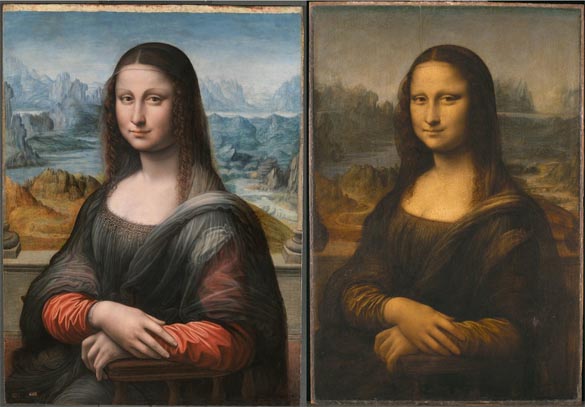
Picture: Prado/Louvre
A classic example of how speculation can become fact. From the Daily Telegraph:
'Mona Lisa copy may have been painted by Leonardo's lover'
Last month, a copy of Leonardo's most famous painting rocked the art world with revelations about its provenance.
Two weeks after it went on show to the public at the Prado, the museum's conservation team believe they are closing in on a conclusion about the painting's authorship.
The most likely candidate is Gian Giacomo Caprotti, the apprentice known as "Salaì" - which translates as "Little Devil" - who went to work in Leonardo's workshop when he was ten years old.
Many historians believe, though it is not proven, that Salaì was Leonardo's lover. He is presumed to be the youthful model for Leonardo's paintings 'St. John the Baptist' and 'Bacchus', as well as numerous drawings.
Things we can't know for sure in relation to this story:
- Nobody knows if Salai was Leonardo's lover, or even if Leonardo was gay.
- We can't really be certain that the Prado copy was painted simultaneously alongside the original.
- We don't know much at all about Salai's style or oeuvre, and certainly not enough to make a stylistic attribution.
A Lely in Louisiana?
March 5 2012

This came up for sale over the weekend in the US, and made a strong price. Catalogued as 'Follower of Van Dyck', the picture looked to us like a portrait by Sir Peter Lely, from early in his career. The sitter was identified as Lady Newburgh.
Mona Lisa copy - it was painted by Leonardo's lover??
March 1 2012

Picture: Prado
The speculation on this is just going to run and run. Here's the latest headline from The Art Newspaper:
"Leonardo’s lover probably painted the Prado’s Mona Lisa"
How do we get to this news-tastic conclusion on the basis of hard-to-interpret infra-red imagery - and no other evidence whatsoever?
Here's the reasoning:
In attempting to identify the copyist, curators at the Prado began by eliminating pupils and associates such as Boltraffio, Marco d’Oggiono and Ambrogio de Predis—since they each have their own individual styles. They also eliminated two Spanish followers of Leonardo, Fernando Yáñez and Fernando de Llanos, whose work is distinctively Valencian.
Miguel Falomir, the head of Italian paintings at the Prado, now believes that the copy of the Mona Lisa “can be stylistically located in a Milanese context close to Salaì or possibly Francesco Melzi”. Melzi was an assistant who joined Leonardo’s studio in around 1507, but the Prado’s copy may well have been started earlier. Of the two, Salaì now seems the most likely.
So it's by a process of elimination. Boltraffio, d'Oggiono and da Predis must be ruled out because they are far superior painters than the hand responsible for the Prado's copy. Presumably the same goes for Yáñez and Llanos. Melzi only joins Leonardo after he began the Mona Lisa, so that's him out. And we're left with Salai, for whom, perhaps conveniently, we have very few firmly attributable works for comparison. I'm not sure about this...
On connoisseurship
February 29 2012

Picture: Philip Mould Ltd. Fig.1: Attributed to John Greenhill (c. 1644-1676, 'Portrait of John Locke', c.1672-6, Graphite on vellum, 5 1/4 in. high (oval) Private collection, U.S.A.
I recently wrote an article on connoisseurship in the US-based magazine, Fine Art Connoisseur. It's been a while since the issue was out, so here, with editor Peter Trippi's permission, is the full article for any readers who may be interested.
On the Importance of Connoisseurship
When the celebrated English philosopher John Locke sat to Godfrey Kneller for his portrait in 1704, he made a special request. He asked “Sir Godfrey to write on the backside of mine, John Locke 1704 ... this is necessary to be done,” he continued, “as else the pictures of private persons are lost in two or three generations and so the picture loses of its value, it being not known whom it was made to represent.’” 1
Sadly for Locke, not everyone has followed his advice. About a year ago, Philip Mould and I found a fine portrait drawing of him (Fig. 1) in a sale at Christie’s secondary saleroom in London. It was catalogued as Portrait of a Gentleman, and, proving that Locke was right to worry about his portrait’s future value, was bought for just £386 — a fraction of its true worth. It relates to a painting by John Greenhill in the National Portrait Gallery, London (Fig. 2).

Picture: National Portrait Gallery. Fig. 2, John Greenhill (c. 1644-1676), 'Portrait of John Locke', c.1672-76, Oil on canvas, 22 1/8 in. high (oval)
A home grown discovery
February 23 2012

Picture: Philip Mould
We've just sold this, so I thought I'd put it on the site before it disappears into a private collection: a newly discovered self-portrait by Michael Dahl (1659-1743). Dahl, born in Sweden, was probably Sir Godfrey Kneller's nearest rival in England in the late 17th and early 18th Centuries. We found this in a country auction catalogued, like so many Dahls these days, as attributed to Kneller. Like many self-portraits, it is unfinished. It is not as striking as Dahl's earlier self-portrait, which is one of the finest works in the National Portrait Gallery, but gives a good indication of what he was capable of. The hand is particularly good. Most artists are at their best, I find, when they're painting themselves.
Prado reveals evidence behind 'earliest Mona Lisa copy' claim
February 22 2012

Picture: Museo Prado
A few weeks ago the Prado unveiled a newly-cleaned copy of the Mona Lisa, and claimed that not only was it the earliest known copy of the original, but that it was made in Leonardo's studio alongside the master by one of his pupils. And today they released an excellent series of images and videos setting out the evidence behind the claim, in a first-class presentation that should be the model for all future museum discoveries.
The main evidence behind the claim is the infra-red imagery. Briefly, the Prado say that the infra-red image of their picture matches the infra-red image of the original, including in areas where Leonardo subsequently changed his mind. So, for example, in the infra-red images of both the original and the Prado copy we can see a line of under-drawing to the right of the Mona Lisa's veil at about the level of her neck. But in both the finished original and the copy this change is not visible on the final painted surface. This must mean, say the Prado, that the copy was drawn alongside the original, and when Leonardo made a change, so did the copyist. There is other quite convincing evidence to put the picture in Leonardo's studio, such as the walnut panel, and the type of ground layer used.
[more below]
The oldest paintings in the world?
February 13 2012

Picture: Nerja Cave Foundation
Paintings discovered in a cave in Spain are thought to be the oldest in the world. In case you're wondering how they know:
...charcoal remains found beside six of the paintings – preserved in Spain's Nerja caves – have been radiocarbon dated to between 43,500 and 42,300 years old.
That suggests the paintings may be substantially older than the 30,000-year-old Chauvet cave paintings in south-east France, thought to be the earliest example of Palaeolithic cave art.
The next step is to date the paint pigments. If they are confirmed as being of similar age, this raises the real possibility that the paintings were the handiwork of Neanderthals – an "academic bombshell", says Sanchidrián, because all other cave paintings are thought to have been produced by modern humans.
More in New Scientist here.
Ken-tastic!
February 2 2012

Picture: BG
On Monday I posted a story about French artist Jocelyne Grivaud's modelling of Barbie in the guise of various Old Masters - and issued this challenge:
If somebody cares to send me Action Man in the guise of Michelangelo's David I'll put it up...
Well I'm delighted to say that a reader has accepted - and, voila, above, in what must be a world first, is Barbie's boyfriend Ken as David. Apparently Action Man was out of stock, but that's a good thing because Ken doesn't come with those glued-on blue Y-fronts - and, best of all perhaps, there's no need for a fig leaf (poor Barbie).
The reader writes:
At first I thought it would be a piece of cake, but it was not.
For instance, in order to recreate the trickier "contrapposto pose" I found myself using a lighter to bend both David´s arm and leg (task which was not fully achieved, I am afraid.)
Poor Ken! Well, at that point there was no turning back so, carried away by the joy of procrastination, my David was born.
P.S - Please note that I am not crazy, just bored. Tomorrow I will redeem myself by arriving early at the library, to continue with my thesis.
Excellent. Keep them coming!
The Mona Lisa's curious new face
February 2 2012

Picture: TAN/Museo Prado
There was much excitement in the press yesterday about the Prado's newly restored copy of the Mona Lisa. To recap, the Prado have cleaned what they thought was a not-very-important copy of the Mona Lisa, only to discover that the black background was over-paint, revealing a landscape background underneath. The Prado say that their version is the 'earliest known' copy of the Mona Lisa, and that it was painted in Leonardo's studio at the same time as the original by one of his pupils.
Now this is some claim: a copy of the most famous painting in the world, painted under Leonardo's own supervision? But hang on - where is the evidence? Apparently the copy is painted on walnut, which was used as a support in Italy at the time Leonardo painted the Mona Lisa. But it was also used in France in the later 16th Century, and cannot be dated by dendrochronology. So we cannot rely on the panel for a date. Has there been any paint analysis? Is there any documentary evidence to support its creation in Leonardo's studio? Have the Prado analysed all the other early copies, and proved they post-date the Prado's copy? We are not told. The only compelling evidence we have so far relates to the under-drawing in the copy, and comes from The Art Newspaper article by Martin Bailey (who broke the story):
There was an even greater surprise: infrared reflectography images of the Prado replica were compared with those obtained in 2004 from the original of the Mona Lisa in the Louvre. This process enables conservators to peer beneath the surface of the paint, to see underdrawing and changes which evolved in the composition.
The underdrawing of the Madrid replica was similar to that of the Mona Lisa before it was finished. This suggests that the original and the copy were begun at the same time and painted next to each other, as the work evolved.
This is a curious claim, for we know that Leonardo took many years to complete the Mona Lisa. So at what stage was the copy made? If the under-drawing in the copy was made before the original was finished, then why does the painted surface of the copy look like the original after it was finished? Perhaps the copy was completed alongside the original at each stage of its execution. Or perhaps the different nature of the under-drawing in the copy could suggest that it is not as sophisticated or complete as that in the original - which is inevitably the case with a copy.
I'm sorry to sound unneccessarily sceptical, but presenting conclusions without the evidence to back them up is bad practice, in any discipline. It only gives rise to peevish questions from people like me. And in the meantime, the conclusions get exaggerated by the press: in the Washington Post the copy is now described as 'painted with help from Da Vinci'. It is of course entirely up to the Prado to announce their findings when they want. But I bet there's a whole load of art historians out there who are as frustrated as I am by the delay. For if the Prado is right, then this is indeed a great discovery, one which can really advance Leonardo studies. So why not release the evidence now? I asked the Prado if they had any more details, and received the following:
There will be an official press release coinciding with the presentation of the work once the restoration has ended. We will do a press conference in the week of the 20th of February to announce the final works of conservation and all the information regarding the research done on the painting.
Maybe I should just be more patient. So - until 20th February we have only the various photographs released to the media to go on. Is anybody else puzzled by this? Or am I just being cantankerous?
Hollywood meets art history
January 26 2012
Video: Sullivan Entertainment
A new film has been released which explores the scientific analysis of hidden masterpieces. There's a review by Judith Dobrzynski here, and more on the film's website here. Looks like it's worth ordering - not least to hear the great Donald Sutherland, who narrates the film, make nerdy terms like 'multi-spectral photography' and 'pigment analysis' sound enticingly exciting.
New discovery - a portrait of the young James I & VI
January 25 2012

Picture: Philip Mould
A quick note about a picture I've recently found; above is a portrait described in a minor auction house as a 'Portrait of a Young Girl'. Underneath the old varnish and dirt I found an original inscription identifying the sitter as 'Jacobus', King of Scotland, painted when aged 9. The face-type was recognisable from the well-known portrait of James aged 8 in the Scottish National Portrait Gallery, which is by Arnold Bronkhorst, then court artist in Edinburgh. Our portrait uses the same head type, but with a slightly more adult form of formal court dress.
But perhaps the most interesting thing about the picture is what lies beneath it. When cleaning the portrait, I noticed a third ear emerging from James' forehead. An infra-red photograph of the picture, below, revealed that it had been painted on top of another, much earlier portrait of a saint. The so far anonymous saint is holding a chalice, and his hands can be seen clasped in prayer. The integral frame is original to the earlier picture; the portrait of James was painted straight on top of the saint, and within the existing frame. The picture of the saint looks Netherlandish, perhaps early sixteenth century, and by a good artist. One can speculate as to why the picture was over-painted, but it was probably something to do with the move against religious imagery in Reformation Scotland. And since the painting of the saint was made to a piece of good quality imported oak, it would have made sense to re-use it rather than destroy it.

What is a 'nein-sager'?
January 24 2012
Readers may be interested in this view of connoisseurship from the art historian Max Friedlander (1867-1958), who divided connoisseurs into those who held an open mind on making attributions, whom he called the 'yes' men, and those who as a rule rejected them, the 'no' men (or, in German, 'nein-sagers'):
As the 'No' man imagines that he stands above the 'Yes' man - and probably also to others to seem to stand higher - critics will always feel the impulse to attack genuine works in order to win the applause of the maliciously minded. The 'Yes' men have done more harm, but have also been of greater usefulness, than the rigorous 'no' men, who deserve no confidence if they never have proved their worth as 'Yes' men.
Only about half of Friedlander's attributions have stood the test of time (largely because he was a generalist, not a specialist, and felt able to attribute pictures to a whole range of artists) - but his basic analysis of the impulses of a connoisseur remains, sometimes, worryingly sound.
Update - I found in Brian Sewell's autobiography an important anecdote about Friedlander: he himself admitted that only his attributions before 1933 should be taken seriously, for after that he often gave optimistic attributions to Jewish families trying to raise funds by selling art, or to Nazis who demanded certificates of him.
Hitting 'le jackpot' - eventuellement...
January 17 2012
Video: Francetvinfo
The town of Vic-le-Comte in France is celebrating a EUR2.3m windfall, after the Louvre bought the above Pieta by Jean Malouel (d.1415). The Louvre paid EUR7.8m for the picture - but part of the price went back to Vic-le-Comte in order to resolve a potential legal dispute over its ownership.
The work had first been sold by a parish priest in the town for just a hundred francs in 1985. The priest thought it was an 18th or 19th Century work, and needed to raise funds to pay for the heating. But - heureusement - in France all works of art in churches have belonged to the state since 1905, so it was never the priest's to sell. And happily, as it says in the film above, the town has now been able to reclaim at least a part of 'le jackpot' it missed out on in 1985.
In Le Figaro, the chief curator of paintings at the Louvre, Vincent Pomarede, called the acquisition 'the most important in the last fifty years'. For more details in English head over to Le Tribune de l'Art here.
A new Rubens discovery in Oslo
January 16 2012

Picture: National Gallery, Oslo
Rubens scholar Dr Nico Van Hout has published a newly discovered early sketch by Rubens in an excellent article in the Rubensbulletin (the image in the bulletin can be magnified in great detail in pdf). The sketch, which belongs to the National Gallery in Oslo, has for many years been catalogued simply as 'Flemish School'. Van Hout, however, is convinced that it is by Rubens, and dates it to 1610-11. He believes it may relate to Rubens later painting of 1618, the Rape of the Daughters of Leucippus in the Alte Pinakothek, Munich (below), as a ‘first draft’.

The picture has had a chequered attributional history. Julius Held, the late guru of all Rubens sketches, believed it was ‘not autograph’. He noted that ‘the gamut of colours is darker than is normal with Rubens, and the paint film lacks the characteristic use of delicate glazes’. Van Hout argues that some of the ‘darkness’, such as in areas of the background, is due to later over-paint and the fact that the sketch appears to be painted over another composition. He also suggests that the original study has been worked up into a finished picture, and this may be why it has lost some of the fluidity of a normal Rubens oil sketch.
I can see elements of both arguments here. The brushwork is first class, and the expressions of the male figures are very Rubensian, as is the drawing of the horse. On the other hand (and obviously I am far from being an expert on Rubens and his studies), the handling of areas such as the flesh tones in the daughters does seem to me to be a little unusual. A layer of darker than usual ground (Rubens studies are usually on a pale imprimatur) gives the flesh tones a grey and slightly heavier quality than the deft and rapid application one might expect, and the face of the central daughter might almost be described as laboured. And perhaps the overall composition is overly lyrical at the expense of the subject’s narrative power, something Rubens so often focuses on, as seen in the 1618 Rape. For example, in the Oslo study the figures are finely arranged in a harmonious, rising cascade from left to right, which gives rise to a very pleasing composition – but it gives no obvious explanation as to how the figures got there. They seem to be floating, which is something noted by Elizabeth McGrath in her volume of the Rubens Corpus Subjects from History, where she did not identify the sketch as being by Rubens. In the 1618 picture there is no such ambiguity - the daughters are clearly being hoisted up by the twin brothers Castor and Pollux, called the Dioscuri. Perhaps this is why Rubens abandoned the earlier composition. Hopefully more technical evidence will be available; it would be good to see an x-ray of the panel to see what lies beneath.
The composition is known in five other works, including this drawing in the Musee Conde ascribed to Rubens but not by him, and intriguingly a panel previously called ‘Van Dyck’ in the Roselius Collection in Bremen. I'll see if I can find an illustration of this.
Boast
January 10 2012

Picture: BG
Here's a newly discovered painting by Van Dyck leaving our gallery on its way to one of the world's leading museums. Will post more details soon.
An important Van Dyck discovery in Scotland
January 6 2012

Picture: Scottish National Portrait Gallery
Since today is assuming a bit of a Van Dyck theme (see below), it may be a good time to mention an important re-attribution at the Scottish National Portrait Gallery. The above portrait of Civil War hero James Graham, Marquess of Montrose, was for a long time thought to be by William Dobson. But the Gallery's sixteenth and seventeenth century senior curator David Taylor has now changed the attribution to 'Studio of Van Dyck'.*ÂÂ
This is a bold step, and an absolutely right one. In fact, I'd go further, having seen the picture recently, and say that it is very probably by Van Dyck himself, albeit rather damaged. Later over-paint gives the picture the appearance of a less skilled work from Van Dyck's studio. The canvas had been heavily re-lined in the past, and this combined with some abrasion had given the picture a slight look of being painted on the type of thick canvas that Dobson ocassionally used.
I'd say it is a late Van Dyck, and I note that Montrose was in London in 1636. If he did sit to Van Dyck then, this picture would accord reasonably well with the artist's style at that time. It is similar to his portrait of Lord Goring, which was recently on the market, and which Sir Oliver Millar dated to later in Van Dyck's career, and as late as 1638-40. There is, incidentally, no other surviving candidate around to be Van Dyck's original of Montrose. So Scotland seems to have lost a Dobson, but gained a Van Dyck. With any luck, the SNPG may one day have the picture cleaned, and take off the later restorations. Then we can see what it is really like.
*The SNPG's website is a little muddled - it attributes the picture to Van Dyck in full, but dates it to 1644, after Van Dyck died. The label on the wall at the SNPG says "Studio of Van Dyck".
Jane Austen?
January 4 2012

Picture: Guardian/Dr Paula Byrne
A number of readers have asked what I thought of the 'Jane Austen' drawing which featured in a BBC2 programme on boxing day. It was an intriguing bit of telly. But I wasn't wholly convinced by the claims made for the drawing being Jane the novelist. Here's why;
- There is no evidence for the sitter being Jane outside the drawing itself. That is, there are no documentary references to it, and no enticing hints of provenance.
- We have no idea who made the drawing, and thus whether they can be connected to Jane.
- The main clue in the drawing, the very obviously placed background showing Westminster Abbey and St Margaret's, Westminster, bears no relation to anything in Jane's life. [update, new evidence means this is incorrect, see above post]
- The clothing argument, that a dress worn by Jane revealed similar dimensions to the sitter, is flawed. The early provenance of the dress used in the programme is far from certain - it may well not be Jane's. Here's the early history of the dress from Hampshire County Council's website:
The pelisse was given to Hampshire Museums Service in 1993. The donors' great, great, great grandfather was Jane Austen's elder brother James (1765-1819), who got it from their grandmother, who had received it from Eleanor Steele (nee Glubbe, b1857). She had visited the Knight family as a young lady of eighteen, and was given the dress by Miss Marianne Knight, sister of Captain John Knight, around 1875. At the age of seventy three she eventually felt that the pelisse should return to the Austen family, and sent it to James's great granddaughter Mrs Winifred Jenkyns. Her note accompanying the parcel reads: "I missed the little coat for a long time but lately it turned up. I cannot remember if it was 'Jane's' but it seems probable"
- The 'isn't her nose similar to her those of her brothers' argument doesn't hold water, sadly. One cannot rely on those kind of claims when identifying sitters in portraits, especially when comparing a rubbed drawing by an amateur. The sequence in the programme where a modern forensic expert was used to give his view on the sitter in the drawing was a touch misleading. If only it really was that easy to identify sitters. Furthermore, the programme didn't deal convincingly with the written description from Jane's nephew that her nose was 'small' - the nose in the drawing is enormous - and nor did the programme touch on the possible Jane Austen silhouette, also in the NPG, which, if genuine, would be our best guide to Jane's nose. The programme omitted to discuss the nose of Jane's sister, Cassandra, which apears beautifully rendered in a silhouette, and is not like the large thing seen in the drawing of 'Jane'.
- The 'the cat denotes spinsterhood' argument. Well, perhaps. But a pet in a portrait could mean just about anything, if you want it to. And would an amateur artist be familiar with the cat-as-indicator-of-spinsterhood tradition, if it existed? And would Jane herself want to be defined as a spinster, even in her thirties? Incidentally, the sitter was wearing a lot of jewellery; there are lines of pearls in the cap, apparently three necklaces, a brooch at her waist, and a number of rings - all of which may not accord well with our idea of a relatively poor spinster up from the country.
- The best evidence for the drawing remains the 'Miss Jane Austin' inscription on the back. I thought the programme dealt well with the Austen/Austin argument. But I would liked to have seen some more rigorous analysis of the inscription; what type of script was it, and when was it added? If, for example, the word 'Miss' had been spelt with an old-fashioned long first 's' (which looked like an 'f', so 'Mifs'), as Jane herself used, then that would have suggested the inscription was more likely to be nice and early. I know the long 's' was falling out of use in the late 18th and early 19th centuries, but it still would have been good to have some discussion on the handwriting used in the inscription, which to my unexpert eye looked later than the drawing.
- Finally, no effort was made to preclude any other 'Jane Austins' out there. I know this is a tangential argument, but a quick look through Family Search highlights what a common name 'Jane Austin' was in early 18thC England (and I presume still is!). It seems there are even some 'Jane Austins' who got married in Westminster at about the time the drawing could have been made.
So, on balance, the evidence for the identification of this anonymous and not particularly good drawing seems to me to be a little thin. I note that the National Portrait Gallery curators were conspicuous by their absence. But we certainly can't rule it out - and hopefully more research and analysis will help us to solve the mystery. In the meantime, I'll stick with Cassandra Austen's undisputed drawing of Jane.
A Saenredam discovery, and the power of the web
January 3 2012

Picture: BG
Here's a very satisfying discovery with which to begin the year - a rare exterior landscape by Pieter Saenredam. You may remember that I recently posted an article on the picture when it was at auction last year, catalogued as 'follower of Saenredam' at Christie's South Kensington. It was estimated at £3-5,000. It looked to me a little better than 'follower of' (I wrote that 'it shone out at the viewing') and I was hoping to bid on it myself.
Sadly, it was withdrawn (perhaps another dealer paid too much attention to it), and the picture was expunged from the online catalogue. But happily Saenredam scholar and noted art historian Gary Schwartz saw the picture here on AHN. And now he has written a fascinating entry on his own blog about the picture. His conclusion, along with that of his colleague Marten Jan Bok (co-author of Schwartz's 1989 book on Saenredam), is that there is little doubt the painting is indeed by Saenredam.
How then, if they have only seen the image on Art History News, can they be so sure about the attribution? Through excellent research. Read their analysis in full here, but the crucial facts are these:
- The scene shows the town of Assendelft, where Saenredam lived. The main building is the town hall. In front of it is the scourge post to which local villains were tied. The church is that of St Odulphus.
- The house in which Saenredam grew up can be seen in the painting, to the left of the church.
- The picture is dated 1634, when Saenredam is documented as returning to the town, and making a series of drawings that relate to the painting.
Obviously, this is not only a fantastically rare work by Saenredam, but a highly important document in relation to the artist's life. While it will always be a shame I couldn't buy it for £3,000 (tho' I suspect it would have made far more), it is wonderful that the full story behind the picture has now come to light.
The story is also an example of how the internet is driving art history forward at an unprecedented rate. Further proof of this can be found at the end of Gary Schwartz's blog post, for after reading Gary's post, a reader got in touch with news of some early provenance for the picture - dating to 1784. Sounds like the auction houses need to start their own blog...
PS - top AHN tip, if you think you've seen a sleeper at auction, don't stare at it for too long. It may get withdrawn.
PPS - curious coincidence: my post on the picture being withdrawn from CSK was made on 8th December, exactly one year after the last Saenredam sleeper sold for over a million pounds at Bonhams.
Newly found Rubens for sale at Sotheby's New York
December 23 2011

Picture: Sotheby's
Hats off to Sotheby's New York for amassing one of the most impressive line ups of Old Masters I've seen at auction for a long time. Available for you to buy on January 26th are works by Guardi, Cranach, Van Dyck, Canaletto, Tintoretto, and Fra Bartolomeo. It seems consignors are taking up the opportunities of the growing momentum behind Old Masters sales. It'll be insteresting to see how well things sell - I expect strong prices.
A highlight of the sale will be the above newly discovered study by Rubens for The Adoration of the Magi, estimated at $2-3m. It surfaced last year at Koller auction in Switzerland, where it was catalogued as 'Workshop of Rubens', and sold for CHF 140,000. There, the attribution was presumably complicated by the existence of another study of the same subject by Rubens, and some rather awkward passages. Some of these, it transpires, were the result of later over-paint, and have been removed. You can zoom in on the Koller picture and play spot the difference. Full details here.
