


Category: Discoveries
Salvator Mundi, dude
November 8 2011

Picture: Robert Simon/National Gallery
In The Guardian, Adrian Searle looks at Leonardo's Salvator Mundi, and sees a hippie:
New research published this summer has now identified this as an authentic Leonardo. Or at least some of it. Maybe. What a difficult painting this is to like, let alone to be affected by. Jesus has the glazed look of someone stoned. You can imagine the raised fingers holding a spliff. Once imagined, the image won't go away. In the same way that it is hard to forget the moustache Marcel Duchamp supplied the Mona Lisa with, making her a cartoonish drag king (and amplifying the idea that the Mona Lisa is a sort of transvestite self-portrait of the artist), I can no longer see the Salvator Mundi on its own terms. It is difficult enough, in any case.
Check back later today for my review of the show.
New Stern estate restitution
November 1 2011

Picture: Stern Estate/Concordia University
The Max Stern Restitution Project have tracked down another painting from the estate of Max Stern, the Jewish art dealer forced to sell his stock by the Nazis in the 1930s. Above is The Masters of the Goldsmith Guild in Amsterdam, 1701, by Juriaen Pool II (1665-1745).
The picture was found hanging in a casino in Southern Germany. Full details here.
Newly discovered work by Evelyn Dunbar
November 1 2011

Picture: Sim Fine Art
As a keen fan of wartime art, I'm grateful to Andrew Sim of Sim Fine Art for alerting me to a fine work by Evelyn Dunbar (1906-60), Britain's only salaried female war artist during the Second World War. The picture is called Girls Learning to Stook and Men Stooking, 1940, and was a commission to record Women's Land Army subjects. What a great picture.
To celebrate the rediscovery of this and other works by Dunbar, her biographer Dr Gill Clarke will be speaking at Persephone Books on 8th November at 6pm. Tickets, at £20, from 020 7242 9292.
First footage of 'Salvator Mundi'
October 31 2011

Picture: BBC
In case you missed it last night, you can still see Fiona Bruce's programme on the newly discovered Leonardo here. I thought the picture looked compelling - from my sofa. I was fascinated to see the x-ray images; the damage, mainly caused by a knot in the wooden panel, is clearly quite extensive, but has been dealt with very well.
I find it puzzling that Leonardo didn't take more care about selecting his support - I don't think Holbein, for example, would have dared use a panel with a knot in it.
A newly discovered Rodin? Or 'a complete fiction'?
October 31 2011

Picture: AFP
An art expert and sculptor has claimed that this curious little silver statue (22.5cm tall) is the work of Rodin, perhaps the greatest sculptor of the modern age. Bought in a French flea market in the 1980s, the work has no signature, no foundry marks, and does not appear in any documentation linking it to Rodin. But in a flamboyant presentation to the French press today, Gilles Perrault presented a 60 page dossier claiming the piece is undoubtedly by Rodin.
As is increasingly the case these days, 'scientific analysis' has been used to shore up the claims. From AFP:
In particular he focused on the subject's hands -- the spacing between the fingers -- on its highly-stylised feet, and on the folds of the draping, which he argues are typical of Rodin.
"Back then," Perrault explained, "Rodin was at odds with the whole establishment, he was the only sculptor who used fabric covered with plaster or wax."
Analysis uncovered microscopic traces left by the plastered fabric on the statuette, he said, along with minute grooves similar to ones found on a Rodin work in memory of the writer Honore de Balzac.
However, the Rodin Museum in Paris has doubts.
"We are very, very sceptical, in the absence of documents referring to the existence of such a silver statuette, or to any other works that relate to it," said its asset curator Aline Magnien, contacted earlier this week.
"This work has no pedigree," she said. "Gilles Perrault has created a fiction."
See a more detailed photo here.
New Velazquez discovery
October 27 2011

Picture: Bonhams
Bonhams will sell a newly discovered work by Velazquez this December. Estimated at £2-3m, it was nearly sold in their Oxford saleroom as a sleeper. The London department spotted the picture, and advised it be withdrawn. More details on the painting here, and a more detailed photo below the jump.
Michelangelo (?) makes it to Rome
October 25 2011
The Kober family must be jumping for joy after their painting (which they believe to be) by Michelangelo is to be exhibited in Rome as part of an exhibition of the artist's work.
The painting affectionately known by the family as 'The Mike' was kept behind a sofa after a dusting incident knocked it off the wall. The painting is believed to date from c.1545 and depicts Mary with her arms open over the body of Jesus, whose arms are held by angels.
Although opinions on the painting are still contradictory, it marks an important stage in its acceptance since research by the owner begun back in 2002. Kober suggests that the painting was undertaken by the Italian master at the age of seventy and was painted for his friend Vittoria Colonna. It was eventually passed on to a cardinal, and archbishop and a family in Croatia where it hung in a castle for many years. The painting entered the Kober family through marriage from a German baroness who willed it to his great-great grandfather's sister in law.
Last year Michelangelo expert William E. Wallace didn't go as far as confirming its authenticity but didn't rule it out. The process of getting everyone to agree on attributions for paintings of this age is a long and tricky one, and no doubt this particular example will always be questioned. It is however a very interesting story well worth following...
More here.
By LH.
Fortune Favours the Cold
October 19 2011

Picture: National Portrait Gallery. Simon Verelst, 'Portrait of Nell Gwyn', Private Collection.
The National Portrait Gallery's new exhibition The First Actresses: Nell Gwyn to Sarah Siddons is to feature a newly discovered portrait of actress and royal mistress Nell Gwyn (some of you Londoners may have seen it advertised on the tube this morning).
The portrait has been in the ownership of the same family since the 1940's when it was purchased for its decorative frame, the sitter's identity only realized after it was cleaned.
Gwyn's seductive appearance was clearly too much for the kill-joy Victorian viewer and at some point during the nineteenth century her open blouse and bare chest were painted over and replaced by something more 'acceptable'. Unfortunately no images exist of its previous appearance. At the gallery we have encountered these censoring campaigns on a number of occasions, including another of Gwyn here.
Professor Gill Perry, curator of the exhibition says:
'Images such as this rarely seen portrait have contributed to the idea of Nell Gwyn as an early celebrity, whose life story and appearance are known through biographies and salacious gossip. But she was a shrewd manipulator of her own public image, known not just for her affairs and outspoken views, but also for her acting abilities and famous wit'.
Her wit was indeed observed by social commentators of the day including Samuel Pepys who first encountered 'Pretty Witty Nell' at the Dukes Theatre in Lincolns Inn Fields in April 1665.
The portrait was painted by Simon Verelst (1644-c.1721) between 1680-5. Verelst came to England in 1669 already having an established reputation as a flower painter - an element he frequently incorporated into his portraiture. Gwyn was a consistent patron of Verelst and the NPG already has on display a more formal half-length on display in the Wolfson Gallery.
Information and tickets for the exhibiton can be seen here.
By LH
Over on another art history blog...
October 17 2011
...you'll find an article featuring - me! Three Pipe Problem is a fascinating site offering in depth analysis on all aspects of art history, with a particular emphasis on science and technical analysis.
The writer behind 3PP is Hasan Niyazi, who has a background in clinical sciences. Niyazi's scientific training gives his views on art the sort of analytical edge you don't often find amongst art historians. In this piece, he looks at connoisseurship - an issue readers of this site will know I often bang on about - and proposes an ingenious system of reporting for art historical discoveries.
Niyazi has often been baffled by the huge differences in reporting findings in his two disciplines of science and art history. For example, any scientific discovery should be reported in a weighty peer-reviewed journal, with all the available data published for analysis and debate, and opposing views given equal weight. Whereas in art history, the evidence for a discovery can often be nothing more than the pronouncement of a single expert. So Niyazi suggests (and I'm paraphrasing) what should be an industry-accepted system based on: (1) stylistic, thematic and iconographic evidence; (2) documentary evidence; (3) visual and technical evidence; and (4) consensus - critical response and peer review.
Another restitution - but this time from WW1
October 13 2011

Picture: Musée de la Chartreuse
A Fisherman's Daughter by Jules Breton (above) has been returned to the Musée de la Chartreuse in France after intervention by the United States. The picture had been stolen from the museum by a German soldier in 1918.
Valued at EUR 140,000, the picture was lost for decades, but turned up again in 2000 after it had been consigned to Sotheby's. It then appeared for sale at Maastricht in 2010, before finally being restituted after much legal wrangling.
I'm all in favour of restitution, especially of works so brutally stolen by the Nazis. But 1918 is a long time ago, and you have to wonder where we draw the line on restitution cases. What about a picture taken (and there's plenty of them) by Prussian forces from Paris in 1870? Or Napoleon's army? Or Genghis Kahn?
The dangers of 'science', art history and optimism
October 13 2011

All images: Art History Today/Graeme Cameron
A new self-published book has made a number of startling art historical claims. The most eye-catching is a new theory on the Mona Lisa: the sitter is, claims Graeme Cameron, an idealised portrait of Leonardo's mother. Cameron also lays claim to a new Leonardo Self-Portrait, and a Portrait of Elizabeth I by Hans Holbein.
Although I have only seen the findings published over at Art History Today, rarely have I seen so many wild theories in a single book. It's worth ordering a copy of the book out of sheer fascination. The theories highlight how too much 'scientific' analysis of paintings can lead one off on wild tangents if you're not grounded in proper art historical training and connoisseurship. [More below]
How do you find a Leonardo?
October 12 2011

Picture: Artinfo/Science Television Workshop. Martin Kemp examines 'La Bella Principessa'.
With good old fashioned connoisseurship (partly). Martin Kemp, Leonardo scholar and proponent of the putative Leonardo discovery La Bella Principessa, explains, in an interview for ArtInfo:
Connoisseurship still plays a role. It's much denigrated and criticized, but ultimately, without connoisseurship, we really wouldn't know Leonardo's work at all. It's still a fundamental tool in establishing what was done by him and when it was done, since none of it is signed, none of it is dated, and, apart from "The Last Supper," nothing has a continuous provenance. So you still have a lot of that rather old-fashioned judgment by eye to do.
So, in the flesh, you look at it. It's on vellum, and you can see the extent to which the surface is deteriorated, which you can't see, really, in a digital file, which smooths out the surface. You can begin to see where it's been restored — as you look at it in different light and from different angles, the physicality of it becomes apparent. But that's only your starting point. Then, all the heavy-duty research comes in, and we now have, of course, an enormous body of extra things we can look at. So the initial connoisseur's reaction merely tells you that something is worth looking at, but at any point one wrong thing can throw that all away — a later pigment, a bit of something that might come up about its history to indicate it was forged at some point, and so on. I was trained as a scientist, and if you have a scientific theory, you only need have one bit of the experiment that says, "this is not right," and the whole thing collapses. You always have to be looking for that one thing that is going to demolish the whole expectation that's being set up.
Kemp also backs away from the ludicrous 'Leonardo finger print' evidence that was much touted in his recent book on the Principessa. Even an amateur sleuth could see that the 'finger print' discovered by the controversial art investigator Peter Paul Biro was entirely unconvincing. Kemp now says:
I would not now probably say much about it at all, because on reflection I think we don't have an adequate reference bank of Leonardo fingerprints. I've talked to fingerprint specialists, and they typically require a full set of reference prints. We don't have that for Leonardo. My sense is — and this is Pascal's sense, too — that it's probably premature, given what we know about Leonardo's fingerprints, to come up with matches at all.
For a more thorough analysis of the whole Principessa case, toodle over to Three Pipe Problem.
The story behind the discovery of Leonardo's 'Salvator Mundi'
October 9 2011

Picture: BG/Sunday Times
Dash out and get a copy of the Sunday Times if you haven't already got one. The magazine has the story behind the discovery and attribution of Leonardo's Salvator Mundi. There's even a quote from moi. (I would link to it, but Murdoch's paywall is in the way.)
The most convincing evidence, for me, is the photo of the exquisite pentimento on Christ's thumb (above). See my earlier pentimenti story for why these little changes can be such useful evidence.
Where AHN leads, The Sunday Times follows...
October 5 2011
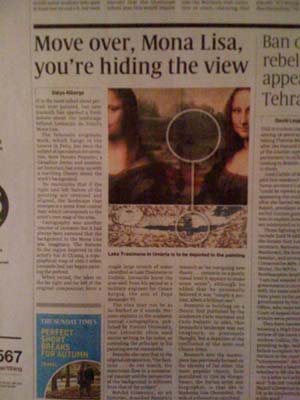
I forgot to brag about the Mona Lisa background story making it into the Sunday Times this weekend (even with a little quote from moi). Here was the original post.
Elizabeth Taylor: Actress, Star, Connoisseur?
October 4 2011

Picture: LA Times
A portrait from Elizabeth Taylor's collection has been identified as a Frans Hals by Christie's. Previously, the picture was considered to be an imitation of Hals' work. From the LA Times:
The painting, "Portrait of a Man, Half-Length," was for decades thought to be by an imitator or student of Frans Hals, the great Dutch painter often compared to Rembrandt for his vigorous, sometimes humorous depictions of the growing merchant class. Now Ben Hall, the head of Christie's Old Masters department in New York, is making the case that Taylor's painting was the handiwork of Hals himself. An expert in Hals' work agrees.
With the change in attribution comes a change in projected value: a canvas that would have likely brought less than $100,000 could now bring $1 million in an Old Masters auction in January.
The re-attribution is an example of the importance of seeing a painting, long known through reproduction, in the flesh. In the 1970s, the painting appeared in scholar Seymour Slive's catalogue raisonné on Hals — the industry standard for what is and is not authentic — as "doubtful and wrongly attributed." But Slive only saw the work in a black-and-white reproduction.
Hall, on the other hand, saw the painting in person in July, when it arrived at Christie's Rockefeller Center warehouse with other material from Taylor's estate. He said it "packed a real punch — making a tremendous impact from even 20 feet away."
Exclusive - Nazi loot extortion attempt foiled?
October 3 2011

Picture: The Art Newspaper
The Art Newspaper recently reported on an attempt to sell a painting by Jan van Huysum stolen from the Palazzo Pitti in 1943/4. The picture had been evacuated from Florence in 1943, but was 'acquired' by a German soldier in Italy in 1944 'in exchange for food'.
Now, the soldier's grandson wants a EUR2m 'finder's reward' for returning the picture. He is threatening to sell the painting if he doesn't get the money. The demand has come through Edgar Liebrucks, the German lawyer who represented those who handled the Tate's two stolen Turners in 2002-4, for which the museum paid a ransom fee for information of £3.5m.
Liebrucks has proposed that if the picture is worth EUR 10-12m, then it should be sold at auction with 80% of the proceeds going to the museum, and the balance to his client. Liebrucks says:
My client needs the money, and it is feared that he will sell the painting elsewhere. I hope this will never happen.
Well, Edgar, I hope it doesn't happen either. After The Art Newspaper reported the story, I contacted The Art Loss Register. Surely, if the picture was not lawfully disposed by the Palazzo Pitti, it cannot legally be sold now? And sure enough, it can't. The picture is now listed on the Art Loss Register's database, ruling out the auction option at least. So if Mr Liebrucks and his client still want to squeeze money out this shoddy deal, they'll have to think of a plan B.
The lost Jacobite Princess
September 30 2011

Picture: Philip Mould Ltd
Bit of a plug this one, but art history news nonetheless. Above is a c.1701 portrait of Princess Louise-Marie Stuart (1692-1712) by Francois de Troy. She was the youngest daughter of James II, and was born in exile in France after her Catholic father was deposed in the Glorious Revolution of 1688. The supporters of James II, and his descendants the 'Old Pretender' James III and the 'Young Pretender' Bonnie Prince Charlie, were known as the Jacobites.
We recently bought the picture in France, where, like so many Jacobite portraits, the identity had been changed to a French sitter. The portrait is known in an engraving, and at least two other variants, one in the Fleming Collection, and that sold recently at Sotheby's, which may have been painted a little earlier. The Sotheby's picture had an interesting provenance - it belonged to Princess Sophia of Hanover, the 'rival' Protestant Stuart descendant and mother of George I - the man the Jacobites tried repeatedly to depose.
There was some talk of the young George I marrying Louise-Marie, to unite the two branches of the family. But she died unmarried of smallpox at the age of 19. Her life must have been a sad and strange one - feted as a royal princess, but with none of the power, wealth or dignity of a real one. She lived at the Chateau of Saint-Germain-en-Laye outside Paris. I went there this summer - it is a grim place, not unlike Wandsworth Prison (where I haven't been).
New evidence on '£100m Leonardo' drawing
September 29 2011
Martin Kemp, a leading Leonardo scholar, has unearthed some compelling evidence about the controversial drawing 'La Bella Principessa'. It was sold as a 19th Century pastiche by Christie's in 1998 for £11,400, but some now say it is by Leonardo and worth £100m.
The drawing is on vellum, and Kemp says he has now found the actual 15th Century volume from which it was taken (in Poland). From The Guardian:
[Kemp] has identified the drawing as a missing sheet from a 15th-century volume linked to Leonardo's great patron, the Duke of Milan, Ludovico Sforza.
Last year, Kemp provisionally identified the sitter as Bianca, the duke's illegitimate daughter, who died a few months after her marriage at the age of 13. This identification was supported by the title page of the Sforziad, a volume celebrating the Sforzas; symbols in the book show that it was a wedding gift.
"Assertions that it is a forgery, a pastiche, or a copy of a lost Leonardo are all effectively eliminated," Kemp told the Guardian. Earlier this year, he embarked on what he describes as a "needle-in-a-haystack" search for a 15th-century volume with a missing sheet. A clue lay in the stitch-holes along the portrait's left-hand margin, suggesting it had been torn from a luxury-bound volume. But the chances of this volume surviving 500 years were remote, and the chances of it being found even remoter.
Against the odds, Kemp tracked the volume down, to Poland's national library in Warsaw; the stitch-holes are a perfect match for those on La Bella Principessa, a portrait in ink and coloured chalks on vellum. It is overwhelming evidence, Kemp says, that the portrait dates from the 15th century – and not the 19th century, as Christie's thought when it sold it in 1998 for £11,400 (it could fetch £100m as a Leonardo).
So, if true, this is indeed proof that the drawing dates from the 15th Century (which is fairly obvious just by looking at it), and puts to shame those who said it was a later fake. Whether it proves it is by Leonardo or not is another matter...
The sort of thing I dream about...
September 28 2011
A stash of 300 pictures thought to be worth 'millions of euros' has been found in an outhouse in Poland. They seem to have been there since the end of the second world war. Details are sketchy at the moment, but more here.
Lost Sassoferrato found in US?
September 27 2011

Picture: Fairfield Auction
A painting thought to be by Sassoferrato has been discovered in a small auction house in New England. Catalogued as 'Italian Old Master', and with an estimate of just $5-7,000, the picture sold for $184,000 including premium. More images here (scroll down to Lot 108).
