


Previous Posts: November 2012
A Ribera for the Met
November 9 2012
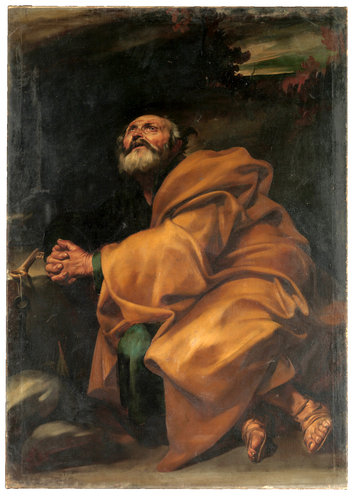
Picture: New York Times/Met
Congratulations to the Metropolitan Museum in New York, which has acquired a full-length Penitent Saint Peter by Jusepe de Ribera. It is believed the asking price had been $1.3m. More details here.
Meanwhile, in New York...
November 9 2012

Picture: Sotheby's
Last night the above Picasso sold at Sotheby's New York for $41.5m (inc. buyer's premium), coming in at the lower end of the estimate of $35m-$50m (which does not include premium). The picture had been guaranteed, and had sold for $28.6m in 2000 at Christie's New York. The increase in the 12 years since is not perhaps as big as you might expect.
Despite Christie's sale on Wednesday of a Monet water lillies for $43.8m, the New York Impressionist and Modern Art sales this week have been a mixed bag, as Carol Vogel in the New York Times reports:
It has been a tough week for Sotheby’s and its archrival, Christie’s. Both auction houses had padded their sales with mediocre material, and buyers knew it. On both nights, second-tier examples of artists including Cézanne, Matisse, Monet and Picasso went unsold. Christie’s auction on Wednesday night had been a struggle, but in the end it had more high-priced works and its total, $204.8 million, was higher than Sotheby’s, which brought $163 million on Thursday. Both were below their estimates.
The varying prices tell Jonathan Jones, in The Guardian, that there is evil everywhere in the art market:
Is it all teetering on the edge of apocalypse? Is the boom in art prices that has defied a wider economic stagnation about to end? If so, it would be bad for no one except a few "rich bastards" (to quote the artist Mark Rothko on the people he had no wish to paint for). A fall in art prices would be good for museums, good for public collections and good for the mental health of our culture.
At least we know now whom art collectors vote for. One reason for the flat sale at Christie's, it has been suggested, is that buyers were depressed by the re-election of Barack Obama. The art market, it seems, may be the Republican party at play, to add to its other charms.
Readers will know that this little corner of the art market, at least, was relieved at Obama's re-election. Which feelings, incidentally, drew this response from a reader in America:
Several of the people who would consider shopping in your gallery would not appreciate your political comments about Obama. Your clients, I am sure, are in another category and would find it difficult to read your comments in your blog. The American political situation is terribly complicated and very sensitive at the moment. I would stay away from it--by miles.
To which, as we say in England, bollocks.
National Gallery archive online
November 8 2012

Picture: BG
The National Gallery has put its archive catalogue online. You can search for all sorts of things. From the NG's site:
What you might find
With records dating back to 1824, the Archive has an array of material covering everything from the travel notebooks of the Gallery’s first Director, Sir Charles Eastlake, to details about contemporary art exhibitions.
Highlights include records that relate to:
- Daily life at the Gallery in Victorian Britain (NGA2/3/2/13)
- Correspondence from Charles Dickens (NGA1/22/267)
- Vigorous debates on the Gallery opening on Sundays in 1896 (NG7/198/1)
- The arrival of technology at the Gallery when a phone line to Old Scotland Yard was installed in 1898 (NG17/6)
- Details about acquiring Degas’ paintings from Paris whilst it was under German bombardment during the First World War (NG14/25/1)
- A complete visual record of the evacuation of the paintings to Wales during the Second World War (NG30/1941/8)
- The public appeal to secure Titian’s ‘Death of Actaeon’ for the nation in 1971-2 (NG69/1)
I love the one about Sunday openings. We must be forever grateful for a:
Letter from the Sunday Society enclosing a memorial signed by 1050 persons in favour of keeping the National Gallery open all the year round on Sundays.
Does anyone want to start an Evening Openings Society? My life would be a great deal better if I could easily visit museums after work. Wouldn't yours?
Working both ends
November 8 2012

Picture: New York Times
In New York, mega-dealer Larry Gagosian is being sued by a collector for allegedly under-selling their Roy Lichtenstein painting. According to the NY Times, the vendor says it was unlawful for Gagosian to take a commission from both sides without fully disclosing the financial relationship. The picture was sold for $2m, and Mr Gagosian took a commission of $1m.
A central question in the case has been whether Mr. Gagosian in essence worked both ends of the deal — not disclosing to Mr. Cowles that his gallery had a relationship with the buyer and that it was trying to get a favorable price for that buyer. In a deposition made public on Wednesday, Mr. Gagosian said that he frequently represented both the seller and buyer in a deal without disclosing that fact to either party. “To be honest with you, the question hardly ever gets asked,” he said. “I never get asked the question, ‘Are you representing both sides.’”
The case is an interesting one, because in the art world some dealers (and worse, 'advisers') often do work both ends of the deal, as the NY Times puts it, without disclosing the fact. This obviously creates a significant conflict of interest. Happily, in the UK this practice is now illegal, due to the introduction of the new Bribery Act (and if you think about it, working for 'both ends' is a sort of bribe). All the Old Master dealers I know in London would only take a commission from a seller.
The problem with taking a commission from both buyer and seller, even with full disclosure, is which party is your primary responsibility? For example, the major auction houses take commissions from both buyer and seller quite openly - but in whose interest should they really be working? The standard seller's premium at Sotheby's and Christie's is 12%, but the buyer's starts at 25% (which with Vat adds 30% to any hammer price). Often, with really valuable paintings, the vendor will pay little or no premium, and the auction house's profit will come wholly from the buyer's premium.
However, auction houses work overwhelmingly in the interest of the seller. Rarely have I felt, as a prospective buyer, that an auctioneer is working to get me the best deal. The very process of bidding (and especially sham bidding up to the reserve) is designed to work against the interest of the buyer. The price can only ever go up. Reserves are agreed with the seller, and not disclosed to the buyer. Auctioneer's terms and conditions can give buyers little comfort in the event of a duff attribution, and then, especially in the world of Old Masters, there is the question of a picture's condition, which is rarely if ever given the full attention it deserves by auctioneers (and I've seen major auction houses provide condition reports that are little more than works of fiction).
So shouldn't auction houses only take a commission from vendors, as (Mr Gagosian excepted) most dealers do?
Update - a reader from the financial world sends this interesting insight:
Auctioneers already protect themselves by defining very limited responsibilities towards buyers, so the question of commissions is surely one of efficient pricing. If we all acted rationally, the split of commission between buyer and seller would make absolutely no difference - buyers would adjust their bids in line with the commission to be added on top. In the real world, buyers might experience more 'sticker-shock' if the full price (including commission and VAT) were bid in the room, rather than a number almost a third lower than what they will have to pay. On the other side, sellers perceive their commission to be the price they're paying, and will focus more on that than on the buyers' premium - which also reduces the portion of the price that they will receive. The classic example given in economic research in this area is printers, which are sold below cost price but with eye-wateringly expensive ink cartridges increasing lifetime cost.
I'm not sure they're doing such a great job for vendors either. Academic research suggests that it's really hard to incentivise agents to maximise prices - they are much more focused on doing the deal rather than getting the highest possible price. If a sale falls through, the vendor keeps the asset, but the agent gets nothing. If it sells below fair market value, the vendor nurses a loss, but the agent gets a commission. For the vendor, the difference between a fair price and a good price is really important. For the agent it's a matter of a few percentage points.
I agree with you about the inadequate discussion of condition, although that's not restricted to the trade. Academic art history rarely discusses condition adequately, and museums almost never mention condition in wall text - which has always struck me as one of the most useful things they could explain.
Giotto, or Grotto?
November 7 2012

Picture: Telegraph
Restoration work at the Chapel of St Nicholas in the Basilica of St Francis in Assisi, which was damaged in an earthquake in 1997, has revealed evidence to suggest the frescoes may be the work of Giotto. More here.
Update - a reader writes:
If Ghiberti thought he was at Assisi it's good enough for me. If you look at his evolution between the Arena Chapel in 1305 and the Bardi Chapel in 1325, the St Francis cycle could be the same painter in the 1290s. The secondary figures in the Arena Chapel are like figures from Assisi. Giotto is the moment painting starts walking on two legs. I don't think he ditched the icon style overnight.
Phew
November 7 2012
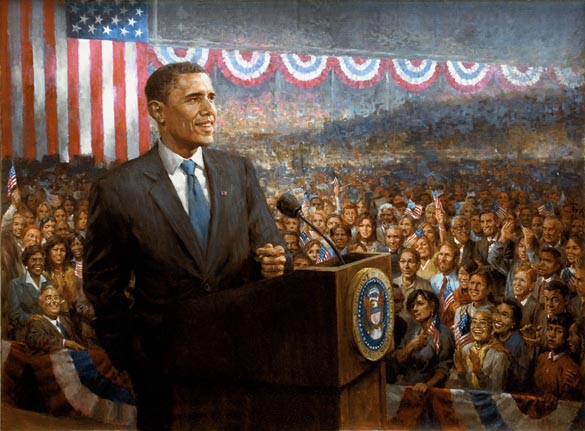
Picture: Huffington Post/Andy Thomas
Let's celebrate with this curious collision of Obama-ography and Socialist Realism.
Greenwich's Painted Hall to be restored
November 7 2012
The Guardian reports that Sir James Thornhill's painted hall in Greenwich is to be restored. A large part of the cost is being met by our new best friends, the Heritage Lottery Fund:
The £335,000 grant from the heritage lottery fund will pay most of the cost of the £475,000 first phase of the work, on the enormous west wall, which features giant figures of George I towered over by allegories of naval victory, surrounded by children and grandchildren including the future King George II and Prince Frederick, father of the future King George III, with the artist himself standing meekly in the shadows in the foreground.
The total cost including later work on the ceiling and remaining walls will be more than £2m. Events including scaffold tours are planned while the work is carried out.
How not to restore Titian toes
November 7 2012

Picture: Museo Prado
A reader has secretly sent me a high-resolution image of the Prado's newly restored Titian discovery. Just for now, I'll treat you to a close-up of the toes.
"...somebody wrote a pretty big check"
November 6 2012
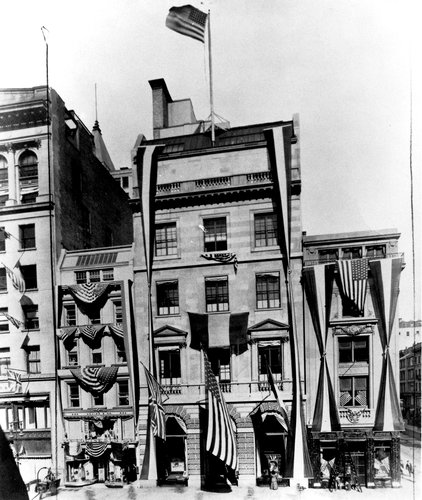
Picture: Getty Research Institute
The now defunct but once venerable Knoedler gallery has settled a case involving an alleged $17m fake Jackson Pollock. the details are confidential, but it's thought a lot of money was involved. However, as the New York Times asks, what will happen to the picture now?
Among the questions left unanswered is what will happen to the work itself: including whether it will become a possession of the defunct gallery, which is selling some of its remaining inventory at auction. The work, known as “Silver Pollock,” is one of a group of paintings handled by Knoedler that came from a Long Island dealer, Glafira Rosales, who is now a target of a federal investigation, according to court records.
Indeed, the problem of fakes being recycled, even after they've been outed, is apparently a growing one. The New York Times again:
For organizations like Mr. Grant’s [who manages the estate of Richard Diebenkorn] that are charged with protecting an artist’s legacy, the job of patrolling for fakes has become something like a game of Whac-A-Mole.
“You put it down, and then five, seven years later, poof!, and there it is again,” he said by phone from the foundation’s offices in California.
The resale of fakes is a persistent and growing problem without a good solution, say collectors, dealers, artist estates and law enforcement agencies. Although the Federal Bureau of Investigation can seize forgeries in criminal cases, these represent only a tiny portion of the counterfeit art that is circulating.
“They churn through the market,” James Wynne, an F.B.I. special agent who handles art forgery cases, said of fakes.
I say burn 'em.
For a good overview of the Knoedler story, see Michael Shnayerson's article in Vanity Fair, here. Last month the gallery's archive was bought by the Getty Institute.
Mini plug
November 6 2012
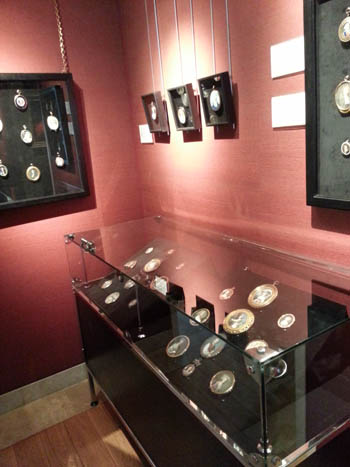
Picture: BG
If you like European 18th Century portrait miniatures, then the best place in the world to see some at the moment is at our gallery. Today we are installing an exhibition of miniatures from the renowned Tansey collection. The show, called Miniatures from the Age of Marie Antoinette, opens tomorrow, until 13th November.
New Titian discovery unveiled at the Prado
November 5 2012

Picture: Museo Prado
In September, I mentioned (actually, it was a bit of scoop, in English at least) that the Prado would soon be unveiling a newly discovered Titian of St John the Baptist from their collection. Now, the restoration of this previously over-looked and much damaged original has been completed, and the picture will be the subject of a new mini-exhibition. From the Prado website:
Saint John the Baptist is the only work by Titian in the Prado not to have originally been in the Spanish royal collections. Rather, it came via the Museo de la Trinidad, entering the Museum in 1872 as by an “anonymous Madrid School artist of the seventeenth century”. As such it was sent fourteen years later to the parish church of Nuestra Señora del Carmen in Cantoria in the province of Almeria.
[...] in 2007 the Museum embarked on a study of the work, reaching the conclusion that it was not a copy but an original by Titian. Technical characteristics such as the preparatory layer of white lead with added calcium carbonate as well as the similarity between the landscape and those found in other works by the artist of the early 1550s allowed for its date to be established.
The painting arrived at the Museum in extremely poor physical condition. The recent, outstanding restoration by Clara Quintanilla has recovered the composition’s legibility by re-establishing the balance between the figure and its setting. Furthermore, in the less damaged areas (the sky and landscape) it is now possible to appreciate Titian’s grandeur and subtlety. The importance of this new Saint John the Baptist is not, however, aesthetic (the work is too damaged) but rather documentary. Firstly, research has shown that this was one of the artist’s most popular religious compositions in Spain, evident in the large number of copies that have been identified. The fact that the earliest are from Zaragoza and nearby suggest that the painting’s first owner lived there, who may well have been Martín de Gurrea y Aragón, 4th Duke of Villahermosa (1526-1581). Secondly, the painting constitutes an exceptionally important record of how Titian repeated his compositions (see below). Finally, it provides information on the other two versions of the subject, strengthening the arguments for the autograph status of the El Escorial painting, which has recently been questioned.
All very interesting, but excuse me for saying that, on the basis of this photo, the restoration leaves something to be desired. The formless drapery, the overly rendered face, and in fact most of the body (what's with those curious toes?), looks as if it has been restored in the same workshop as the famous Fresco Jesus. It's interesting that the Prado has not published a high resolution image - surely, if the museum wants us to believe that, despite the damage, this is really a Titian, we need to not only see a decent photo of the picture as it is now, but, more importantly, one showing the picture stripped down, so that at least we can see what remains of original Titian there are left (not much, I suspect).
Update - find more coverage in The Art Newspaper.
Update II - a reader writes:
In light of the most recent case (Titian, ‘St John the Baptist’, Prado) do you agree that restorers should, in such drastic cases, be strictly prohibited from extensively repainting canvases? The most important value of any painting, whatever remains of it, is artistic, and that lies solely in the original and not in any subsequent repainting that hopes to represent what the original might have once looked like. In such drastic cases (here, of the entire work, only the lamb seems to have been left relatively undisturbed) they might as well have started a fresh canvas, perhaps then placing it alongside the damaged but stabilised work for the sake of comparison. What’s the point of covering up a Titian??
Take your important Queen Henrietta Maria Van Dyck as a valid case in point. Whatever the state of the original was, you vested all of your primary interest in the overpainted hand of Van Dyck. This understandably justified the stripping away of the perhaps more compositionally pleasing 18th Century additions, and this despite running the risk of ending up with no composition to appreciate at all. In Spain’s latest Titian case, the thought process was totally reversed. I’m guessing the Fresco Jesus Fever (FJF) didn’t help when deciding the original’s fate. Perhaps the Prado are looking for a new pop icon? They in fact used the same… logic? as Ms Gimenez.
Titian approves of this message.
In this case, I think I agree. Though of course I would want to see an image of the stripped down Titian first.
Also not Seduced by Art
November 5 2012
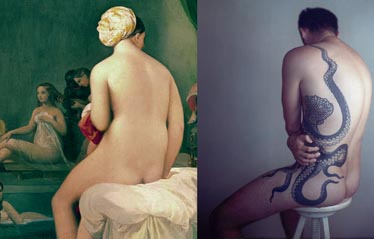
Picture: National Gallery
Further to my raised eyebrow last week, the great Waldemar also is a little baffled by the National Gallery's latest exhibition, 'Seduced by Art':
The good news about Seduced By Art is that it is the first major photography show mounted by the National Gallery. New approaches are being explored, and modern moods. The bad news is that the show itself is a mess: incoherent, under-whelming, and sent all over the place by hit and hope curatorial thinking.
And if you thought that was bad, wait till you see what Brian Sewell has to make of it. I'll skip the usual barbed zingers, and take you straight to his forensic critique of the premise behind the show:
The gallery has, it seems, “specially commissioned for the exhibition” new photographs to compete with old paintings, but that it should feel compelled to do so surely indicates that there must have been too little evidence to lend importance to the link, and thus that it is a point hardly worth the demonstrating in an exhibition. If the underlying thesis is that photography must be acknowledged as an art of pictorial legitimacy equal to that of painting, yet, in order to support it, photographers must be let loose in the gallery, there to be inspired into rivalry with the old masters, then the thesis must be very weak and the curators should not have been allowed to engineer the evidence. To turn the thesis on its head, however, and prove that painters with no imagination are readily seduced by photography (and even use it as a form of underpainting, even of easy collaboration), then the visitor to the National Gallery has only to wander upstairs and examine the spurious paintings of Richard Hamilton (and why are these, pray, in Trafalgar Square rather than any of the too many Tates?), or go next door to the National Portrait Gallery where, annually, ghastly portraits based on photographs are jubilantly exhibited as art.
[...]
To be blunt, I was not provoked but sickened by this exhibition, nausea my overwhelming response to it. As an exhibition, its content is much less than the ugly catalogue suggests and the hang so haplessly confused that it fails to make the points energetically promoted in the text — but the catalogue too is repellent, the nastiest example of book design ever issued by Yale University Press. None of this would matter were it the show of the year in Milton Keynes or Margate but it is in London, in Trafalgar Square, in the National Gallery with Christopher Riopelle (in charge of 19th-century paintings there) as co-curator, and that magisterial institution is disgraced by it. Shoddy, mischievous and gravely mistaken, intellectually the work of students at some post-polytechnic university, those who devised it have seduced the National Gallery, led it astray, debauched and corrupted it.
Ouch.
On the other hand, Laura Cumming is on hand in The Observer to give us some much needed balance:
...Seduced By Art is an enthralling show, beautifully selected to express the numerous ways in which painting has inspired or affected the evolution of photography. It has work by contemporary art photographers such as Nan Goldin and Thomas Struth, but most of the pictures are 19th century, and not the least of its pleasures is the intermingling of paintings by Goya and Degas, say, with photographs by Fox Talbot and Nadar.
High-res and free at the Rijksmuseum
November 5 2012

Picture: Rijksmuseum
The Rijksmuseum in Amsterdam now allows you to download and use for free (for personal use) high-resolution images of their collection. Above is a detail of Van Dyck's Portrait of Johannes Baptista Franck, c.1621.
Plug
November 5 2012

Picture: CUP
Because I know you're all dying to buy it, here's the cover for my forthcoming book. It shows Benjamin Disraeli (left) and his Foreign Secretary Lord Derby pulling the wheel of government in opposite directions during the Great Eastern Crisis of 1877-8. The book will be out on 30th November - just in time for the Christmas bestseller lists. You can't yet buy it on Amazon.
Save Trafalgar Square
November 5 2012
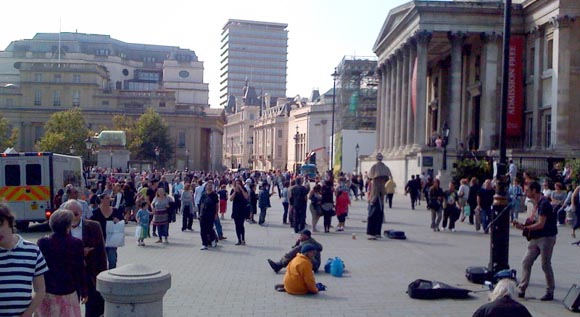
Picture: BG
The Art Newspaper is running a story that needs to be read by Mayor Boris Johnson:
Nicholas Penny, the director of the National Gallery in London, has criticised the contemporary works that temporarily occupy the empty plinth in front of the gallery in Trafalgar Square as “antagonistic to the architectural character of the square”, turning the plinth into “a stage, which can be used ironically, farcically [and] inappropriately”.
In an interview with The Art Newspaper, Penny expressed his “grave concerns” about the square in general, particularly the “tawdry tents and hoardings for advertising” that regularly “conceal” the gallery from view.
Regular readers will not be surprised to hear that I agree with Penny. Trafalgar Square should be one of London's majestic centrepieces, but it's so often disfigured by random concerts and PR events that I often wish it was still isolated by traffic on all sides, as it used to be. At least then the director of the National Gallery didn't have to put up with all those mega-phone touting buskers outside his office.
But Penny is not so sound on the subject of the fourt plinth:
Penny outlined his alternative ideas for the square, proposing that the two northern plinths in front of the gallery should have two “well-matched contemporary works” and that Francis Chantrey’s equestrian statue of George IV be placed on a pedestal within the steps leading up to the gallery from the square.
The fourth plinth has been left empty because it will one day have a statue of the Queen on it, probably an equestrian one, to match that of George IV (and also to reflect HM's love of horses). I had always assumed that this was widely known among the arts establishment, but evidently not.
Update - a reader writes:
Yes, I understood that was the Fourth Plinth Plan as well, HM c.1970 on Burmese. I hope it doesn't fall through the gaps.
London does parks brilliantly, but not squares, like the brand new same old Leicester Square.
Maybe tawdry huckstering is just the London way, like the piazza at Covent Garden.
People of America!
November 5 2012
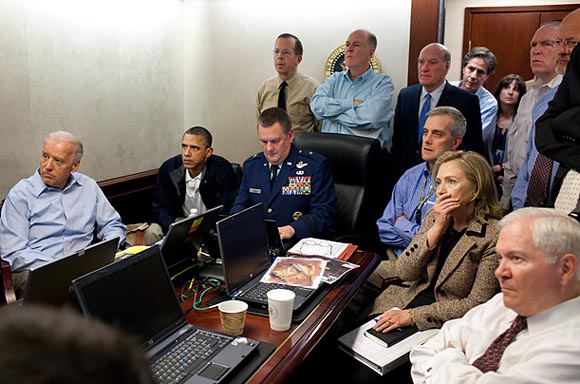
Picture: Time
Both series of our art-sleuthing TV show, 'Fake or Fortune?', will soon be broadcast in America on PBS. But since Mitt Romney has said he will shut down PBS if he's elected, the only way US readers can be sure of seeing the programme is if you vote for President Obama (seen above at a special White House screening of 'Fake or Fortune' earlier this year).
You know your duty...
Picture labels in Bulgaria
November 2 2012

Picture: Tim Williams
Reader Tim Williams has been to Bulgaria, and sends this example of a label from the Gallery of Foreign Art in Sofia. It also seems the gallery has been relying on Google Translate for other labels.

Tim suggests that only the intrepid should visit Bulgaria for its art:
Their museums and galleries are quite bizarre. The gallery of foreign art in Sofia has the most eclectic collection I've ever seen, 80% of which is of really poor quality - when they need a Goya they display a page from the Gazette des Beaux Arts, or a Dali a Divine Comedy print (which you can buy for about £40), some paintings are almost falling off the wall, and in some spots you feel you might go through the floor at any given moment. The old masters were few and far between...
Update - a reader writes:
Three cheers that they at least tried to give text in English! How many museums still do not use anything but the language of their own country?
View from the Artist no.12 - answer
November 2 2012
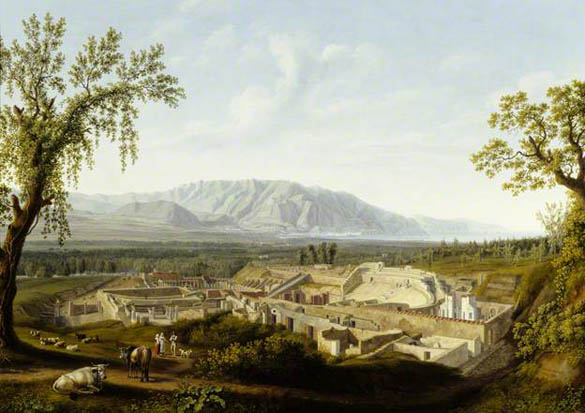
Picture: National Trust
Thanks for all your guesses. Most of you were pretty close, as the subject matter was a bit of a giveaway:
Can't think where a pastoral scene can lie outwith a city in a semi ruinous state. So I am going to guess that it is Jerusalem and there is something of a saintly nature going on in the section that is concealed. I would go Flemish but would want to research this if my baked potato were not sitting on the table in the distance.
Another reader wrote:
Could you possibly expand the detail (not to blind your readers) and to see if someone spot something in the ruins that helps to establish which one it is?
No cheating!
This was amongst the early correct answers:
Artist's view no. 12 is the Jakob Ph. Hackert [Excavations at Pompeii] from Attingham Park [in Shropshire], 1799.
Do I win a cruise now?
Alas, AHN's prize fund is in negative equity. At least one reader was thrilled to be right:
I'm elated to say that I came [up] with the answer: it's from Hackert's Ruins of Pompeii, Attingham Park, The Berwick Collection.
The picture is currently on display at the Getty Centre in Malibu. Not sure why.
Update - a reader alerts me to the current Pompeii exhibition at the Getty.
Looted Kandinsky to be auction
November 2 2012
Picture: Bloomberg
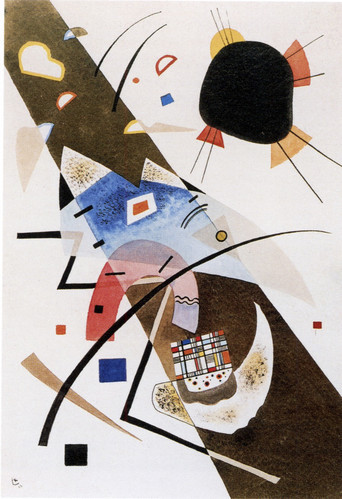
Over on Bloomberg, Catherine Hickley reports that a Kandinsky worth up to $2.4m which was looted by the Nazis is to be sold at Christie's on 7th Nov, after a settlement was agreed with the heirs of German art historian Sophie Lissitzky- Kueppers.
The painting had previously been offered for sale in Cologne at the auction house Lempertz, who disputed the heirs' claim (and who under the Nazis held a number of so-called 'Judenauktions'), but it failed to sell.
More details here.
Fitzwilliam acquires Poussin Sacrament
November 1 2012

Picture: Fitzwilliam Museum
Amazing - the Fitzwilliam Museum has succeeded in buying Poussin's Extreme Unction, one of the Rutland Sacrament series. The total price with tax deductions (through the laudable Acceptance in Lieu scheme) was £3.9m. The Art Fund helped provide £242,000, supporters of the Fitzwilliam another nearly £1m, and the Heritage Lottery Fund £3m. Well done to everyone involved.
This means that the good news from the Heritage Lottery Fund just keeps on coming. Having in the past been very suspicious of helping museums acquire paintings (much to AHN's repeated frustration), they are now proving to be generosity itself. The HLF's recent policy change in this regard is probably the single most important development for the UK's artistic heritage in the last few years. The Fund has lately helped acquire the Manet for the Ashmolean, and a Reynolds full-length for Birmingham, with really substantial grants. It compares favourably with the Fund's previous stinginess and reluctant support for buying paintings (such as the National Gallery's Titians for example), or indeed any objects.
Of course, it may be churlish to mention it now, but imagine what we might have saved if the HLF had always been this supportive of art acquisitions (like another of the Poussin Sacraments, which is now in Texas).
Update - a reader writes:
Further to your recent observation regarding the HLF's apparent change in policy, (below), perhaps the true test of this will come if there is a willingness on the part of the HLF to substantially fund the acquisition of Picasso's Child with a Dove. Given how poorly Picasso is represented in UK public collections it is certainly a very important work to try and keep- and, like the Manet and Poussin, it would come with a- albeit smaller- tax exemption.
We shall see.
The HLF's recent policy change in this regard is probably the single most important development for the UK's artistic heritage in the last few years.
The Fund has lately helped acquire theManet for the Ashmolean, and a Reynolds full-length for Birmingham, with really substantial grants. It compares favourably with the Fund's previous stinginess and reluctant support for buying paintings (such as the National Gallery's Titians for example), or indeed any objects.
