


Apologies...
November 21 2012
...for the lack of service yesterday - rather busy at the moment. Hope to return to posting later today.
Barbarians in Yorkshire
November 19 2012

Picture: Mail/Ross Parry
Vandals in Yorkshire have chopped up and defaced a tree trunk made famous by David Hockney's latest landscape paintings. More here.

Inside the new Prado's Van Dyck show
November 19 2012
"The Young Van Dyck" on Display at the Museo Del... by tvnportal
Video: DailyMotion
Does this cabbage turn you on? (ctd.)
November 19 2012

Picture: Christie's
Following our naughty cabbage story (below), a reader writes:
Couldn't agree more on being rather suspect of reading overly sexual meanings in pictures such as the Dou you posted this week. However, I think from time to time my fellow countrymen painters did like to include a dubious prop or two, such as Abraham van den Tempel in this picture sold at Christie's Amsterdam this week [above]. The calabash in question could hardly be over-interpreted, in my view...
Phwoar.
More fakery (ctd.)
November 19 2012
Video: Momentum Pictures
A reader writes:
With all these stories of dodgy art dealers selling fake paintings to unsuspecting art collectors, I wondered if you had heard that there is a new film that will be released this coming Wednesday (21 Nov), staring Colin Firth as an unscrupulous art dealer who recruits Cameron Diaz to sell a dodgy Monet painting to Alan Rickman? It's called 'Gambit' and the bus shelters of London are currently stuffed with adverts for it, as I discovered while driving round the south circular this afternoon! Apparently it is a remake of a 60s film [with Michael Caine].
More fakery alleged in New York
November 16 2012

Picture: TAN
Here's a really nasty case of contemporary art fakery colliding with dodgy business ethics. The above 'Mark Rothko' was sold to Eleanor and Domenico De Sole in 2004 for $8.3m by the now-closed but previously world-famous Knoedler Gallery in New York. Knoedler had bought the work in $950,000 from Glafira Rosales in 2003, who claimed to be the agent of a mysterious 'Mr X' selling his collection of previously unknown Pollocks, Rothkos, de Koonings, and so on.
Rosaeles is currently under investigation by the FBI for selling fakes. Knoedler recently settled another case of a 'Jackson Pollock' sold by them for $17m in 2007, which the gallery had also bought from Rosales, and which has been proved to be a fake. You can see where this is going...
Having heard of the dubious practices at Knoedler, the De Soles are now suing former Knoedler President, Ann Freedman, claiming that their Rothko is also fake. So far so obvious. But Freedman's defence is, outrageously, that if the 'Rothko' is a fake then it isn't her fault, but that of the De Soles' for buying it. The De Soles' were, the defence goes, foolish to rely on any Knoedler statement of authenticity, and anyway, since this was all in 2004 it is outside the statute of limitations. In other words, go hang.
It also transpires that one of the experts Knoedler said they consulted on the painting denies that he ever examined it. Laura Gilbert in The Art Newspaper has more details:
According to Knoedler and Freedman's motion to dismiss: “In the end, [the] plaintiffs seek to blame Knoedler and Freedman when it was plaintiffs and their art advisor… who acted recklessly: they purchased a multimillion dollar painting without asking a single expert for an opinion considering its authenticity (including any of the experts Knoedler and Freedman said had 'viewed' the work), [and] without seeing a single document reflecting the provenance (which they knew could not be entirely and indisputably verified by Knoedler)… ”
The De Soles argue they could not have known the facts of a fraud until they learned that the London hedgefunder Pierre Lagrange sued Knoedler and Freedman in December 2011, alleging that the gallery sold him a fake Jackson Pollock. The De Soles then hired a forensic expert to examine their painting who concluded that the “materials and techniques… are inconsistent and irreconcilable with the claims that Untitled was painted by Mark Rothko.”
As a dealer, I find the Knoedler defence deeply unsettling. Here's hoping the De Soles win their case...
Behold - the young Van Dyck
November 16 2012

Picture: Prado/Gemäldegalerie der Akademie der bildenen Künste, Vienna
Christmas has come early for this Van Dyck anorak, with the apparent news that Van Dyck's earliest Self-Portrait (above, c.1615) has been cleaned.
I say apparent, because I don't know quite when it happened - but the image on the Prado's website for their forthcoming 'Young Van Dyck' exhibition shows the picture looking very different to all previous illustrations of the picture. So I presume it has been cleaned for the exhibition. Before, the picture was hard to interpret thanks to what looked like ingrained dirt and old varnish remaining in the impasto (see below, and here), and, from the photos at least, was a trifle underwhelming. Now, however, the picture looks as wonderfully fresh and spontaneous as you'd expect a youthful Van Dyck self-portrait to look. It's completely fantastic.
The exhibition opens on 20th November, till 3rd March 2013.

Incidentally, please note how different this undoubted self-portrait is to the Portrait of Van Dyck by Rubens at the Rubenshuis (below) of about the same date, which has lately (and most curiously, in my view) been attributed to Van Dyck. I see for now that the Rubenshuis website still identifies the picture as by Rubens, which is a relief. You can see a high-res image of the Rubens here for comparison with the Prado picture.

More on that lost 'n found Renoir
November 16 2012

Picture: Washington Post. Susan Helen Adler, niece of Saidie Adler May, poses outside the Baltimore Museum of Art. On her T-shirt is a photo of the stolen Renoir.
That Renoir bought in a flea market for just $7, and which turned out to have been stolen from the Baltimore Museum of Art, has renewed tensions between the museum and the family of the collector who donated the picture to the museum, Saidie Adler May. From The Washington Post:
The relatives said they believe that the museum has not always safeguarded their family’s donations. Until late October, the descendants didn’t know that art donated by May’s sister, Blanche Adler, a prominent BMA donor, also had been stolen from the museum. They also complained that the museum does not display enough of May’s art.
Museum officials said the thefts happened a long time ago, and security has been beefed up considerably since. They noted that the museum can show off only so much from one family’s collection, and that May’s mix of classical and Egyptian works, Renaissance textiles, 20th-century European paintings, and even a Jackson Pollock, was given with no strings attached.
National Gallery exhibitions 2013
November 16 2012

Picture: National Gallery/Scala
Newly announced treats next year include:
BAROCCI: BRILLIANCE AND GRACE
27 February – 19 May 2013, Supported by The Joseph F McCrindle Foundation, Sainsbury Wing, Admission charge
Federico Barocci (1535–1612) is celebrated as one of the most talented artists of late 16th-century Italy. Fascinated by the human form, he fused charm and compositional harmony with an unparalleled sensitivity to colour.
Thanks to the cooperation of the Soprintendenze delle Marche, the exhibition will showcase Barocci’s most spectacular Marchigian altarpieces, including his famous Entombment from Senigallia [above]
and Last Supper from Urbino Cathedral – never before seen outside Italy. In total, 16 of his most important altarpieces and devotional paintings and five of his finest portraits will be on display alongside their preparatory drawings and oil sketches.
Barocci was an incessant and even obsessive draughtsman, preparing every composition with prolific studies in every conceivable medium. Drawing from life and inspired by the people and animals that surrounded him, his works are characterised by a warmth and humanity that transform his religious subjects into themes with which all can identify.
VERMEER AND MUSIC:
LOVE AND LEISURE IN THE DUTCH GOLDEN AGE *
26 June – 8 September 2013, Sainsbury Wing, Admission free
This exhibition explores the concept of music as a pastime of the elite in the northern Netherlands during the 17th century.
Vermeer and Music: Love and Leisure in the Dutch Golden Age will bring together for the first time the National Gallery’s two paintings by Vermeer, Young Woman Standing at a Virginal and Young Woman Seated at a Virginal, and Vermeer’s Guitar Player, on exceptional loan from the Iveagh Bequest, Kenwood House. The exhibition aims to enhance viewers’ appreciation of these beautiful and evocative paintings by Vermeer and his contemporaries by juxtaposing them with musical instruments and songbooks of the period. Visitors will be able to compare 17th-century virginals, guitars, lutes and other instruments with their painted representations to judge the accuracy of representation and what liberties the painter might have taken to enhance the visual or symbolic appeal of his work. In 17th- century Dutch paintings, music often figured as a metaphor for harmony, a symbol of transience or, depending on the type of music being performed, an indicator of one’s education and position in society. Musical instruments and songbooks were also included as attributes in elegant portraits to suggest that the sitter was accomplished in this area.
THE PORTRAIT IN VIENNA 1867–1918 *
9 October 2013 – 12 January 2014, Sainsbury Wing, Admission charge
The Portrait in Vienna 1867–1918 is the first exhibition to explore Viennese portraiture during the Austro-Hungarian Empire, showing both the continuity and the rupture between the Biedermeier and imperial traditions of the 19th century and the innovations of avant-garde artists such as Gustav Klimt, Egon Schiele, Richard Gerstl and Oskar Kokoschka in the years around 1900. The period is widely regarded as the time when the avant-garde overthrew the academy.
The exhibition explores how portraiture came to be closely identified with the distinctive flourishing of modern art in Vienna during its famed fin-de-siècle years. It is divided into six sections: Biedermeier-Modern (the rediscovery around 1900 of early 19th-century portraits of the Alt-Wien bourgeoisie); Modern Family/Modern Child; The Artist; Modern Men/Modern Women; Love and Loss (the use of the portrait to declare love and commemorate the dead); and Finish and Failure (unfinished works abandoned by frustrated artists, or rejected by outraged sitters).
National Trust picks up a bargain
November 16 2012

Picture: Christie's
Good to see that the National Trust is not averse to a spot bargain hunting. Curators at Dunham Massey will soon be receiving the above portrait of George Booth, 1st Lord Delamer, bought at Christie's in New York for just $2,125. In their Arts Bulletin, the Trust reveals that it found some extra provenance linking the picture to the house. But despite their purchase, the Trust seem cautious about firmly identifying the sitter, although it's a dead ringer for their other portrait of Delamer, attributed to Lely.
Does this cabbage turn you on?
November 16 2012

Picture: Schwerin, Staatliches Museum/Erich Lessing, Art Resource New York
To the authors of a new study in Volume 35 of Art History,* the above cabbage is 'startlingly erotic'. In The Erotics of Looking: Materiality, Solicitation and Netherlandish Visual Culture, Angela Vanhaelen and Bronwen Wilson have written an engaging piece exploring supposed sexual themes in pictures like Woman Peeling a Carrot by Gerrit Dou (below, Schwerin, Staatliches Museum), which they call 'sexually charged'.
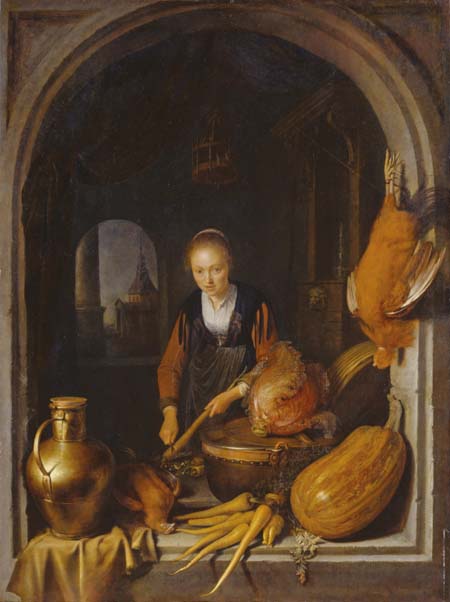
Personally, I'm not entirely convinced by their argument, which I enjoyed reading. But read the article yourself and let me know what you think. The authors rightly establish at the outset of their piece that there is a problem with interpreting pictures like Dou's in an overly sexual way:
Early modern Netherlandish artists did not write all that much about their practice and what little they did write has long frustrated art historians with its seeming refusal to divulge information about what the pictures actually mean. While art treatises devote much attention to the mechanics of art making, they contain no instructions about how to interpret the enigmatic visual motifs that recur especially in the ostensibly descriptive genres such as still life, landscape and genre scenes. Instead, the treatises repeatedly describe both the making and viewing of art in explicitly erotic language.
I'm not so sure. One of the treatises they refer to is Karel van Mander's 1603/4 Lives of the Illustrious Netherlandish and German Painters, which is hardly Forum. Florid certainly, but probably not that erotic. Unfortunately, none of van Mander's text is cited by Vanhaelen and Wilson for the general reader to make their own judgement.
Anyway, the article reminds me of a Dutch-inspired late 17th Century picture we have in stock here at the gallery. It shows Charles II's famous mistress Nell Gwyn (below, the head is based on Samuel Cooper's lost miniature) washing sausages, with a breast exposed, and satirically dressed in virginal white. In this case, we don't really need to find any texts by the likes of van Mander to know that its meaning is sexual. The sausage washing theme goes back to Brueghel the Elder, and is a fairly common one when suggesting an erotic subject matter.
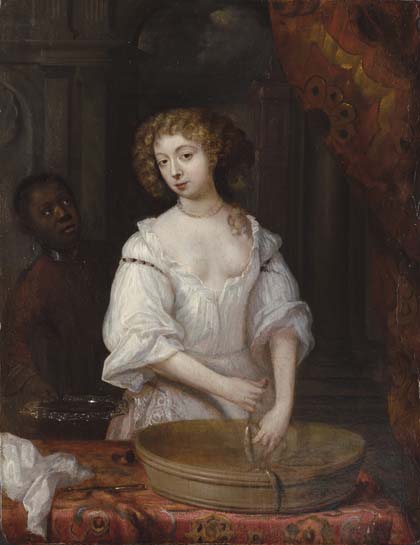
That said, I have always felt that pictures like Nell Gwyn's are not only taking their satirical aim at the sitters, but also at the Dutch genre pictures they're ripping off. Dou's woman may be peeling a large, firm carrot of the sort treasured by Uncle Monty in Withnail & I, but regular readers will know that I'm not one for seeing willies everywhere in paintings. And if we're not supposed to see 'startlingly erotic' cabbages in works just decades earlier by those fathers of still-life, Joachim Beuckelaer and Pieter Aertsen, then I'm not sure we are in Gerrit Dou's work either. At least, not until someone finds some convincing contemporary evidence that we are.
*kindly flagged up to me by Dr Matt Loder from the Association of Art Historians.
Fresco Jesus - the restorer's story
November 15 2012
As told to Saturday Night Live.
New director at the Barber Institute
November 15 2012

Picture: Barber Institute
Congratulations (a little belated I'm afraid) to Nicola Kalinsky, who has become the new director of the Barber Institute in Birmingham. More details here.
How do you sell a £10m Raphael (ctd.)
November 15 2012
Video: Sotheby's
It's interesting to see that Sotheby's have toned down the hyperbole in their video for Raphael's drawing Head of an Apostle, which is being offered for sale in London next month at £10m-£15m. In the 'trailer' for the above film, we previously had Sotheby's head of contemporary art, Tobias Meyer, saying:
This drawing is the complete pivotal centrepoint of art history. It opens up everything toward the future.
Now that has become a more honest:
Everything that ultimately becomes relevant for the future of art history is right in this drawing.
But in a sign that Sotheby's are still hoping to lure contemporary bidders towards the drawing, we get Meyer summarising it thus:
...it has the intensity of a great Warhol, or a great Bacon. The fact that it is over 500 years old is completely irrelevant.
You and I might disagree about that. But what is incontrovertibly (and to me mind-bogglingly) true is that compared to a 'great Warhol', this undeniably great Raphael is cheap.
Also worth a watch is Sotheby's video on two important Burgundian manuscripts being sold by the Duke of Devonshire in December. It's notably free of guff, and much the better for it. Somebody should give Sotheby's manuscript specialist Dr Timothy Bolton his own TV show - he's brilliant.
Update - a reader writes, naughtily:
I think the real star of that Sotheby's video is Tobias Meyer's hairdo.
Boom (ctd.)
November 15 2012
Video: Christie's
Alas, Sotheby's excitement at their highest auction total ever ($375m) was short-lived. Last night Christie's New York contemporary art sale fetched a record total of $412.2m. The top lot was, inevitably, a Warhol, the Statue of Liberty silkscreen featured in the video above. Another Warhol, of Marlon Brando, made $23.7m. The fact that it last sold in 2003 for $5m gives you an idea of how crazy the art world is.
Carol Vogel in the New York Times says Christie's knew they were in for a big night, because:
...in addition to a great deal of interest in the sale from collectors around the world, Brett Gorvy, chairman of Christie’s postwar and contemporary art department worldwide, said there had been a record number of requests for sky boxes — those invitation-only spaces secreted a floor above the salesroom, where the superrich can watch and bid without being seen.
Yuk.
Boom
November 14 2012

Picture: Sotheby's
Sotheby's have brought out the bunting to celebrate their highest ever auction total at last night's contemporary art sale in New York. Aided by a $75m Mark Rothko (above), the sale took in $375m (inc. premiums). Full details here.
Tut tut
November 14 2012

Picture: Bonhams
In just over two weeks time, Bonhams Old Master sale will go on view at Bond Street. But their catalogue is still not online.
Update - now it is! This means I can stop pressing refresh every hour... It's good to see that Bonhams has resolved its zoom image issues - now they're excellent. Sotheby's have got much better too.
More on the Prado's new Titian
November 13 2012
A reader has kindly alerted me to the above video, in which we can briefly see the Prado's St John the Baptist by Titian before it was restored. It looks very damaged, but much better.
I've asked the Prado for an image of the picture in its stripped down state, but answer comes there none...
National Gallery annual review
November 13 2012

Picture: National Gallery
The National Gallery's annual review for 2011-12 has been published, and is worth a read. It details all the latest acquisitions and loans, and surveys what must be one of the Gallery's most successful years ever, with the acquistion of Titian's Diana and Callisto, and the Leonardo exhibition (which was the Gallery's busiest yet). Regarding the latter, I see that in his introduction, Director Nicholas Penny makes a special mention of the 'loyalty of a group of Gallery Assistants' who broke the strikes at the Gallery last year, and allowed the Leonardo exhibition to remain open.
NPG buys portrait of Gerry Adams
November 13 2012

Picture: Irish Times
The National Portrait Gallery in London has bought a portrait of the Sinn Fein leader, Gerry Adams (detail, above).
When should the NPG display portraits of contemporary figures? At what point in history does it decide who deserves to have their portrait included in the national collection? Should the NPG acquire and display portraits of here today gone tomorrow types, as it sometimes does now? Or should it remember that as Shakespeare wrote, 'all that glistens is not gold', and present a more discerning array of the nation's leading figures, one advised by the passage of time and not contemporary notions of celebrity, success or sanctity. If you think the former course is the right one, then there will inevitably be times when the NPG comes to regret spending public money on portraits of people it will one day have no desire to display. Because for some contemporary figures we cannot know now, with confidence, how history will judge them.
Update - a reader tweets:
I shouldn't think Gerry Adams will be wild about being included in the British NPG either!
Update II - another reader writes:
The NPG question is interesting. How much of its mandate is DNB and how much 'Who's Who'? The 'Who's Who' part is always very busy. Gerry Adams's teflon 'statesman' persona means he fits both criteria.
