


Also not Seduced by Art
November 5 2012
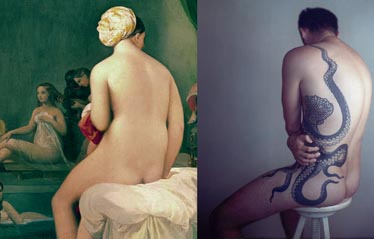
Picture: National Gallery
Further to my raised eyebrow last week, the great Waldemar also is a little baffled by the National Gallery's latest exhibition, 'Seduced by Art':
The good news about Seduced By Art is that it is the first major photography show mounted by the National Gallery. New approaches are being explored, and modern moods. The bad news is that the show itself is a mess: incoherent, under-whelming, and sent all over the place by hit and hope curatorial thinking.
And if you thought that was bad, wait till you see what Brian Sewell has to make of it. I'll skip the usual barbed zingers, and take you straight to his forensic critique of the premise behind the show:
The gallery has, it seems, “specially commissioned for the exhibition” new photographs to compete with old paintings, but that it should feel compelled to do so surely indicates that there must have been too little evidence to lend importance to the link, and thus that it is a point hardly worth the demonstrating in an exhibition. If the underlying thesis is that photography must be acknowledged as an art of pictorial legitimacy equal to that of painting, yet, in order to support it, photographers must be let loose in the gallery, there to be inspired into rivalry with the old masters, then the thesis must be very weak and the curators should not have been allowed to engineer the evidence. To turn the thesis on its head, however, and prove that painters with no imagination are readily seduced by photography (and even use it as a form of underpainting, even of easy collaboration), then the visitor to the National Gallery has only to wander upstairs and examine the spurious paintings of Richard Hamilton (and why are these, pray, in Trafalgar Square rather than any of the too many Tates?), or go next door to the National Portrait Gallery where, annually, ghastly portraits based on photographs are jubilantly exhibited as art.
[...]
To be blunt, I was not provoked but sickened by this exhibition, nausea my overwhelming response to it. As an exhibition, its content is much less than the ugly catalogue suggests and the hang so haplessly confused that it fails to make the points energetically promoted in the text — but the catalogue too is repellent, the nastiest example of book design ever issued by Yale University Press. None of this would matter were it the show of the year in Milton Keynes or Margate but it is in London, in Trafalgar Square, in the National Gallery with Christopher Riopelle (in charge of 19th-century paintings there) as co-curator, and that magisterial institution is disgraced by it. Shoddy, mischievous and gravely mistaken, intellectually the work of students at some post-polytechnic university, those who devised it have seduced the National Gallery, led it astray, debauched and corrupted it.
Ouch.
On the other hand, Laura Cumming is on hand in The Observer to give us some much needed balance:
...Seduced By Art is an enthralling show, beautifully selected to express the numerous ways in which painting has inspired or affected the evolution of photography. It has work by contemporary art photographers such as Nan Goldin and Thomas Struth, but most of the pictures are 19th century, and not the least of its pleasures is the intermingling of paintings by Goya and Degas, say, with photographs by Fox Talbot and Nadar.
High-res and free at the Rijksmuseum
November 5 2012

Picture: Rijksmuseum
The Rijksmuseum in Amsterdam now allows you to download and use for free (for personal use) high-resolution images of their collection. Above is a detail of Van Dyck's Portrait of Johannes Baptista Franck, c.1621.
Plug
November 5 2012
Picture: CUP
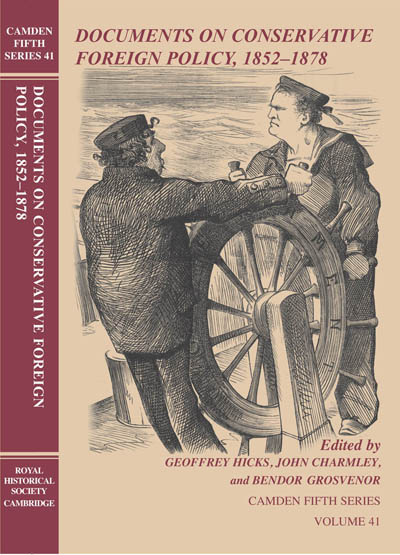
Because I know you're all dying to buy it, here's the cover for my forthcoming book. It shows Benjamin Disraeli (left) and his Foreign Secretary Lord Derby pulling the wheel of government in opposite directions during the Great Eastern Crisis of 1877-8. The book will be out on 30th November - just in time for the Christmas bestseller lists. You can't yet buy it on Amazon.
Save Trafalgar Square
November 5 2012
Picture: BG
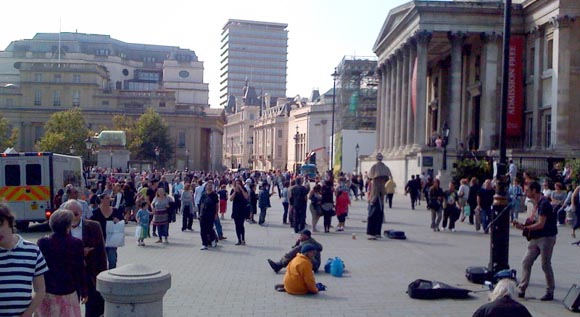
The Art Newspaper is running a story that needs to be read by Mayor Boris Johnson:
Nicholas Penny, the director of the National Gallery in London, has criticised the contemporary works that temporarily occupy the empty plinth in front of the gallery in Trafalgar Square as “antagonistic to the architectural character of the square”, turning the plinth into “a stage, which can be used ironically, farcically [and] inappropriately”.
In an interview with The Art Newspaper, Penny expressed his “grave concerns” about the square in general, particularly the “tawdry tents and hoardings for advertising” that regularly “conceal” the gallery from view.
Regular readers will not be surprised to hear that I agree with Penny. Trafalgar Square should be one of London's majestic centrepieces, but it's so often disfigured by random concerts and PR events that I often wish it was still isolated by traffic on all sides, as it used to be. At least then the director of the National Gallery didn't have to put up with all those mega-phone touting buskers outside his office.
But Penny is not so sound on the subject of the fourt plinth:
Penny outlined his alternative ideas for the square, proposing that the two northern plinths in front of the gallery should have two “well-matched contemporary works” and that Francis Chantrey’s equestrian statue of George IV be placed on a pedestal within the steps leading up to the gallery from the square.
The fourth plinth has been left empty because it will one day have a statue of the Queen on it, probably an equestrian one, to match that of George IV (and also to reflect HM's love of horses). I had always assumed that this was widely known among the arts establishment, but evidently not.
Update - a reader writes:
Yes, I understood that was the Fourth Plinth Plan as well, HM c.1970 on Burmese. I hope it doesn't fall through the gaps.
London does parks brilliantly, but not squares, like the brand new same old Leicester Square.
Maybe tawdry huckstering is just the London way, like the piazza at Covent Garden.
People of America!
November 5 2012
Picture: Time
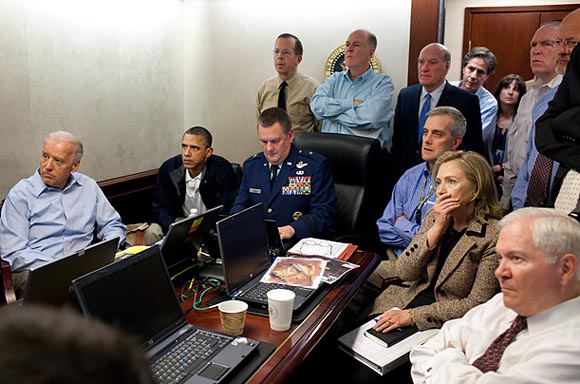
Both series of our art-sleuthing TV show, 'Fake or Fortune?', will soon be broadcast in America on PBS. But since Mitt Romney has said he will shut down PBS if he's elected, the only way US readers can be sure of seeing the programme is if you vote for President Obama (seen above at a special White House screening of 'Fake or Fortune' earlier this year).
You know your duty...
Picture labels in Bulgaria
November 2 2012
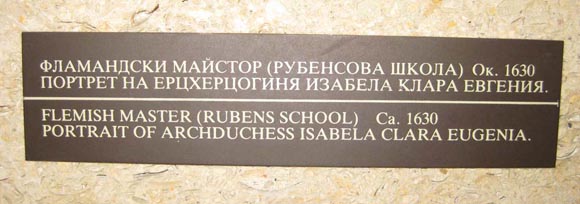
Picture: Tim Williams
Reader Tim Williams has been to Bulgaria, and sends this example of a label from the Gallery of Foreign Art in Sofia. It also seems the gallery has been relying on Google Translate for other labels.
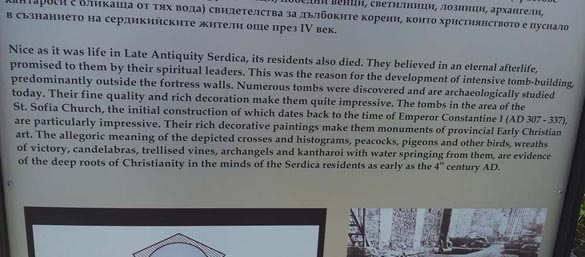
Tim suggests that only the intrepid should visit Bulgaria for its art:
Their museums and galleries are quite bizarre. The gallery of foreign art in Sofia has the most eclectic collection I've ever seen, 80% of which is of really poor quality - when they need a Goya they display a page from the Gazette des Beaux Arts, or a Dali a Divine Comedy print (which you can buy for about £40), some paintings are almost falling off the wall, and in some spots you feel you might go through the floor at any given moment. The old masters were few and far between...
Update - a reader writes:
Three cheers that they at least tried to give text in English! How many museums still do not use anything but the language of their own country?
View from the Artist no.12 - answer
November 2 2012
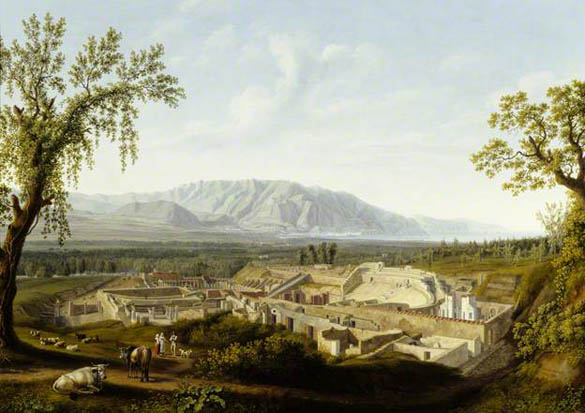
Picture: National Trust
Thanks for all your guesses. Most of you were pretty close, as the subject matter was a bit of a giveaway:
Can't think where a pastoral scene can lie outwith a city in a semi ruinous state. So I am going to guess that it is Jerusalem and there is something of a saintly nature going on in the section that is concealed. I would go Flemish but would want to research this if my baked potato were not sitting on the table in the distance.
Another reader wrote:
Could you possibly expand the detail (not to blind your readers) and to see if someone spot something in the ruins that helps to establish which one it is?
No cheating!
This was amongst the early correct answers:
Artist's view no. 12 is the Jakob Ph. Hackert [Excavations at Pompeii] from Attingham Park [in Shropshire], 1799.
Do I win a cruise now?
Alas, AHN's prize fund is in negative equity. At least one reader was thrilled to be right:
I'm elated to say that I came [up] with the answer: it's from Hackert's Ruins of Pompeii, Attingham Park, The Berwick Collection.
The picture is currently on display at the Getty Centre in Malibu. Not sure why.
Update - a reader alerts me to the current Pompeii exhibition at the Getty.
Looted Kandinsky to be auction
November 2 2012
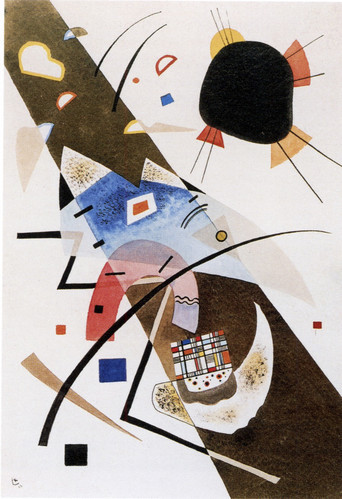
Picture: Bloomberg
Over on Bloomberg, Catherine Hickley reports that a Kandinsky worth up to $2.4m which was looted by the Nazis is to be sold at Christie's on 7th Nov, after a settlement was agreed with the heirs of German art historian Sophie Lissitzky- Kueppers.
The painting had previously been offered for sale in Cologne at the auction house Lempertz, who disputed the heirs' claim (and who under the Nazis held a number of so-called 'Judenauktions'), but it failed to sell.
More details here.
Fitzwilliam acquires Poussin Sacrament
November 1 2012

Picture: Fitzwilliam Museum
Amazing - the Fitzwilliam Museum has succeeded in buying Poussin's Extreme Unction, one of the Rutland Sacrament series. The total price with tax deductions (through the laudable Acceptance in Lieu scheme) was £3.9m. The Art Fund helped provide £242,000, supporters of the Fitzwilliam another nearly £1m, and the Heritage Lottery Fund £3m. Well done to everyone involved.
This means that the good news from the Heritage Lottery Fund just keeps on coming. Having in the past been very suspicious of helping museums acquire paintings (much to AHN's repeated frustration), they are now proving to be generosity itself. The HLF's recent policy change in this regard is probably the single most important development for the UK's artistic heritage in the last few years. The Fund has lately helped acquire the Manet for the Ashmolean, and a Reynolds full-length for Birmingham, with really substantial grants. It compares favourably with the Fund's previous stinginess and reluctant support for buying paintings (such as the National Gallery's Titians for example), or indeed any objects.
Of course, it may be churlish to mention it now, but imagine what we might have saved if the HLF had always been this supportive of art acquisitions (like another of the Poussin Sacraments, which is now in Texas).
Update - a reader writes:
Further to your recent observation regarding the HLF's apparent change in policy, (below), perhaps the true test of this will come if there is a willingness on the part of the HLF to substantially fund the acquisition of Picasso's Child with a Dove. Given how poorly Picasso is represented in UK public collections it is certainly a very important work to try and keep- and, like the Manet and Poussin, it would come with a- albeit smaller- tax exemption.
We shall see.
The HLF's recent policy change in this regard is probably the single most important development for the UK's artistic heritage in the last few years.
The Fund has lately helped acquire theManet for the Ashmolean, and a Reynolds full-length for Birmingham, with really substantial grants. It compares favourably with the Fund's previous stinginess and reluctant support for buying paintings (such as the National Gallery's Titians for example), or indeed any objects.
Art conservation, Italian style (ctd.)
November 1 2012

Picture: 3PP/Google Art Project
In an interesting post over on Three Pipe Problem, Hasan Niyazi describes why he is so keen on Raphael, and reveals that the first time he saw he Raphael's Self-Portrait in the Uffizi, it was displayed in a rather sad setting (above):
At this point in time, the portrait was in a scuffed corner of a room featuring works by Raphael and Andrea del Sarto. I recall it was near a window, which on the day was partially ajar to allow in some air, showing a glimpse of the Arno river.
Beneath the picture is a portable humidifier.
View from the artist no.12
November 1 2012

We haven't had one of these for a while - can you guess where the view is, who painted it, and when?
Elizabeth I goes to Moscow
November 1 2012

Picture: Kremlin Museum
The earliest full-length portrait of Elizabeth I is the star attraction at a new exhibition on the English Tudor and Stuart court at Moscow's Kremlin museum. The picture is a favourite of mine - when Philip Mould bought it in 2007, I spent a long time researching it with Dr David Starkey. Amazingly, it had never been published before, so there was plenty of work to do. Philip wrote a chapter on the process in his book, Sleuth.
The exhibition is being put on jointly by the V&A, and the portrait will be displayed at the V&A next year from 9th March. In the meantime, you can find more details on on our research here.
Galleries flooded in New York
November 1 2012
Bloomberg reports that a number of art galleries in New York's Chelsea district have been hit by the recent flooding. Sotheby's in New York have also postponed some sales.
The Raphael app
October 31 2012

Picture: Louvre
Talking of Raphael, I haven't noted that the 'Late Raphael' exhibition which was recently on at the Prado has now opened at the Louvre. It's there until January 14th. To whet your appetite, there's even a Raphael app.
How do you sell a £10m Raphael drawing?
October 31 2012
Video: Sotheby's
If you're Sotheby's, with a touch of Hollywood, and lashings of hyperbole. In this cleverly shot 'trailer', Sotheby's have gone all moody, with string music and tilt shift focussing to give a tempting glimpse of the Raphael Head of an Apostle on offer in their December Old Master sale (with an estimate of £10m-£15m). They have also drafted in their 'voice' of art, Tobias Meyer, which suggests, given that he is usually to be found selling modern and contemporary art, that Sotheby's are hoping to look beyond the circle of Old Master buyers for the drawing.
I'm all for presenting Old Masters in a trendy new light. But check out the guff here - Meyer says, presumably without blushing:
This drawing is the complete pivotal centrepoint of art history. It opens up everything toward the future.
Now it's a fine drawing, and will no doubt exceed its estimate. But if an art history undergraduate said that a drawing (or more specifically, an 'auxilary cartoon') for an unnamed apostle by Raphael was 'the complete pivotal centrepoint of art history', that is, a work so important that every other work of art before or since revolved around it, their tutor would not only choke on his or her biscuit, but stab the paper violently with a red pen.
Must try harder...
Not seduced by art
October 31 2012

Picture: BG
On Monday, I was lucky enough to have two invitations on my desk for private views. One for the National Gallery's new exhibition 'Seduced by Art' - which pairs photography with painting in a 'dialogue' - and another for the Royal Collection's new show The Northern Renaissance - Durer to Holbein. Which one to go to?
It was of course a no brainer. As I wrote last week, I find the new 'contemporary resonance' route being taken by the National Gallery all a bit off beam. I'll write more on the excellent Northern Renaissance later. But I'm interested to see in The Guardian today that Jonathan Jones finds that Seduced by Art makes little sense:
It is all very interesting, but it feels like a conversation between people speaking different languages. Photography and painting are profoundly different. One is made by hand, the other by a machine. Painting is an transfiguration of reality by the painter's imagination, a photograph is a deposit of light on to paper or digital memory.
Incidentally, if you are ever similarly spoilt for choice for private views, always go to the Royal Collection. They let you take drinks into the exhibition, so that even for die-hard anti-socials like me the combination of fine wine, art and good company is all most convivial. And they even allow you to take photos. I snapped the above Noli me Tangere by Holbein; don't you think it should be re-named Karate Jesus?
Bond on art
October 31 2012

Pictures: Eon productions
I haven't seen the new Bond film Skyfall yet,* but apparently it features a nice scene in the National Gallery. Daniel Craig, above, can be seen admiring works by Gainsborough and Wright of Derby. (In Derby, this has caused great excitement.) I'm secretly hoping that, in return for allowing the filming, National Gallery director Nick Penny managed to blag a role as an extra. Has anyone spotted him?
Bond clearly likes good old fashioned painting. In Dr. No, a scene in Bond's London apartment (below) reveals him to own a Kneller or Jervas-like portrait. And in the same film, Bond spots that Dr. No has stolen Goya's Portrait of the Duke of Wellington. Clearly, Bond reads AHN.

* and please let it be better than the woeful song by Adele.
Van Dyck watch
October 30 2012

Picture: BG
Spotted in the new Burlington Magazine, coming up at Christie's in London this December, a fine Italian period work, probably unfinished. The estimate is £700,000-£1,000,000. I bet it makes more...
Guffwatch - Koons special
October 30 2012
Video: Christie's
I always love the contrast in these videos between artists speaking guff, and the Christie's suits trying desperately to explain why the guff is worth millions of dollars. In this case, the 'piece' is so special it's catalogued as 'estimate on request'. And if you need to request, you can't afford it.
For more guff, check out the lot notes for Tulips (which, inevitably contains the word 'iconic' not once but twice). Here's a good couple of lines:
It is an enchanting sculpture that casts the illusion of joyous weightlessness but is paradoxically heavy, employing over three tons of meticulously sculpted stainless steel. This is a multivalent sculpture, operating on a number of different levels from the simple and directly arresting visual beauty of the object and its awe-inspiring scale, to the ground-breaking complexity of its fabrication and to the deep conceptual themes which lie beneath its apparently flawless surface.
Update - Dr Ben Harvey tweets:
The tulip, symbol of deluded markets and vastly overinflated prices?
Ah, but it's multivalent you see - so it could be a symbol of anything.
Update II - In The Star Ledger, Dan Bischoff tells us that Tulips is (are?) being sold by Norddeutsche Landesbank, and is slated to fetch up to $20m. It was bought for $2.2m in 2002:
“Tulips” has been on display in the bank’s courtyard in the German city of Hanover since it was bought for $2.2 million in 2002. The bank hopes to raise $20 million in the sale, which gives some idea of the incredible price spike we’ve seen over the past 10 years for contemporary art.
Banks, Koons, profit, guff - Tulips presents a good narrative of all that's crazy in the art world.
Got a dirty picture?
October 30 2012
Video: Museo Thyssen
If you have a picture at your museum which needs conservation, then consider applying to the Bank of America Merrill Lynch's Art Conservation Project. The closing date for this year's grants is 30th November. Above is a video from the Museo Thyssen, which has been funded by the bank to clean Tintoretto's Paradise.
