


What price modesty?
October 9 2012

Pictures: BG
My post below about Gainsborough's grave reminds me of a thought I recently had about the new RAF Bomber Command memorial in Green Park (London); to what extent should a benefactor's name be put on a memorial?
In the case of poor old Gainsborough, the artist himself asked specifically for a very simple inscription. But in 1865 Edward Matthew Ward, a history painter, restored the grave, installing in the process a much more verbose plaque (as seen above). And bizarrely, Ward put his own name on it, which is written in even larger letters than Gainsborough's.
We are not faced with anything quite so absurd with the new Bomber Command memorial, which I like very much. But I still find it a little de trop that the most prominent names carved on the side and front of the memorial - in fact, pretty much the only names on the whole site - are those not of the leading airmen of the war or the most decorated, or those who were killed, but those who helped pay for it (below). We must of course applaud Lord Ashcroft and John Caudwell (founder of Phones4U) for their generosity in supporting the memorial. But surely it would have been better, in both the case of Gainsborough's grave and the Bomber Command memorial, if modesty had triumped over vanity?
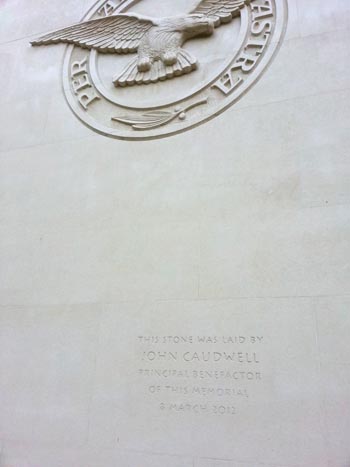
Update - a reader writes:
I'm glad you like the Bomber Command memorial. My Grandfather missed seeing it by a couple of years and I think he would have been secretly very moved.
You're quite right about carving names. Recently I was at a school reunion and I noticed there were a lot of empty panels in the dining hall. I knew the school would be millennium fundraising soon and I had a brilliant idea. Why not donate by sponsoring panels and having our names carved in them? My friends were all very keen but while we were negotiating the price of immortality there was another appeal for the new war memorial, designed with empty spaces for the future. This put everything in its proper perspective.
And another:
Re. Bomber Command Memorial. I quite agree, to me it’s an insult. I once read there are two considerations when giving to charity. One give that which you cannot really afford to give. Two don’t tell the world about it.
Gainsborough's grave restored
October 9 2012

Picture: BG/St Anne's Church Kew
Some time ago, I highlighted the parlous state of Gainsborough's grave in Kew (above), and the efforts of St Anne's Church to raise funds to restore it. I'm delighted to report that the Friends of St Anne's succesfully raised the necessary £15,000, and have now completed their work.
More grave matters here.
Developing connoisseurship
October 9 2012

Picture: NPG
A reader poses an interesting question:
The two series of Fake or Fortune have really piqued my interest in the art world, the problem is no I know very little about it.
For a total beginner looking to develop his eye, with an aim to start collecting in the future what steps do I need to take? I understand there are no short cuts involved but are there any specific books or other resources I should be looking at?
Books? Pah. You can't learn much from tiny illustrations. The best advice I can give to anyone wanting to improve their 'eye' is to go to as many museums, auction rooms and stately homes as possible, and simply look at pictures - as if your life depended on it. Practice the art of close looking by staring intently at as many pictures you can, as close as you can, until the room guards begin to wonder if you're entirely normal. Take a pair of binoculars, and if you dare a torch. Spend just as long looking at bad pictures as good ones (for that's really the best way to train your eye to spotting genuine masterpieces; you have to first be able to tell the difference between, say, a copy, a workshop variant, and the real thing). So just look, look, look. And always buy the guidebook, or the picture list. In time, you can use it to test yourself with the attributions.
Of course, the perfect primer for anyone starting out is Kenneth Clark's epic TV series, Civilisation. Order a copy (on Blu-Ray ideally) here.
Update - a reader writes:
Bendor, why don't you organize some "conoisseurship workshops" in your gallery, allowing prospective collectors to examine closely real things, copies and workshop variants? I am sure would be very popular!
Today...
October 8 2012
...we have a planning meeting for the next series of 'Fake or Fortune?', and then I must write a lecture (for this evening, on Van Dyck). So service may be a little thin I'm afraid...
Why did nobody hit him?
October 8 2012

Picture: Guardian
An idiot has scrawled graffiti on a Mark Rothko painting at Tate Modern. Some reports say he used black paint and a small brush. That is, it was more than the work of a moment. And then, after 'sitting there for a while', he was able to leave without being caught.
As we say over on Twitter, #securityfail.
Update - even the idiot in question* was surprised:
"I was expecting that the security at Tate Modern would take me straight away, because I was there and I signed the picture in front of a lot of people. There is video and cameras and everything, so I was shocked."
*here on AHN we have a no-naming rule for publicity seeking prats.
Update II - he's been arrested. Now can we hit him?
A bargain Bond in paint?
October 5 2012

Picture: Artnet
Sometimes Bonhams puts pictures in rather random sales, where they pass under the normal picture-buying radar. (I once bought a very important portrait of Disraeli in a 'Gentleman's Library' sale for peanuts. It's now hanging in the House of Commons.) The painting above came up last year in an 'Entertainment Memorabilia' sale, and sold for just £5,400 (inc. premium). Today's 50th Anniversary of Dr No, the first Bond film, has reminded me of it.
The picture was catalogued as 'attributed to Robert McGinnis', who designed the poster for The Man with the Golden Gun. Bonhams suggested it was the unfinished preparatory painting for the iconic poster. In which case, the picture was a steal at £5,400. But I see that the Bonhams website carries this update, with a quote from Mr McGinnis:
"It's possible I did it and have forgotten; however, if I didn't do it, someone made an exact copy of my final poster painting of Roger Moore."
So depending on Mr McGinnis' memory, it was either the Bond bargain of the decade, or a rather cunning fake. It thought it was well painted - if I'd seen it, I reckon I'd have had a punt...
Long live Charles III
October 4 2012

Picture: Highland Council/PCF
Fellow Jacobites will be pleased to see this portrait of Bonnie Prince Charlie firmly catalogued as 'Charles III' on the Your Paintings website. It belongs to the Highland Council, which gives you some idea of the residual Jacobite loyalties up in highland Scotland.
The artist is given as 'Attributed to Pompeo Battoni'. But it is of course a Hugh Douglas Hamilton type, and would appear to be by him. You can see another version here at the NPG. It's a rare portrait of Charles as an older man, and rather sad.
Council to sell £20m Moore statue
October 4 2012

Picture: East London Advertiser
Tower Hamlets council is planning to sell a Henry Moore sculpture, Draped Seated Woman. Acquired for £6,000 in 1960, it is currently stored at the Yorkshire Sculpture Park (above, which the East London Advertiser refers to simply as 'a field in Yorkshire') for fear of vandalism. More details here.
Newly discovered Elsheimer in Munich
October 4 2012

Picture: Alte Pinakothek, Munich
A newly discovered Mystic Marriage of St Catherine by Adam Elsheimer has been put on display at the Alte Pinakothek in Munich. From the AP's website:
A recently discovered painting by Adam Elsheimer on show at the Alte Pinakothek. Elsheimer, who came from Frankfurt and was active in Italy, is one of the most important masters of early Baroque painting in Europe. Not only Rubens and Rembrandt were inspired by his art. Elsheimer's Oeuvre is not extensive, with few more than 30 works being accepted today as having been created by his own hand. In this respect, the attribution of The Mystic Marriage of St. Catherine is of considerable significance. Elsheimer is represented in the Alte Pinakothek with two paintings - The Burning of Troy of 1600/1601 and his central work The Flight into Egypt of 1609. Until the end of the year The Mystic Marriage of St. Catherine, created in Venice and c. 1598/1599, will be displayed next to these two paintings providing an opportunity for the new attribution to be examined in context. It is also possible to compare it with three works by Hans Rottenhammer (1564/1565-1625). The painter from Munich who ran a workshop in Venice enjoyed an enduring success with elaborately executed, small-format paintings on copper. During his stay in Venice in 1598/1599 Elsheimer worked in Rottenhammer's workshop and with the artist himself, and gathered a number of important stimuli. Elsheimer depicts the vision of the mystic marriage of St. Catherine. According to legend, the Cypriot king's daughter aspired to marry a man who equalled her in rank, wealth, beauty and wisdom. Having been told by a hermit that only Jesus Christ could be her true bridegroom, and after being baptised, she had a vision in which the Christ Child placed a ring on her finger.
Update - a reader writes:
The Elsheimer now on display in Munich was sold in Paris, 4th December 2009, as North Italian School, for about 30000 euro. It might be identical with entry # 5 in the Elsheimer-inventories published by Elizabeth Cropper and Gerda Panofsky in The Burlington in 1984.
Last ever 'Your Paintings' photoshoot
October 4 2012

Picture: Katey Goodwin/PCF
The last ever photoshoot for the Public Catalogue Foundation's 'Your Paintings' project takes place today, at the National Football Museum. What a great achievement. This makes the UK the first country in the world to have an online database of all its publicly owned paintings. And all this achieved with not a penny of government money (or for that matter, and shamefully, any meaningful government support at all).
Test your connoisseurship - and win a holiday!
October 4 2012

Picture: Teylers Museum
Over at Art History Today, David Packwood alerts me to an intriguing method of attributing Raphael drawings. At a new exhibition on Raphael drawings at the Teylers Museum in Haarlem, visitors can vote on whether they think the above Raphael drawing is by Raphael or not. The museum's website tells us why their curators need the public's help:
Research carried out for this exhibition led to three more of the drawings in the collection of Teylers Museum being attributed to Raphael. But there is one drawing about which the experts cannot agree: the three women’s heads, dating from around 1518.
Visitors can record their own reactions and give their opinions straight away by using a special voting machine set up in the first gallery. All those taking part have a chance of winning a trip for two to Raphael’s home country, offered by Labrys Reizen. The winner will be announced on this site on Friday 11 January 2013.
Update - a reader writes:
When I was younger and a porter in the English Drawings and Watercolour Dept at Christies, I used to watch, listen and talk to my boss Noel Annesley about the Old Master Drawings and as he called it, 'first instinct of the eye'.
So, my heart leapt as I scrolled down and before I reached the text I thought Raphael. The two upper heads are just too good, the lips and the noses are spot on and the angle of the heads have sold me, so I'm voting yes.
Hobsbawm and the end of painting
October 4 2012
Here's an interesting essay by Donald Kuspit on the late Marxist historian Eric Hobsbawm's 1998 article 'Behind the Times: The Decline and Fall of the 20th-Century Avant-Gardes'. In the article, Hobsbawm examines how the definition of modern and contemporary 'art' became so widely inclusive as to be almost anything. At the root of it all, perhaps, was the exhausted end of painting:
What could painting do once it abandoned the traditional language of representation, or moved sufficiently far from its conventional idiom to make it incomprehensible? What could it communicate? Where was the new art going? The half-century from the Fauves to Pop Art was filled with desperate attempts to answer this question by means of an endless succession of new styles and their often associated and often impenetrable manifestoes. Contrary to the conventional belief, they had nothing in common except the conviction that it was important to be an artist and, once representation was left to cameras, that anything was legitimate as art, so long as the artist claimed it as a personal creation.
Be 'Fresco Jesus'!
October 4 2012

Picture: Dangerousminds.net
If you're invited to a restorers fancy dress party, this is what you should wear. Thanks to Matt Loder for alerting me.
Mona Lisa theory no.671
October 3 2012
Video: Isis - The Mona Lisa Revealed
Ping! Into my inbox comes an email pushing a new ebook on the Mona Lisa, which;
...offers a whole new interpretation of Leonardo da Vinci's Mona Lisa, unlike anything ever seen before.
It's the usual story of imagined shapes seen in various places in the painting, as you can see in the above video. Apparently the one shown to the left of Mona Lisa is Leonardo's own portrait. Looks like an angry cat to me.
The deranged and the desperate, ctd.
October 2 2012

Picture: Twitter
Some months ago I mentioned a fellow on Twitter, 'Tom Mersey' who was selling a Damien Hirst-like 'Spot Painting' for £2m. Tom seems to spend his days tweeting random people asking them if they would like to buy his painting.
Well, Tom is still at it. And when asked recently why the picture was so expensive, he came up with the above genius response. Must try it some time.
Birmingham acquires Reynolds full-length
October 2 2012

Picture: Birmingham Museums
Congratulations to Birmingham for completing their acquisition of Joshua Reynolds' fine full-length of Dr John Ash. Says their press release:
[Museum director] Professor Sumner comments, "We are delighted to announce that Birmingham Museums will be acquiring this significant work. The portrait is one of Reynolds' late, great works, and its combined historic and artistic qualities make it one of the most important cultural icons of the city of Birmingham. The acquisition comes at a particularly opportune time for the city, and will be presented as part of a larger celebration of portraiture from Birmingham’s collections in 2013." [...]
Birmingham Museums Trust was awarded a grant of £675,000 from the Heritage Lottery Fund and £100,000 from The Art Fund to support the acquisition. The Museums Trust has successfully raised a further £100,000 through grants from organisations including the Museum Development Trust, Public Picture Gallery Fund, the Friends of Birmingham Museum & Art Gallery, William A Cadbury Trust and John Feeney Trust.
It's been interesting to watch this acquisition unfold, and quite quickly too - I went to do the initial valuation just under a year ago. Well done to all involved.
A fingerprint - but whose?
October 2 2012

Pictures: BG
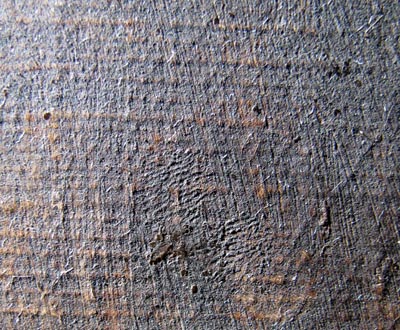
A piece of interesting evidence that didn't make it into the programme on our Henrietta Maria was the appearance of two fingerprints beneath the 18th Century over-paint. One was in the hair (below), and the other (above) was a thumb print at the bottom edge of the canvas, as if someone had picked up the still wet painting with their hand on the stretcher bar, but their thumb on the bottom of the canvas - just as you would if it was propped up against a wall, or against other pictures.
Now before you start groaning, none of us ever thought we could say that these were Van Dyck's fingerprints. That whole area of forensic analysis is sadly too discredited. But it was interesting nonetheless, and suggested that, certainly in the softer brown pigments of the hair, the layer of original paint we reached was relatively intact. Had the picture been massively over-cleaned and abraded in the past, the soft impasto of a finger-print would most likely have been removed.
Optimism, ctd. (again)
October 2 2012

Picture: Mail
In their weekly 'expierience' column, The Observer treated us to a piece entitled 'I inherited a Da Vinci'. There was no illustration of the picture, but sadly it turned out to be the above case of severe optimism, which we covered here earlier. Said the lucky heiress, Fiona McLaren;
...experts have examined her, and the consensus is that she is from the school of Leonardo da Vinci, possibly even by da Vinci himself. Either way, it's a masterpiece, and could be worth millions. I've no idea if the man who gave the painting to my father knew any of this, or how it came to be in his possession.
Through my own research, I've become convinced the painting is Leonardo's final commission, at the request of Francis I of France and completed shortly before his death. I am equally certain that it depicts Mary Magdalene rather than the Virgin Mary, and that the infant in her arms is the child of Jesus – it would have been considered heretical by the church, and put the artist at great risk. But we won't know for sure until next year.
The Madonna is now locked up in a vault, awaiting expert appraisal. I miss her terribly, but I hope she will be the catalyst for a great good. When the painting finally goes to auction, I've pledged to use the money raised to set up a foundation named after Leonardo's 16-year-old peasant mother, Caterina, who had her child taken from her, to provide support for children in care. I'd like to believe such an act would be very much in the spirit of the great man himself. I won't sell to a private collector: it's vital that she ends up in a gallery or museum, where anyone who wants to see her will be able to – myself included.
All very worthy, but surely readers deserve better of The Observer.
Optimism, ctd.
October 2 2012
I keep getting emails from someone trying to pass off this portrait of an unknown French nobleman as Bonnie Prince Charlie. The latest involves a fantastic bit of video tomfoolery to 'prove' the likeness. Watch as someone takes a bicycle pump to the head, and inflates it furiously.
I've tried to reason with the portrait's backer, but to no avail. There was a Wikipedia page about the picture with all sorts of ludicrous claims, but as this was repeatedly corrected, it got deleted. Now, the portrait has its own website, which seeks to explain away details (like the lack of any Garter sash) with airy nonsense. It's simply a half-decent portrait of a member of the Order of St Esprit - but these days there's no convincing some people.
Henrietta Maria mid-clean
October 1 2012

Picture: BG
I thought I'd put this picture up of the Henrietta Maria in mid-clean. What an amazing job our restorers Rebecca Gregg and Jo Gorlov did. What you see here is the exciting nature of what lay beneath the 18th Century over-paint. The revealed drapery was in pleasingly good condition - there is no re-touching here at all.
As you can see, the over-paint was not removed as systematically as you might imagine - it was a case of following a good 'seam' of over-paint, almost following the strokes of the paint as it had been applied.
