


Australia repatriates aboriginal art
May 26 2022

Picture: Sotheby's
An important painting by the celebrated aboriginal artist William Barak has been acquired by the state of Victoria in Australia from an auction in New York. The state contributed AU$500,000, to add to a fundraising campaign to buy the 1897 painting, 'Corroboree (Women in possum skin cloaks)', at Sotheby's. A wooden parrying shield was also acquired. More from Benita Kolovos in The Guardian here.
Turner 'between the sheets'
May 26 2022

Picture: Turner's House
Turner's House museum in London will soon open an exhibition dedicated to Turner's 'erotic' drawings. The drawings are on loan from Tate. More here.
A recovered $7m Titian?
May 26 2022
There was a story doing the rounds a few days about Italian police seizing a 'lost' Titian worth $7m. The picture was unveiled to the press in Italy, and with much fanfare 'returned to the Italian state'. It seems the picture was not stolen, but illegaly exported to Switzerland in 2004 without a correct export licence (any picture worth more than €13,500 and over 70 years old requires an export licence in Italy).
And yet, the picture doesn't really look like a Titian, even from the available photos. So I don't see how it could ever be worth $7m, and to be honest I'm not sure it would even be worth more than the threshold required for an Italian export licence. And even more curiously, the picture was 'recovered' in Italy. So it may never have been permanently exported in the first place.
What's going on? Who knows, but in the Italian press, the politician and superstar art historian Vittorio Sgarbi has waded in, saying the whole thing is a bit of a 'scam'. He also says the picture is certainly not by Titian. And best of all, he's recorded a You Tube video on it here, which was filmed in a motorhome being driven on the motorway. I'm envious - AHN needs its own chauffeur-driven motorhome.
Stolen de Kooning returns to US museum (ctd.)
May 26 2022

Picture: Silver City Sun News
Here's a PS to a story AHN first reported on back in 2017; a de Kooning painting stolen from Arizona University by a retired schoolteacher (simply because he liked it) will now be the subject of an exhibition at the Getty. More here on CNN, and exhibition details here.
Italian Museums (ctd.)
May 26 2022
From the National Gallery of Art in Rome, exciting news that they have launched an online collections site. The images are tolerably good, and there are even photos of pictures in their frames, and the reverses. You can search here. Illustrated above is their Holbein of Henry VIII, which some Holbein scholars now doubt, but which I'm sure is right.
Apologies...
May 25 2022
I've been in London a few days, seeing Raphael, and cleaning a picture. Or rather, watching Simon Gillespie clean a picture. I'll catch up on AHN tomorrow.
The 'Ugly Duchess' at the National Gallery
May 20 2022

Picture: National Gallery
Next year there'll be an intriguing exhibition at the National Gallery in London, based around one of their most curious pictures, the so-called 'Ugly Duchess' by Quentin Massys. Says the NG:
This exhibition looks again at one of the best-known faces in the National Gallery: Quinten Massys’s 16th-century depiction of an old woman, a painting known as ‘The Ugly Duchess’. For the first time, this work is displayed with a related drawing after Leonardo da Vinci, showing their shared interest in fantastical, ‘grotesque’ heads and the vibrant artistic exchange between Italy and Northern Europe in the Renaissance.
‘The Ugly Duchess’ is reunited in the exhibition with her companion, 'An Old Man', on rare loan from a private collection. Massys shows us a woman whose age, appearance and deportment are noticeably different to other women represented in the collection. This is a deliberate choice by the artist. Her exaggerated facial features, devil-like headdress, low-cut dress and wrinkled bosom were used by Massys to parody the traditional marriage portrait: this is an old woman acting like a maiden and offering her partner – who is more formally and soberly dressed – an unrequited token of her love.
You might think that this painting served only as a cruel joke, where we are invited to laugh at this woman’s self-delusion. However, when you look beyond the surface you may discover a Duchess who is also subversive, fierce, and defiant – brazenly flaunting the conventions of her day. The painting captures the rise of secular and satirical art during the Renaissance, two areas that Massys pioneered.
It's free, and runs till 11th June, more here.
Marble Hill House
May 20 2022

Picture: English Heritage
The great Palladian villa outside London, Marble Hill House, has been closed for years, but is now reopening after a major restoration. The house was home to Henrietta Howard, best known as George II's mistress. Nadia Khomami has the story in The Guardian:
The major reformation by English Heritage, supported by funding from the National Lottery, has reversed decades of disrepair. The charity has reinstated the interior paint scheme that existed at Marble Hill during Howard’s lifetime and conserved the fine collection of early Georgian paintings, including portraits of Howard’s circle.
It has also restored and recreated some of the house’s furnishings including crimson silk wall hangings and an intricate carved peacock motif table (peacocks were the symbol of the ancient Roman goddess Juno, the protector of women). Also on display are a number of Howard’s personal items including a Chinese lacquer screen bearing her family’s crest and her prized collection of paintings by the Italian artist Giovanni Paolo Panini.

There's just something so perfect about Georgian architecture and interior design, isn't there? Look at this dining room, doesn't it make you instantly feel calm and contented?
Details on visiting here.
Waldemar in Ukraine
May 20 2022

Picture: ZCZ Films
The Great Waldemar is back on the telly, with a film about art in Ukraine, and how it's being protected from Russia's war. Sky Arts, 23rd May, 7.25pm.
Mary, Queen of Scots' casket
May 20 2022
Video: National Museum of Scotland
The National Museum of Scotland has acquired an exceptional French silver letter casket which once belonged to Mary, Queen of Scots. In the video above, Dr Anna Groundwater, Principal Curator of Renaissance and Early Modern History at the Museum tells us why it's so important. And on this special website there's a whizzy high resolution 3D scan of the casket, which you can zoom in and out of, including the inside. Wouldn't it be great if all museum objects could be photographed like this?
More on the acquisition here.
'What should an art museum be?'
May 18 2022

Picture: Thames and Hudson
Regular readers will doubtless already have a copy of Charles Saumarez Smith's new book, 'The Art Museum in Modern Times'. Here he is in a new podcast discussing the subject more broadly, not only on how architecture can help shape a museum's core purpose, but what an art museum should be.
Charles is very sound on these issues, but the use of architecture in a museum can be (in my museumgoer's view) a tricky balance to strike. Nowadays there seems to be too much emphasis on building vast, expensive (and usually empty) atriums, which are seen as essential to luring visitors in.
This is not to say that front doors - that is, entry spaces in general - are unimportant, and not worth getting right. For many people (disabled visitors, those on the autistic spectrum, and perhaps even just the timid) a sensitively designed museum entrance can be vitally important. There's a good phrase they use in retail which is just as applicable to the museum world; 'threshold resistance'. And yet, if anything the craze for swanky new entrances these days manifests itself in the kind of bright, loud entrances that may put off these minority groups.
If you want to bring in new audiences, AHN believes it's better to spend the museum's money on a decent website and digital outreach instead.
Glyn Philpot at Pallant House
May 18 2022

Picture: via The Guardian
In The Guardian, Hettie Judah reviews (and gives five stars to) a new exhibition on Glyn Philpot at Pallant House in Chichester. The show casts a new light on Philpot, who has (in my view at least) been unjustly ignored in the sweep of modern British art:
Philpot appears an artist – and a man – pulled in several directions. A practising Roman Catholic and gay, mesmerised by performance and masquerade, he allowed his interest in the male nude to play out in (at times awkward) symbolist works on classical themes. Influenced by developments in Paris and Berlin, in 1930 he experimented with modernism, painting the chrome, glass and glow of the transforming city. Indebted to Picasso, Cocteau and Matisse, Philpot’s new style was less appreciated in London.
His interest in Black subjects was unusual for its time. Some were performers: Portrait of Paul Robeson as Othello (1930) was rediscovered during research for this exhibition (an earlier painting of the African American tenor Roland Hayes singing is still unaccounted for). In Paris, he painted two portraits of Julien Zaïre, a Martiniquan who performed in cabaret as Tom Whiskey [above]. Positioned against the tubular furniture of a chic interior, Zaïre is the acme of handsome sophistication in black tie and pomade.
The show runs till 23rd October, details here. There's a good overview of Philpot's work on ArtUK here.
Carlo Crivelli in Birmingham
May 18 2022
Video: Ikon Gallery
I'm late to this, but I want to mention the first ever UK exhibition devoted to the Italian Renaissance artist Carlo Crivelli, which is being held in Birmingham, and which, for an Old Master evangelist like me, is a really inspiring story. First, it's great that such a show is being put on 'in the regions', as they're tempted to say in London museum-land, but it's also in a gallery normally devoted to contemporary art, Ikon. Above is a video in which Ikon director Jonathan Watkins describes how he has been fascinated by Crivelli since publishing an article about him in the 1980s. And now, thanks to a grant from the Ampersan Foundation, he's been able to realise a chance to evangelise for Crivelli. How fantastic that Jonathan and his colleagues have been able to give Crivelli the limelight he deserves, in such a great setting.
The show is on till 29th May - hurry! More here.
Archaeology on the front line
May 18 2022

Picture: via Artnet
On Artnet News, Sarah Cascone has the story of some Ukrainian soldiers who, while digging trenches near Odessa, unearthed a cache of ancient Greek artefacts.
A lost Eworth at Burghley?
May 17 2022

Picture: Burghley House
For my latest Diary of an Art Historian column in The Art Newspaper, I wrote about a full-length portrait I saw recently at Burghley House in Lincolnshire. The picture has previously been thought to be a posthumous portrait of Magdalen, Viscountess Montagu (1538-1608), but I think it's period, and probably by Hans Eworth. After Holbein, Eworth was the next start artist working for the Tudor court, and is probably best known for his portraits of Mary Tudor (like this example at the Society of Antiquaries).
The Burghley portrait would most likely have been painted around the time of Magdalen's marriage in 1558, and as such would be one of the last great Marian full-lengths. By the way, the billowing pink drape, which doesn't look 16th Century at all, is largely overpaint, from when the panel was long ago transferred onto canvas.
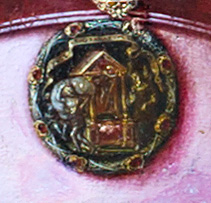
There is one fascinating detail about the Burghley portrait, in the jewel Magdalen wears round her neck (above). As I wrote in TAN:
Eworth worked mainly for Catholics. And fittingly, another mystery in the Burghley portrait—the nature of the scene depicted in the medal around Magdalen’s neck—was solved by a Twitter friend of mine, Fr Robin Gibbons, the first Catholic Priest in Christ Church Cathedral, Oxford, since the Reformation. Robin, without knowing the name of the sitter, identified the scene—of a white robed figure emerging from a tomb, followed by a female figure—as the story of Christ saying “noli me tangere”. It was an eponymous jewel, a Magdalene for a Magdalen.
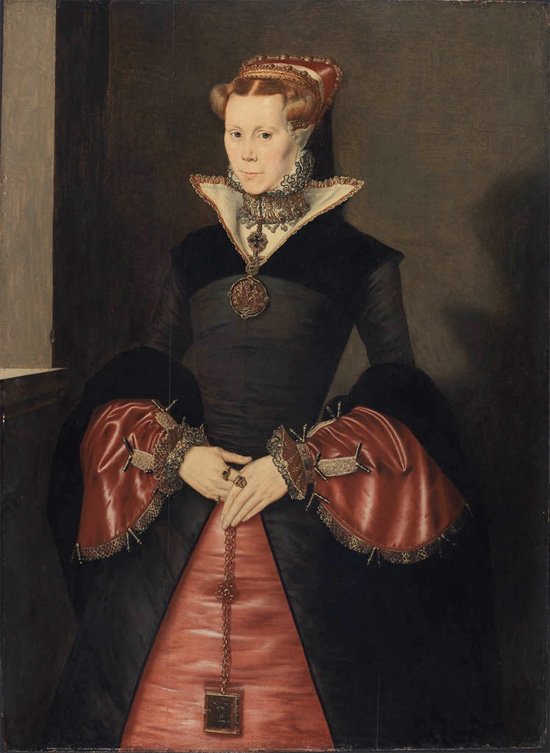
This got me thinking about another Eworth portrait, in the Fitzwilliam Museum, a portrait once thought to show Mary Tudor (above), but currently regarded as an unknown sitter. If the Burghley portrait's jewel showed a Magdalene to identify a Magdalen, did the Fitzwilliam jewel give us any clues as to its identity? The scene in this jewel shows Queen Esther, from the Old Testament story of Esther revealing herself to King Ahasuerus. The only thing is, Esther (or its anglicised version of Hester) was a relatively rare name in the mid-Sixteenth century in England. But there is one Esther/Hester who might fit the bill. From my TAN column again:
among Esthers of the 1550s of an age to be the Fitzwilliam sitter is one Esther or Ethelreda Malte, an illegitimate daughter of Henry VIII. She died in 1559. Her daughter was also called Hester (the anglicised Esther). Her mother, Joan Dyngley, was said to have been a royal laundress, and intriguingly the only other clue to the sitter’s identity in the Fitzwilliam portrait is a prayer book embossed with the letter ‘D’. In the Bible, Esther hides her identity before being recognised by the king, and this is the scene shown on the medallion. Perhaps whoever once looked at the Fitzwilliam portrait and decided it looked like Mary Tudor was half right—is it in fact her half sister?
More here.
Derby museum acquires Wright self-portrait
May 16 2022

Picture: Oliver Taylor/PA, left, Derby Museum curator Lucy Bamford, right, director Tony Butler.
Now this is a lovely story - Derby Museum has acquired a fabulous Joseph Wright of Derby self-portrait, through the Acceptance in Lieu scheme. The self-portrait was painted in about 1772 and in my opinion shows Wright at his absolute best. The picture represents a two-for-one Wright special offer, because on the back is an equally important study (below) by Wright for his famous painting, Experiment on a Bird in an Air Pump (National Gallery, London).
From The Guardian:
The painting was accepted in lieu of inheritance tax, settling a sum of £779,619. Because the work was worth considerably more, Derby Museum and Art Gallery made good the difference of £2.72m with a £2.3m donation from the National Heritage Memorial Fund, plus additional amounts from the Art Fund, private donors and foundations.
The arts minister Lord Parkinson said: “It is wonderful that this rare self-portrait by Joseph Wright has been saved for the nation and acquired by Derby Museums … where it will take pride of place in the world’s largest collection of his works.”
Tony Butler, the museum’s executive director, said: “The acquisition of this painting is a triumph for Derby Museums. The work has never been in public ownership having remained in private hands since it was executed in a studio not far from where Derby Museum and Art Gallery is now. We feel a palpable sense of bringing Joseph Wright of Derby back home.”
The acquisition is another demonstration of how well the Acceptance in Lieu scheme can work. In this case, the painting was worth more than the amount of inheritance tax to be settled by the government (I can't say how much more, as I advised on the valuation, but a lot more) and Derby Museum was able to fundraise the balance, from the Art Fund, the National Heritage Memorial Fund, and others. But the fact that the museum and funders knew the government would in effect be putting down a deposit on the painting gave them time and confidence to embark on raising the extra funds. This is just the latest in an extremely impressive run of acquisitions by Derby Museums, who rarely miss an opportunity to add to their (already outstanding) collection, and are amongst the best in the business at raising funds for new purchases. AHN says, well done to all involved.

Imelda Marcos' Picasso
May 16 2022

Picture: Guardian
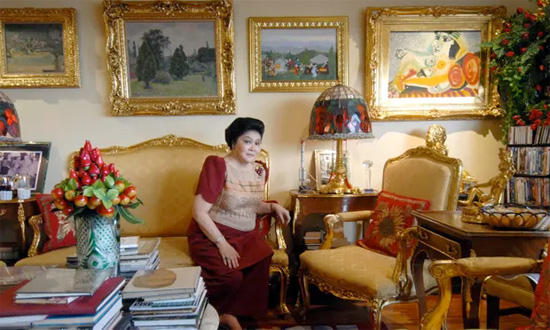
There's been much excitement in the press about a 'lost' Picasso supposedly seen in photographs of Imelda Marcos' home. 'Reclining Nude' was spotted when her son, Bongbong, went to celebrate his win in the Philippines presidential election (see above). However, the picture isn't certainly the same as that seen in photographs of Marcos' home from 2007 (see below). At least, the frame is different. It's all a bit unclear, and I can't really muster much more enthusiasm for the tale. If you can, more here.
The Dancing Plague of 1518
May 16 2022

Picture: Holtzius after Peter Brueghel the Elder
There's an interesting article on the BBC culture website by Rosalind Jana on the so-called Strasbourg Dancing Plague in 1518. The technical term for the plagues is choreomania, and lovers of Brueghel will now it from a number of his works, as above. But as Rosalind explains, the Strasbourg plague wasn't the only one:
Though it is now the most famous example, Strasbourg was not the only "dance plague" to hit Europe during the medieval and early modern era. Many instances of uncontrolled or threatening dancing were recorded in Germany, France, and other parts of the Holy Roman Empire. In earlier centuries these events were interpreted as divine punishment or demonic possession, remedied with religious solutions like processions, masses, or direct intervention from priests. Two decades before the summer of 1518, a cleric in Strasbourg named Sebastian Brant wrote in his satirical allegory The Ship of Fools "that dance and sin are one in kind," blaming Satan for all this "giddy dancing gayly done".
Crypto crash
May 13 2022

Picture: via Twitter
There's a cryptocurrency crash going on, and who knows where it will end. Ethereum, which is used in the art world to buy NFTs, is down more than 50% from its peak in November. As it happens, the British Museum auctioned one of its 'Super Rare'* Hokusai Great Wave NFTs then. So if you were the lucky bidder, you're now down about 50% just on the currency side alone. That's before we worry about NFT values themselves.
*So rare it's one of ten. That is, if you can create any degree of scarcity around a jpeg which is infinitely reproduceable, which is in turn an image of a widely reproduced print which is itself not exclusive to the British Museum.
New acquisition for Cleveland Museum
May 12 2022

Picture: Cleveland.com
This was a few weeks ago, but I'm interested in how museums, especially US ones, are changing their collecting priorities in the wake of Black Lives Matter. The Cleveland Museum of Art has bought a plaster bust by the French 19th Century sculptor Jean-Baptiste Carpeaux, who explored questions of slavery a number of times. Says Cleveland.com:
The Cleveland Museum of Art sees its new acquisition of a major 19th-century French sculpture expressing abolitionist outrage against slavery as a launchpad for wide-ranging discussions on the role of politics, race, and power in art history — and in the history of its own collection.
The plaster sculpture, entitled “Why Born Enslaved!” created by the artist Jean-Baptiste Carpeaux in 1868, is a bust-length portrait of an anonymous enslaved Black woman, bound tightly with ropes, with her gown ripped away, revealing her left breast. [...]
The acquisition of the Carpeaux comes as cultural institutions across the U.S. are re-evaluating racial equity practices in the wake of the police murder of George Floyd in Minneapolis in 2020, and the national wave of Black Lives Matter protests that followed.
The Cleveland museum, which serves a city that is roughly 50% Black and is surrounded by low-income, majority-Black neighborhoods, adopted its first Diversity, Equity and Inclusion Plan in 2018, and over the past decade has stepped up the frequency and scale of exhibitions and purchases of works by African-American artists.
The bust, of which there are a number of versions in different media (there's a bronze in the Indianapolis Museum of Art which, surprisingly, still carries a title from another age), was originally modelled as part of a commission for the Fontaine de l'Observatoire in the Jardin de Luxembourg in Paris. It was intended to represent Africa, which, along with representations of Europe, America and Asia, held up the world. Carpeaux's initial designs drew some scorn, and in the finished fountain the full length figure of Africa is more idealised, and bound only by her ankle.
